
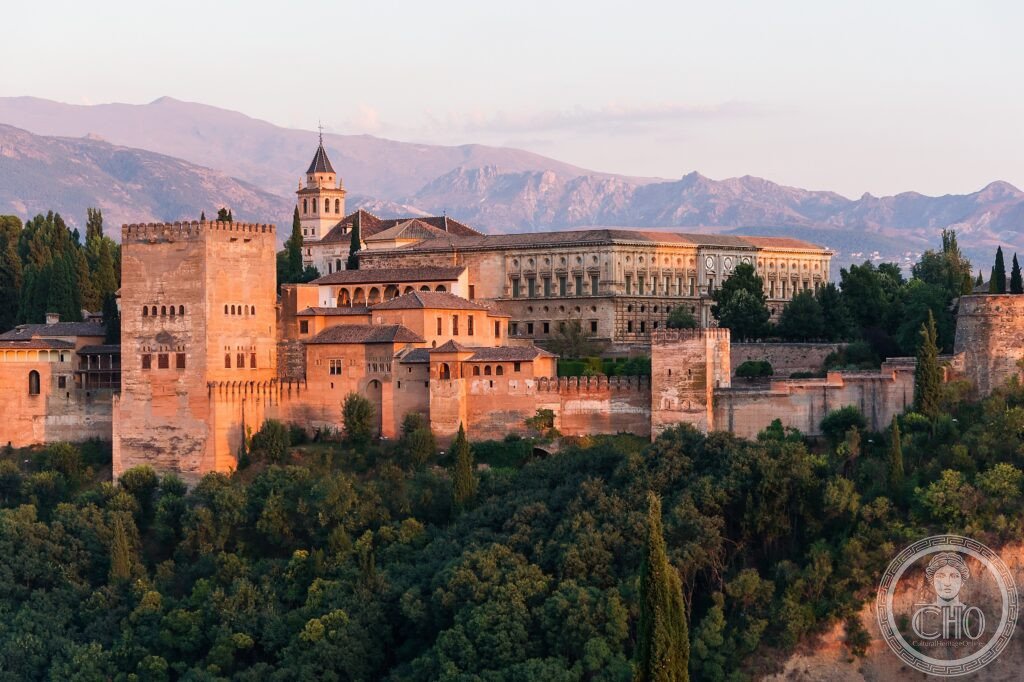
The supreme surviving achievement of Islamic architecture in Europe. The Alhambra of Granada, the palace-fortress of the Nasrid emirs on the Sabika Hill above the city, is a world of light filtered through carved plaster lattices, water channelled through marble courts, and surfaces entirely covered in geometric tilework and inscribed poetry in a density that overwhelms the eye and focuses the mind.
At a glance
The Alhambra complex, UNESCO WHS 1984, covers approximately 11.5 hectares on the Sabika Hill and gathers four things: the palace buildings, the Nasrid Palaces; the military fortress, the Alcazaba; the summer palace and gardens of the Generalife; and the Renaissance Palace of Charles V, an incongruous but impressive early 16th-century addition. It was the residence of the Nasrid emirs of Granada, the last Islamic state on the Iberian Peninsula, from 1232 until the Christian Reconquista ended with the fall of the city on 2 January 1492. On that day Muhammad XII — Boabdil — surrendered the keys to Ferdinand and Isabella, and the hill from which he looked back at the Alhambra for the last time is still called El Puerto del Suspiro del Moro, “The Pass of the Moor’s Sigh”. After 1492 the palace was largely abandoned and fell into disrepair. The major restoration began in the 19th century, triggered in large part by Washington Irving, who lived in the deserted palace apartments in 1829 and published Tales of the Alhambra in 1832, the book that made the place internationally famous. Approximately 2.7 million visitors come each year, which makes it the most visited monument in Spain; entry requires advance booking and is strictly time-limited.
Key facts
- The Nasrid Palaces: the supreme achievement of the Alhambra and of all Moorish architecture. The Nasrid Palaces, the Palacios Nazaríes, were the residential quarters of the emirs: three interconnected complexes built over two centuries. The Mexuar is the oldest surviving section, the audience hall, late 13th century. The Comares Palace, raised by Muhammad III and Ismail I in the early 14th century, is built around the Court of the Myrtles, a rectangular reflecting pool bordered by a geometric myrtle hedge in which the Torre de Comares and the sky are mirrored; inside the tower is the Throne Room, the Salón de los Embajadores, the largest room in the Alhambra and the one where Ferdinand and Isabella received Christopher Columbus in 1492. The Palace of the Lions, built by Muhammad V between about 1370 and 1391, holds the most refined, most celebrated and most photographed interior of the whole complex. Its Court of the Lions is a rectangular court of white Macael marble paved in a geometric star pattern, with the Fountain of the Lions at its centre: 12 marble lions supporting a 12-sided basin, each spouting water from its mouth, the basin inscribed with a poem by the court poet Ibn Zamrak that describes the mechanism of the fountain itself. The lions are believed to stand for the 12 hours of the day, the 12 months of the year and the 12 signs of the zodiac. A forest of 124 white marble columns surrounds the court on all four sides, carrying delicate arcades. At the south end, the ceiling of the Sala de los Abencerrajes is a muqarnas vault of extraordinary complexity: 5,000 individual stucco pieces assembled into a stalactite dome that seems to be perpetually collapsing into itself.
- The Generalife: the summer garden palace of the Nasrid emirs and the most important surviving Islamic garden in Europe. The Generalife (Jannat al-Arīf; “garden of the overseer”; built in the early 14th century on the Cerro del Sol hill above the Alhambra, separated from the main palace by a deep valley; reached by a 15-minute walk from the Nasrid Palaces through a pine forest). The Patio de la Acequia (the Irrigation Canal Court; a long rectangular garden court with a central water channel fed by jets from both sides; the scent of roses and orange blossom; the sound of water; cypresses clipped into dark vertical columns; the most evocative garden space in Spain) and the Patio de la Sultana (the Sultana’s Garden; a smaller enclosed space with a magnificent 700-year-old cypress tree — the legend says the Sultana Zoraya met her Abencerrage lover here, which caused the Sultan to order the massacre of the Abencerrage clan, whose blood supposedly stained the fountain in the Alhambra below red forever).
- The inscribed poetry: the most extensively inscribed building in the world. The interior surfaces of the Nasrid Palaces are covered, wall-to-wall and floor-to-ceiling, with three types of decoration: tilework (geometric zellige tilework in the lower walls), calligraphic inscriptions in Arabic (Quranic verses, poems by court poets including Ibn Zamrak and Ibn al-Khatib, and the phrase “wa-la ghaliba illa-Llah” — “there is no victor but God” — the Nasrid dynastic motto, repeated thousands of times on the walls, columns, and capitals throughout the palace), and muqarnas (stalactite-like plaster honeycomb ceilings of extraordinary elaboration, particularly in the two domes of the Hall of the Two Sisters). The total area of inscribed surface in the Nasrid Palaces is estimated at approximately 10,000 square metres.
- Heritage: UNESCO World Heritage Site (Alhambra, Generalife and Albaicín, Granada), inscribed 1984.
- GPS: 37.1772° N, 3.5883° W.
History
A small fortress existed on the Sabika Hill from at least the 9th century. The Nasrid dynasty consolidated the site from 1238. The major palace buildings were constructed under Yusuf I (1333–1354; the Comares Tower and the Hall of the Ambassadors) and Muhammad V (1354–1391; the Palace of the Lions — the most refined phase of construction). The emirate of Granada was the last surviving Islamic state in Iberia after the Christian kingdoms conquered the rest of al-Andalus. The Reconquista ended with the surrender of Granada on 2 January 1492 and the departure of Muhammad XII (Boabdil). The Catholic Monarchs converted the mosques to churches but largely preserved the Nasrid Palaces. Charles V demolished a section of the complex to build his Renaissance palace (1527–1568; designed by Pedro Machuca; never completed; the circular interior courtyard is nevertheless a masterpiece of Early Renaissance architecture). The palace fell into decay from the 17th century. Washington Irving’s residency (1829) and his Tales of the Alhambra (1832) initiated the Romantic rediscovery of the complex and triggered international interest in its restoration. UNESCO WHS 1984.
What you see
Entry to the Nasrid Palaces is strictly time-limited to 30 minutes, and the timed slot is the most important logistical fact about visiting the Alhambra: arrive outside your allocated time and you do not go in. For July–August, book months ahead. The route runs from the Mexuar to the Cuarto Dorado, then to the Comares Palace with its Court of the Myrtles and Throne Room, and finally to the Palace of the Lions, which holds the Court of the Lions, the Hall of the Abencerrajes and the Hall of the Two Sisters with its muqarnas dome. The Alcazaba is the oldest part of the complex, the military fortifications, and from its watch tower, the Torre de la Vela, comes the best panoramic view of Granada, the Albaicín and the Sierra Nevada. The Generalife, the summer gardens, deserves a separate 1h; the walk there from the Nasrid Palaces goes through a pine forest and takes 15 min. The ground floor of the Palace of Charles V holds two museums: the Museum of the Alhambra, with the most important collection of Nasrid art objects in the world, and the Museum of Fine Arts.
Practical information
- Booking: advance booking is essential (tickets at alhambra-patronato.es; book at least 1–3 months ahead for July–August; the daily total is strictly limited; the timed entry to the Nasrid Palaces is the key constraint — you must be at the Nasrid Palaces entrance at exactly your allocated 30-min slot (slots every 30 min from 8am to 2pm, afternoon from 4pm); the rest of the complex (Alcazaba, Generalife, Charles V) can be visited in any order outside the timed window; ticket approximately EUR 20; photography is permitted everywhere in the complex (no tripods)).
- Getting there: Granada Airport (GRX; 17 km west of the city; Vueling direct from Barcelona, Madrid; Ryanair from some UK airports). From Madrid: AVE high-speed train from Atocha (3h 30 min; approximately EUR 35–80; the Granada AVE station opened 2019). Alternatively the Alsa long-distance coach from Madrid (5–6h; approximately EUR 15–25). The Alhambra is best reached on foot from the city centre (25 min uphill walk from the Cathedral) or by the Alhambra minibuses (the C3 bus from Gran Vía runs to the Alhambra entrance every 10 min; approximately EUR 1.40).
- When to go: late October to mid-March offers the most comfortable weather and far fewer visitors. The morning timed entry (8am–10am) is the least crowded. The Generalife garden is most spectacular in May (roses) and June (roses and lavender). In summer, combined 40°C+ heat and massive crowds make the midday hours exhausting.
Getting there
Madrid by AVE train (3h 30 min). Granada Airport for direct European flights. Minibus C3 from Gran Vía to the entrance. GPS: 37.1772, -3.5883.
Nearby
- The Albaicín (Albayzín). The old Moorish quarter of Granada, on the hill directly facing the Alhambra. UNESCO WHS (added to the Alhambra WHS 1994). The most perfectly preserved medieval Islamic urban neighbourhood in Spain. The Albaicín (a labyrinth of whitewashed narrow streets (cármenes — walled garden houses), carmenes hidden behind gates, the smell of orange blossom and jasmine in spring, and the most celebrated view of the Alhambra — from the Mirador de San Nicolás, a terrace in front of the 16th-century church; the view directly faces the Alhambra with the snow-capped Sierra Nevada behind, best photographed at sunset when the Alhambra is floodlit orange and the snow turns pink). The Arab baths (hammam Al Ándalus in the Calderería Nueva; the street of North African shops and tea houses in the Albaicín is the most authentically Moorish street environment in Spain).
- Granada Cathedral and Royal Chapel. 20 min walk from the Alhambra. The most important Renaissance building in Andalucía. The Royal Chapel (Capilla Real; the mausoleum of Ferdinand and Isabella, the Catholic Monarchs whose conquest of Granada ended 800 years of Islamic rule; the marble effigies of Ferdinand and Isabella (and Philip I and Juana la Loca) by Domenico Fancelli and Bartolomé Ordóñez lie in the chapel; the sacristy museum contains Isabella’s personal art collection — Flemish Renaissance paintings including works by Roger van der Weyden and Hans Memling that she collected during her lifetime; the treasury includes the crown of Isabella and the sword of Ferdinand). The Cathedral of Granada (Diego de Siloé, 1528–1704; the first Renaissance cathedral in Spain; the exterior is unfinished; the interior has a remarkable circular nave with an unusually open, light feel).
- Ronda. 100 km west of Granada (2h by road). The most dramatically sited city in Andalucía. Ronda (a city of approximately 35,000 people on a plateau divided by the El Tajo gorge — a limestone chasm 120 metres deep; the Puente Nuevo (New Bridge; 1793; 98 metres high; the most photographed view in Andalucía — the bridge spanning the gorge with the vertical cliff faces and the Guadalevín River far below); the Bullring (Plaza de Toros; opened 1785; the oldest and most important bullring in Spain; the birthplace of the modern corrida (the modern rules of bullfighting were codified here by the matador Pedro Romero in the late 18th century); the Museo Taurino inside the ring has a fine collection of bullfighting history)).
Sources
- Wikipedia, Alhambra. Generalife. Nasrid dynasty, accessed June 2026.
- UNESCO, Alhambra, Generalife and Albaicín, Granada, WHS reference 314, inscribed 1984.
- Robert Irwin, The Alhambra, Profile Books, 2004.
Find it on the map
See this place and what’s around it →
Events here — now on & upcoming
- Anniversary: The Fall of Granada — January 2, 149202 Jan 2027See the event →
📷 Become a Cultural Heritage Online photographer
Share your photos of places: they stay published under your name as the author. The more they're seen, the more you get noticed — and soon a contest will reward the most appreciated photos.
Log in or sign up free to add a photoIs this page about you?
This page is read by travellers and heritage enthusiasts who find it on Google. Tell us how you are connected to this place and we will take it from there.