
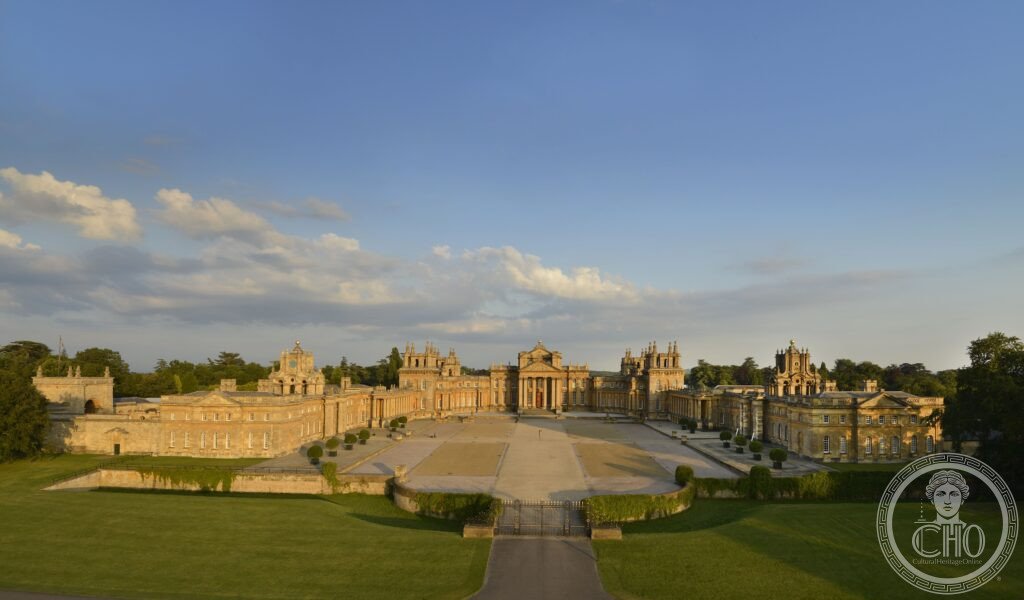
England’s most extravagant act of national gratitude. Built as a gift to John Churchill, 1st Duke of Marlborough, after the crushing defeat of Louis XIV’s army at the Battle of Blenheim (1704), Blenheim Palace (1705–1722) by Sir John Vanbrugh is the largest and grandest English Baroque country house, set in 850 hectares of landscape park redesigned by Capability Brown. The only non-royal, non-episcopal building in England called a Palace. Birthplace of Winston Churchill on 30 November 1874.
At a glance
Blenheim Palace is 13 km north of Oxford and 100 km north-west of London, in the town of Woodstock (a medieval town of considerable charm in its own right, with a long main street of 17th–18th century coaching inns and townhouses). The park covers 850 hectares. The lake created by Capability Brown in 1764 (by damming the River Glyme) is the defining landscape feature. The palace is still the private residence of the Dukes of Marlborough (the 12th Duke and his family). The state rooms, the Winston Churchill exhibition, the formal garden terraces, and the park are all open to visitors. The estate is one of the most visited stately homes in England.
Key facts
- The Battle of Blenheim (1704) and the gift: the War of the Spanish Succession (1701–1714) pitted England, the Dutch Republic, Austria, and Portugal against France and Spain, fighting over who should inherit the Spanish throne and whether France should become the dominant power in Europe. The Battle of Blenheim (August 13, 1704, in Bavaria, on the Danube, at the village of Blindheim/Blenheim) was the decisive engagement. The Duke of Marlborough and Prince Eugene of Savoy routed the Franco-Bavarian army. 14,000 French and Bavarian soldiers were killed, 14,000 taken prisoner (including the French commander, Marshal Tallard, who was brought to England as a prisoner). It was the first time in 60 years that a French army had suffered such a catastrophic defeat and it shattered Louis XIV’s dream of French hegemony in Europe. Queen Anne and the English Parliament voted to build a palace at national expense as a permanent gift to Marlborough. The name “Blenheim” was chosen in honour of the battle.
- Sir John Vanbrugh (1664–1726) and English Baroque: Vanbrugh was the most imaginative and theatrically grandiose architect of English Baroque. He had been a soldier, a merchant, a prisoner in the Bastille (accused of espionage by the French), and a successful playwright (he wrote “The Relapse” and “The Provoked Wife”, two of the wittiest Restoration comedies) before turning to architecture in his 30s, with no formal training. His first building, Castle Howard in Yorkshire (begun 1699), was the largest private house in England. Blenheim, begun 1705, is even larger (the central block alone is 154 metres wide; the full width of the forecourt and wings is 270 metres). The style is Baroque: massive stone masses, dramatic silhouettes, banded rustication, colossal porticos, and theatrical siting that emphasizes the building’s dominance of its landscape from every approach. Vanbrugh worked with Nicholas Hawksmoor as his technical collaborator (Hawksmoor provided the structural knowledge and the detail design that Vanbrugh’s theatrical vision required).
- Capability Brown and the park (1764): Lancelot “Capability” Brown (1716–1783). The most influential English landscape designer of the 18th century, who transformed 170 country house estates, creating the “English style” of landscape (informal, naturalistic, with serpentine lakes, clumped trees, and undulating grass) that influenced parks and gardens worldwide. Was commissioned by the 4th Duke in 1764 to redesign the formal gardens (the original formal Dutch-style parterres created by Henry Wise in 1705–1716 had fallen out of fashion). Brown dammed the River Glyme to create the dramatic artificial lake that now reflects the south front of the palace. He naturalised the banks of the river and created the Great Cascade. The result is one of Brown’s most effective compositions, using the scale of the palace and the width of the valley to create a landscape of exceptional grandeur. The formal Italian garden terraces (south of the palace) were added in the early 20th century by the 9th Duke and Achille Duchêne (a French landscape designer), re-introducing formal elements into the Brown naturalistic landscape.
- Winston Churchill (1874–1965) birthplace: Winston Leonard Spencer Churchill was born at Blenheim Palace on 30 November 1874 in a small ground-floor room near the main entrance (his mother, Lady Randolph Churchill, née Jennie Jerome of New York, had arrived unexpectedly early during a visit to her brother-in-law’s family seat). The room where he was born is now part of the Churchill exhibition (the largest private Churchill exhibition in the world). The exhibition includes original documents, paintings, and personal objects. Churchill himself regarded Blenheim as one of the most beautiful places in England and described it as “the most magnificent house I know”.
- Heritage: UNESCO World Heritage Site, Blenheim Palace, inscribed 1987.
- GPS: 51.8419° N, -1.3553° W.
History
Parliament voted the gift of a palace to Marlborough in 1705. Construction began immediately under Vanbrugh and Hawksmoor. The project was troubled from the start by political intrigue. Queen Anne fell out with the Duchess of Marlborough, Sarah Churchill, her closest friend, whose forceful personality had irritated the queen for years; by 1710 Anne had dismissed Marlborough from his commands and withdrawn the parliamentary grant, with the palace still unfinished. Sarah Churchill dismissed Vanbrugh in 1716 and refused him entry to see the completed building. The palace was finished in 1722 using Marlborough’s own funds, and it has remained in the Churchill family ever since: the 9th Duke (1897–1934) carried out extensive restoration of the interior and formal gardens, the 11th Duke opened it to the public in 1950, and the estate was donated to the English Heritage Foundation as a UNESCO World Heritage Site in 1987.
What you see
Approach from the north (Woodstock Gate) along the Grand Avenue (a 3-km double avenue of lime trees, the longest in England) to the Column of Victory (a 40-metre column topped by a lead statue of the 1st Duke, erected 1730). The palace itself is entered through the Great Court (the forecourt between the two service wings, each of which is larger than most country houses) leading to the North Portico. The state rooms are a sequence of Baroque spatial experiences: the Great Hall (the entrance hall, 20 metres high, with a ceiling painted by James Thornhill showing the Duke of Marlborough presenting his victory dispatch to Britannia), the Long Library (55 metres long, the longest room in any English private house, with a Blenheim Organ of 1891), and the Green, Red, and Second State Rooms with their tapestries, Blenheim portraits, and Baroque furniture. The palace chapel contains the tomb of the 1st Duke and Duchess by Michael Rysbrack (1733). The park circuit on foot (approximately 8 km) or by mini-train (seasonal) takes in the lake, the Grand Bridge (Vanbrugh’s most spectacular engineering work, a 33-arch bridge 400 metres long over a modest stream — the bridge predates the Brown lake and was considered absurdly over-scaled; Brown’s lake finally justified it), the Column of Victory, and the formal terraces.
Practical information
- Admission: approximately £35 adult for palace + park + gardens (park-only tickets approximately £18; the price is high but justified by the scale of the site; annual passes pay for themselves within 2 visits). The palace is open daily mid-February to mid-November, approximately 10am–5pm (last entry 4pm). The park is open year-round. Christmas events (Blenheim Christmas Market, Illuminated Palace) run in December (separate ticket). The site is busy on summer weekends. Arrive early or visit mid-week.
- Getting there: from Oxford by bus: S3 bus from Oxford city centre to Woodstock (30 min, every 30 min). From London Paddington by train to Oxford (1h) then bus (1h 30 total from London). By car from Oxford: 13 km north on A44 (20 min). From London: 100 km north-west (1h 30 min via M40/A44). From Stratford-upon-Avon: 50 km south-east (45 min via A3400/A34). The palace entrance is on the A44 in the centre of Woodstock.
- Oxford and Cotswolds circuit: Blenheim is the ideal half-day excursion from Oxford (the most complete medieval and early-modern English university city; the Bodleian Library, the Radcliffe Camera, the University Church of St Mary the Virgin, the Ashmolean Museum of Art and Archaeology, and the Christ Church Cathedral collectively make Oxford the most architecturally rich city in England after London). Combined with a morning in Oxford and an afternoon at Blenheim, the Cotswolds villages of Burford, Bourton-on-the-Water, and Bourton-on-the-Hill are within 20–30 km of Woodstock (the Cotswolds limestone belt gives these villages a honey-coloured building stone unique in England; the National Trust holds several Cotswolds properties including Snowshill Manor and Hidcote garden).
Getting there
Bus S3 from Oxford (30min). Train London Paddington to Oxford (1h) + bus. By car from Oxford (13 km, 20min). GPS: 51.8419, -1.3553.
Nearby
- Oxford. 13 km south of Blenheim (20 min by bus or car). The intellectual and architectural heart of England. Three stops are essential. The Bodleian Library complex gathers four buildings: the Divinity School of 1488, with the finest Perpendicular Gothic stone ceiling in England; the Duke Humfrey Library of 1487, the oldest reading room in Oxford, which holds Shakespeare’s first-edition quartos; the Radcliffe Camera of 1749, the most perfectly proportioned English Palladian rotunda, in use as a Bodleian reading room; and the New Bodleian, now the Weston Library, of 2015, whose ground-level gallery displays items from the collection daily. Christ Church is the largest Oxford college, founded by Cardinal Wolsey in 1524: its chapel is the Cathedral of the Diocese of Oxford, and its Hall is the model for the Great Hall at Hogwarts in the Harry Potter films. The Ashmolean Museum is one of the world’s great university art museums, with collections ranging from Egyptian antiquities to Raphael drawings and Turner watercolours.
- Rousham House and Gardens. 20 km north-east of Blenheim (25 min by car). The most perfectly preserved English landscape garden of the early 18th century (William Kent, 1737–1741 — before Brown made the informal garden ubiquitous). Rousham is unique in England in having retained its original 18th-century layout with almost no subsequent alteration. It has the scale of a private garden rather than a great estate, which makes the garden experience more intimate than Blenheim or Stowe. Still privately owned (the Cottrell-Dormer family) with opening hours limited to certain days. Also remarkable for the surviving interiors of the house (William Kent furniture and paintings).
- Stowe Landscape Garden. 45 km north-east of Blenheim (45 min by car). The most ambitious and elaborate 18th-century English landscape garden, created by the Temple family (Viscount Cobham) from 1713 to c. 1780, with contributions by virtually every major English designer of the period (Charles Bridgeman, William Kent, Sir John Vanbrugh, and Capability Brown, who trained at Stowe under Kent and produced his first independent designs here). The garden contains 32 listed temples, bridges, and monuments (including the Temple of Virtue, the Temple of British Worthies, the Gothic Temple, and the Temple of Concord and Victory), all set within 250 hectares of designed landscape. Now owned by the National Trust.
Sources
- Wikipedia, Blenheim Palace. John Churchill, 1st Duke of Marlborough. Battle of Blenheim, accessed June 2026.
- UNESCO, Blenheim Palace, WHS reference 425, inscribed 1987.
- David Green, Blenheim Palace, Country Life, 1951 (definitive architectural history).
- John Cornforth, Blenheim and the Churchills, in Country Life, March 1978.
Find it on the map
See this place and what’s around it →
📷 Become a Cultural Heritage Online photographer
Share your photos of places: they stay published under your name as the author. The more they're seen, the more you get noticed — and soon a contest will reward the most appreciated photos.
Log in or sign up free to add a photoIs this page about you?
This page is read by travellers and heritage enthusiasts who find it on Google. Tell us how you are connected to this place and we will take it from there.