
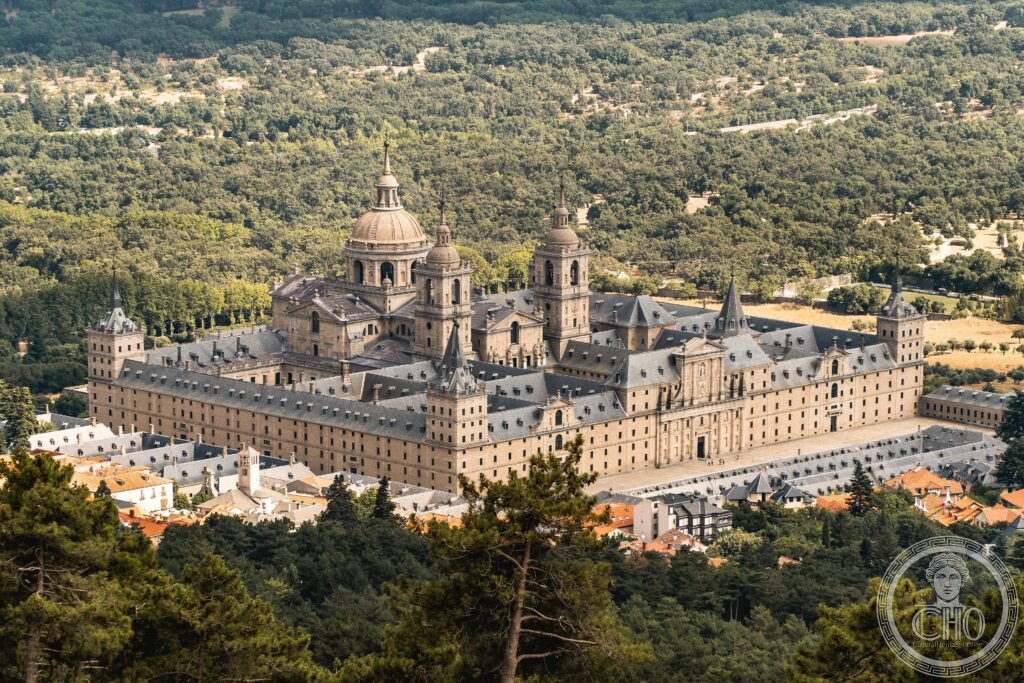
The most severe and magnificent royal building in Europe. The Real Monasterio de San Lorenzo de El Escorial (1563–1584), in the Guadarrama foothills 45 km north-west of Madrid, is simultaneously a royal palace, a Hieronymite monastery, a dynastic mausoleum, and one of the greatest Renaissance libraries in the world, all contained in a single perfect rectangle of grey granite. It is the architectural embodiment of Philip II of Spain’s vision of his monarchy: absolute, austere, universal, and God-directed.
At a glance
El Escorial is 45 km north-west of Madrid (50 minutes by suburban railway Cercanías from Atocha station) at an altitude of 1,028 metres in the Sierra de Guadarrama. The building is the largest Renaissance structure in the world: 208 x 162 metres, 4 corner towers, 15 cloisters, 9 towers, 86 staircases, 16 courtyards, and 300 monastic cells. The main visitor area covers the royal apartments, the basilica, the Panteón de Reyes (the royal mausoleum), and the library. The monastery is still active (Augustinian monks since 1885, replacing the original Hieronymites) and the monks’ cloister and living quarters are closed to visitors. The Royal Library and the Basilica are free to enter (the royal apartments require a ticket).
Key facts
- Philip II (1527–1598) and the foundation: Philip II of Spain was the most powerful monarch in the world during the second half of the 16th century. He ruled Spain (including Castile, Aragon, and Navarre), Portugal (from 1580), the Spanish Netherlands (modern Belgium and Luxembourg), the Kingdom of Naples and Sicily, the Duchy of Milan, and the Spanish overseas empire (Mexico, Peru, the Philippines). He chose to build El Escorial to fulfil a vow made before the Battle of St Quentin (August 10, 1557 — the feast day of St Lawrence, hence the dedication of the building to San Lorenzo), in which the French army was decisively defeated. He also wished to create a permanent mausoleum for his father, the Holy Roman Emperor Charles V (Charles I of Spain), and for the Spanish monarchs thereafter. Philip directed the construction personally from his residence at the Escorial, where he spent much of the last 20 years of his reign (he had a small private apartment above the high altar of the basilica so that he could hear Mass from his bed when ill).
- Juan de Herrera (1530–1597) and the Herreran style: the building was begun by Juan Bautista de Toledo (architect to Philip II, died 1567), who established the basic rectangular grid plan. It was continued and effectively redesigned by Juan de Herrera (appointed royal architect 1572, completed the Escorial 1584). Herrera developed an austere, rigorously geometric style known as “Herreran” or “Desornamentado” (the unornamented style). Grey granite walls without ornament, windows in strict geometric alignment, towers of severe profile, sparing use of classical orders (only at the main portals and the basilica entrance). The style was a deliberate statement of Counter-Reformation values: the rejection of the excessive ornament of late Gothic and Plateresque Spanish architecture (which Herrera considered as distracting from spiritual gravity) in favour of mathematical clarity and structural honesty. The Herreran style was adopted by Spanish royal architecture until the late 17th century and influenced Spanish colonial architecture in the Americas.
- The Panteón de Reyes (Royal Mausoleum): the most symbolically powerful space in El Escorial. The Panteón de Reyes (built 1617–1654 under Philip III and Philip IV, by Giovanni Battista Crescenzi and Juan Gómez de Mora) is a circular chamber directly beneath the high altar of the basilica, reached by a staircase from the basilica sacristy. The walls are covered in black and dark-green marble and dark-bronze funerary escutcheons. The chamber contains 26 identical marble sarcophagi arranged in 4 tiers on each side, containing the remains of all Spanish monarchs from Charles I (Charles V) and Isabella of Portugal to Alfonso XIII and Victoria Eugenia (the last monarchs buried before Spain became a republic in 1931). Juan Carlos I and Sofia are interred here. The Panteón de los Infantes (the adjacent princes’ mausoleum, begun 1654, not complete until the 19th century) contains the remains of Spanish royal children and spouses who were not monarchs in their own right.
- The Royal Library (Biblioteca de El Escorial): one of the greatest Renaissance libraries in the world, established by Philip II using his personal collection and augmented by acquisitions from humanist scholars, monasteries, and the confiscation of private libraries. The library holds approximately 40,000 printed books and 4,800 manuscripts, including the Codex Vigilianus (976 AD, one of the oldest Castilian chronicles), the Cantigas de Santa María of Alfonso X the Wise (13th century illuminated manuscript), Arabic and Greek manuscripts from Philip’s collection, and the personal correspondence of Philip II. The main gallery (66 metres long, with a barrel-vaulted ceiling painted by Pellegrino Tibaldi 1587–1592 showing the seven liberal arts) is the most spectacular Renaissance library interior in Spain.
- Heritage: UNESCO World Heritage Site, Monastery and Site of the Escurial, inscribed 1984.
- GPS: 40.5897° N, -4.1493° W.
History
Construction began in 1563, 6 years after the vow of St Quentin. It was essentially complete by 1584, though interior decoration and the library continued until Philip’s death in 1598. Philip II died in the Escorial on September 13, 1598, after 53 days of illness. He had spent the last decade of his reign directing the affairs of the Spanish Empire from his study in the Escorial, receiving ambassadors, signing documents, and attending daily Mass in the basilica. The Escorial was the effective administrative capital of the Spanish Empire during the late 16th century. The Bourbon dynasty (which replaced the Habsburgs after the War of the Spanish Succession in 1700) preferred the more comfortable palaces of Madrid (the Royal Palace, completed 1764) and Aranjuez. The Escorial was sacked during the Napoleonic invasion (1808). Restored in the 19th century. The Augustinian monks replaced the last Hieronymites in 1885. UNESCO inscription 1984.
What you see
Enter through the Lonja (the granite esplanade surrounding the building on three sides) and the main (west) portal (the Herreran portal with the only significant figural sculpture on the exterior: the statue of St Lawrence with his gridiron, by Juan Bautista Monegro, 1583). The atrium of kings (the inner forecourt before the basilica, named for the six monumental bronze statues of the kings of Israel — David, Solomon, Josaphat, Hezekiah, Jehoshaphat, and Manasseh — by Monegro, symbolising Philip II’s identification of himself with the biblical monarchs). The basilica (the central domed church, 92 metres high at the lantern; the choir stalls carved by Juan de Herrera’s workshop; the 15 altarpieces with paintings by Titian, El Greco, Federico Zuccaro, Juan Fernández de Navarrete, and other masters; the high altar retablo by Herrera with gilded bronze by Leone and Pompeo Leoni). The royal apartments (Philip II’s austere bedroom with direct sight-line to the high altar; the Battle Gallery with frescoes of Spanish military victories; the Bourbon apartments with 18th-century interiors and the Tiepolo ceiling). The Panteón de Reyes (the essential visit, by guided tour).
Practical information
- Admission: the general ticket (Royal Apartments + Basilica + Panteón + Museum + Library) approximately €15 (free Wednesdays 15:00–18:00 for EU citizens; free to all on May 30 and October 12, Spanish national holidays). The basilica and library are free. Open Tuesday–Sunday 10am–7pm (April–September), 10am–6pm (October–March). Closed Monday. The Panteón visit is by timed-entry ticket (included in the general admission; book in advance online at summer weekends).
- Getting there: from Madrid Atocha by Cercanías line C-8a to El Escorial (1h 10 min, every 30 min; the train station is El Escorial, 1 km from the monastery, slightly uphill; bus service from the station to the monastery entrance is available). By car from Madrid: 45 km north-west via A-6 motorway then M-600 (50 min). From Ávila: 60 km east on N-110 (45 min). From Segovia: 50 km south on CL-601 (45 min; El Escorial combines well with a day in Segovia: the Alcázar, the Roman aqueduct, and the cathedral are all outstanding).
- The “Real Sitio” circuit: El Escorial is one of four “Real Sitios” (Royal Sites) in the Madrid region. The others are El Pardo (north of Madrid; the hunting palace, extensive forest), Aranjuez (50 km south of Madrid; the spring royal residence with extraordinary formal gardens; UNESCO WHS 2001), and La Granja de San Ildefonso (15 km from Segovia; the Spanish Versailles, built by Philip V after 1720, with the most spectacular Baroque fountain gardens in Spain). Visiting El Escorial + Segovia + La Granja in a single day (by car) is one of the finest heritage circuits near Madrid.
Getting there
From Madrid Atocha, Cercanías line C-8a (1h 10min). By car from Madrid (45 km, 50min via A-6). From Segovia (50 km, 45min). GPS: 40.5897, -4.1493.
Nearby
- Segovia. 50 km north-east of El Escorial (45 min by car via CL-601). One of the three essential medieval Castilian cities (with Toledo and Ávila). The Roman aqueduct, 1st–2nd century AD, runs 728 metres on 166 arches in two tiers and rises 28 metres at its highest point, built entirely of dry-stone Roman granite without mortar and still functioning until 1973: it is one of the most impressive pieces of Roman civil engineering anywhere in Spain, inscribed UNESCO WHS 1985 jointly with the Alcázar and the Old City. The Alcázar is the most photographed castle in Spain, and its fairy-tale profile of pointed circular towers and steeply pitched blue-slate roofs was the model for the Neuschwanstein-derived Disney castle silhouette; rebuilt after a fire in 1862 in a more fantastical version of its 14th-century predecessor, it is now a military museum. The Cathedral of Segovia, 1525–1768, was the last Gothic cathedral built in Spain and one of the latest examples of the style anywhere in Europe.
- Ávila. 70 km west of El Escorial (1h by car via N-110). The highest provincial capital in Spain (1,131 metres altitude) and the most perfectly preserved medieval walled city in the Iberian Peninsula. The city walls of Ávila (1090–1099 AD; 2.5 km of walls with 88 towers and 9 gates, all in their original pre-Romanesque and Romanesque form; walkable on the top for the full circuit — the best way to understand the scale and completeness of the walls) are UNESCO WHS 1985. The Cathedral of Ávila (begun 1091 in the Romanesque style, continued in the Gothic; the apse of the cathedral is integrated into the city wall and functions as a defensive tower — the fortified apse is one of the most dramatic fusions of military and ecclesiastical architecture in medieval Spain). Birthplace of St Teresa of Ávila (1515–1582), the reforming Carmelite mystic and Doctor of the Church, whose Convento de la Santa (on the site of her birthplace) and the Convento de San José (her first reformed Carmelite convent, 1562) are pilgrimage sites.
- Madrid: Royal Palace and the Prado. 45 km south-east of El Escorial (50 min by car or Cercanías train). Two stops are essential. The Museo del Prado holds the greatest collection of Spanish painting in the world: the Velázquez rooms with “Las Meninas”, the equestrian portraits of the Habsburgs and “Las Hilanderas”; the Goya rooms with the Black Paintings and the “Third of May 1808”; the Titian rooms with the Philip II series and the “Venus of Urbino” copy; and the Hieronymus Bosch rooms, where the “Garden of Earthly Delights” came from Philip II’s personal collection. The Palacio Real, the 18th-century royal palace built by Juvara and Sacchetti between 1738 and 1764, is the largest palace in Western Europe by floor area, 135,000 m² in 3,418 rooms, and the frescoed ceilings by Tiepolo in the Throne Room and the Royal Halberdiers’ Room are the finest 18th-century ceiling paintings in Spain.
Sources
- Wikipedia, El Escorial. Philip II of Spain. Juan de Herrera. Panteón de Reyes, accessed June 2026.
- UNESCO, Monastery and Site of the Escurial, WHS reference 318, inscribed 1984.
- George Kubler, Building the Escorial, Princeton University Press, 1982 (definitive architectural study).
- Henry Kamen, Philip of Spain, Yale University Press, 1997.
Find it on the map
See this place and what’s around it →📷 Become a Cultural Heritage Online photographer
Share your photos of places: they stay published under your name as the author. The more they're seen, the more you get noticed — and soon a contest will reward the most appreciated photos.
Log in or sign up free to add a photoIs this page about you?
This page is read by travellers and heritage enthusiasts who find it on Google. Tell us how you are connected to this place and we will take it from there.