
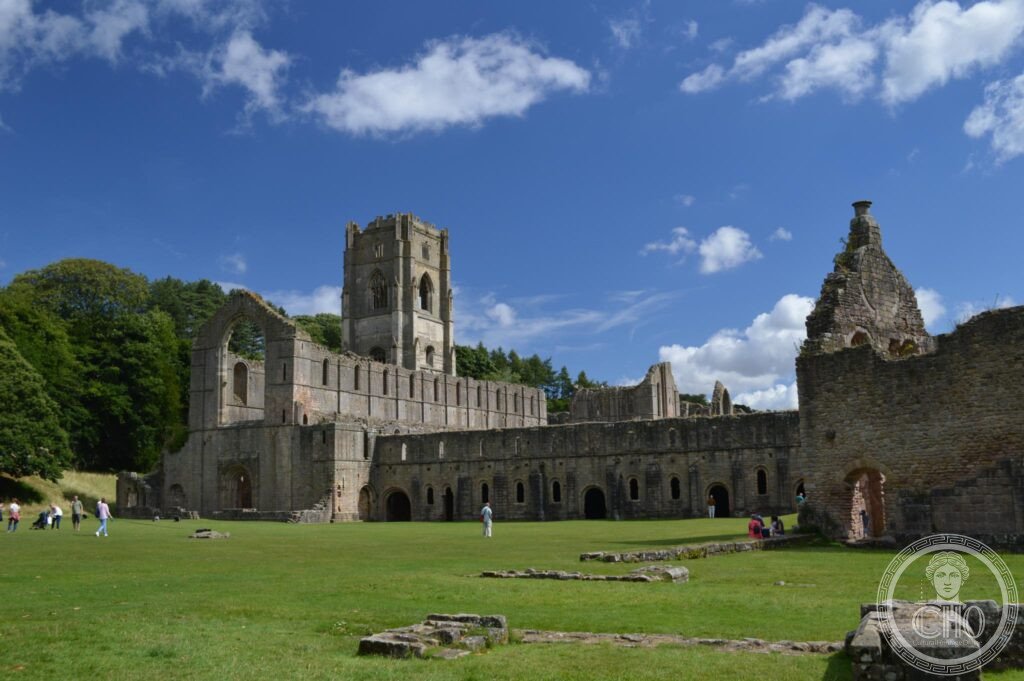
Two of England’s greatest heritage sites in one estate. The ruins of Fountains Abbey (the most spectacular and extensive medieval monastic ruin in England, a Cistercian monastery founded 1132 AD, dissolved 1539) and the Studley Royal Water Garden (the most complete 18th-century formal water garden in Britain, designed by John Aislabie from 1715 and built partly to use the Abbey ruins as a deliberate picturesque element in the composed landscape) form the most powerful combination of medieval and Georgian heritage in England, united within a single 320-hectare estate 5 km south-west of Ripon in North Yorkshire.
At a glance
The Studley Royal estate is 5 km south-west of Ripon (the smallest cathedral city in England, with a Norman-to-Gothic cathedral of considerable interest) in the valley of the River Skell, in the Yorkshire Dales. The estate covers 320 hectares of formal water garden, deer park, woodland, and the Fountains Abbey ruins. The site is owned and managed by the National Trust and is open year-round. The visitor centre is at the Studley Royal end (car park on the B6265). A second car park at Fountains Abbey allows entry from the abbey end. The circuit of the water garden and abbey ruins is approximately 4 km and takes 2.5–3 hours. The complete estate circuit (including St Mary’s Church and the deer park) is approximately 8 km and takes 4–5 hours.
Key facts
- Fountains Abbey (1132–1539 AD): the largest and most complete Cistercian ruin in England. Founded in December 1132 by 13 Benedictine monks expelled from the Abbey of St Mary in York for their reforming zeal (they wished to adopt the stricter Cistercian rule of St Bernard of Clairvaux; the expulsion was the beginning of what became the most significant Cistercian community in England). Archbishop Thurstan of York supported the rebels and granted them land in the remote and boggy valley of the River Skell. Within 20 years, under the first abbots (Richard and Henry Murdac), Fountains had built its first stone buildings and established a model Cistercian community. The monastery grew to become the wealthiest religious house in England by the 13th century (the Cistercians were the medieval equivalent of agribusiness entrepreneurs: they drained bogs, cleared forests, bred sheep, sold wool to Flemish merchants, established granges throughout Yorkshire and as far as Borrowdale in the Lake District, and operated lead mines and iron forges). The monastery survived the Scottish raids of the 13th–14th centuries, the Black Death (which reduced the community from 500 to approximately 100 monks and lay brothers), and the economic decline of the 15th century. Henry VIII dissolved it in 1539 (a late dissolution — most monasteries were dissolved in 1536–1537; Fountains’ last abbot, Marmaduke Bradley, surrendered the monastery on November 26, 1539). The lead was stripped from the roofs, the bells were taken, and the stone was quarried for local building projects. The ruins remained in essentially their present state from 1539 to the present.
- The cellarium (91 metres long): the most spectacular individual architectural element at Fountains and the most complete example of 12th-century monastic architecture in Britain. The cellarium (the lay brothers’ hall/storehouse, running the full length of the west range of the cloister) is 91 metres long, 9 metres wide, and 7 metres high, with 22 bays of Romanesque barrel-vaulted ceiling supported on a central row of pillars. At Fountains, the cellarium was three storeys high: the ground floor (the cellarium proper, used for storage) and two upper floors (the lay brothers’ refectory above, and the lay brothers’ dormitory on the top floor). The ground floor is roofless (the floors above having collapsed) but its barrel vaults survive intact over the full 91 metres. Walking the full length of this space, with the sequence of identical arches diminishing in perspective, is one of the most powerful architectural experiences in England.
- The tower of the Chapel of the Nine Altars (52 metres): the most visible feature of Fountains from a distance and the largest surviving Cistercian tower in England. The late Perpendicular Gothic tower was added to the north end of the east transept approximately 1500–1526 (the last major addition to the monastery before the Dissolution). It is 52 metres high and rises from the east end of the abbey church in a position that from the Studley Royal water garden viewpoints creates the most picturesque silhouette in the composition. The tower is the only significant late medieval addition to an otherwise primarily 12th–14th century building.
- Studley Royal Water Garden (1715–1740): the finest formal landscape water garden in England and one of the finest in Europe. John Aislabie (1670–1742), Chancellor of the Exchequer (the equivalent of Finance Minister) under George I, was disgraced and expelled from the House of Commons in 1721 following his role in the South Sea Bubble (one of the first financial scandals in English history: Aislabie had profited from insider knowledge of the South Sea Company scheme, which crashed in 1720, ruining thousands of small investors). Aislabie retired in disgrace to his estate at Studley Royal and spent the remaining 21 years of his life creating a formal landscape garden in the valley of the River Skell. The garden (with its formal Moon Pond, Octagon Pond, and Canal, its symmetrically arranged lawn terraces, its classical temples, and its carefully framed views of the Fountains Abbey ruins at the eastern end of the valley) was completed by his son William Aislabie after his father’s death in 1742 (William also purchased the Fountains Abbey ruins and incorporated them definitively into the composition). The garden was the most visited of any English garden in the 18th century (travellers came specifically to see the Picturesque composition of classical water garden with medieval ruins).
- Heritage: UNESCO World Heritage Site, Studley Royal Park including the Ruins of Fountains Abbey, inscribed 1986.
- GPS: 54.1156° N, -1.5716° W.
History
The Fountains Abbey community was founded in December 1132 when 13 dissident monks from St Mary’s, York, were granted a site in the Skell valley by Archbishop Thurstan. They sought affiliation with the Cistercian Order in 1135 and were confirmed as a Cistercian house by Bernard of Clairvaux himself (whose Fontenay, founded 1118, was approximately contemporaneous with Fountains’ early building). The monastery grew from a temporary camp in a winter storm to the most powerful religious institution in northern England within 100 years. The Yorkshire Cistercians (Fountains, Rievaulx, Byland, Kirkstall) were the dominant landowners and agricultural entrepreneurs of 12th–13th-century Yorkshire. The Black Death (1348–1349) reduced the community from approximately 500 to fewer than 100. The 15th-century economic recovery produced the late Perpendicular additions (the tower). Dissolution by Henry VIII in 1539 ended 407 years of continuous monastic life. The estate passed through several secular owners before the Aislabie family created the water garden in the 18th century. The National Trust acquired the estate in 1983, and UNESCO recognition followed in 1986.
What you see
Enter from the Studley Royal end (visitor centre) and walk east along the formal water garden terraces: the Moon Pond (the central formal water feature of the garden, a perfect circular pond flanked by two crescent-shaped ponds — the geometry is neo-Platonic, reflecting the mathematical purity of the ideal landscape) is framed between two classical temples. The garden descends gradually east toward the River Skell. At the east end of the garden, the Fountains Abbey ruins come into view as a deliberate theatrical revelation across the valley. The tower rising above the tree line, the cellarium arches visible at river level, the nave and crossing of the church above the terraces. Cross the estate footbridge and enter the abbey precinct from the west (the best approach, giving the full perspective of the cellarium from its open west end). Walk the full cellarium (91m), emerge into the cloister (the cloister arcading survives on the east side), continue to the church (nave, north and south transepts, and the east end with the Nine Altars Chapel). Conclude at the tower base. Allow 2.5h for the main circuit. Allow 4–5h for the complete estate including Deer Park and Victorain church of St Mary (1871, William Burges, one of his finest works).
Practical information
- Admission: approximately £20 adult (National Trust members free; the NT membership pays for itself within 2–3 large-site visits). Open year-round (the estate is at its most dramatic in winter when the bare trees open the views of the ruins; it is spectacularly beautiful in autumn foliage and in spring when daffodils carpet the abbey precincts; summer weekends are busy). The visitor centre café and the estate tea rooms at Studley Royal are open daily in season. The estate is approximately 3 km from the nearest car park to the furthest point (allow 4–5 hours to see everything).
- Getting there: from York by car: 40 km north-west on A59/A61 (50 min). From Leeds: 50 km north on A61 (50 min). From Harrogate: 25 km north on A61 (30 min). By public transport: from York by train to Harrogate (30 min), then bus 36 to Ripon (35 min), then taxi to Fountains (5 km; approximately £10). By bicycle from Ripon: 5 km on the B6265 (15 min; not particularly comfortable but feasible). The estate is approximately 4 km from the centre of Ripon (Ripon has a cathedral, a market, and several excellent hotels).
- The North Yorkshire heritage circuit: Fountains Abbey + Rievaulx Abbey (the other great Cistercian ruin in North Yorkshire; 30 km east of Fountains via the North York Moors; a 12th-century abbey in a dramatic valley; the Rievaulx Terrace, an 18th-century landscape garden above the abbey designed to frame views of the ruins from above — a concept very similar to Studley Royal but earlier and on a smaller scale) + Byland Abbey (15 km east of Fountains; the ruins of the largest Early Gothic Cistercian church in England, distinguished by the surviving fragments of the circular rose window of the west facade, the first example of a circular window in English Gothic architecture) constitute one of the finest medieval abbey circuits in Europe.
Getting there
From York (40 km, 50min by car). From Harrogate (25 km, 30min). By public transport: train York. Harrogate + bus 36 + taxi from Ripon (5 km). GPS: 54.1156, -1.5716.
Nearby
- York. 40 km south-east of Fountains (50 min by car). One of the best-preserved medieval walled cities in England and the second most visited tourist destination in England after London. The York Minster (the largest medieval cathedral in Northern Europe north of the Alps; the Five Sisters window of 1250 AD, the largest assembly of grisaille glass in the world; the Great East Window of 1405–1408, the largest medieval stained-glass window in the world by area; the Undercroft Museum, which reveals the Roman fort of Eboracum directly beneath the cathedral foundations), the city walls (the most complete medieval city walls in England, 3.4 km of walkable ramparts with 4 main gates/bars), and the Shambles (the most completely preserved medieval shopping street in Europe, so narrow that the overhanging upper floors of opposite buildings almost touch) make York one of the essential English cities.
- Rievaulx Abbey. 30 km east of Fountains (35 min by car via A170). The most completely situated Cistercian ruin in England (Fountains has a more extensive ruin; Rievaulx has a more dramatic and atmospheric setting in a narrow wooded valley of the Rye River). Founded 1132 (the same year as Fountains, by Bernard of Clairvaux’s secretary William) as the first Cistercian monastery in the north of England. The standing remains include the nave (partly collapsed), the north transept (substantial), the choir (entirely gone but for the foundations), and the chapter house (the most intact element, with its original 12th-century entrance arch). The Rievaulx Terrace (1758, owned by National Trust; above the valley on the south side, separate from the abbey itself; a 0.5-km grass terrace with two classical temples designed to frame views down to the abbey ruins from above — an early example of the Picturesque movement).
- Harrogate and the Yorkshire Dales. 25 km south of Fountains (30 min by car). Harrogate is the most elegant Victorian spa town in England (the Turkish Baths, 1897, are still in operation and offer one of the most authentically Victorian bathing experiences in Europe; Betty’s Tea Rooms, 1919, is the most celebrated traditional tea room in England; the Valley Gardens are the finest Victorian public park in Yorkshire). Harrogate is an excellent base for exploring both Fountains Abbey and the Yorkshire Dales National Park (the limestone dales of Wharfedale, Nidderdale, and Wensleydale are within 20–30 km of Harrogate, with the Aysgarth Falls, Bolton Priory, and Malham Cove as key natural and historical landmarks).
Sources
- Wikipedia, Fountains Abbey. Studley Royal Park. John Aislabie, accessed June 2026.
- UNESCO, Studley Royal Park including the Ruins of Fountains Abbey, WHS reference 372, inscribed 1986.
- Glyn Coppack, Fountains Abbey: The Story of a Medieval Monastery, Batsford, 1993.
- David Jacques and Arend Jan van der Horst, The Gardens of William and Mary, Christopher Helm, 1988.
Find it on the map
See this place and what’s around it →📷 Become a Cultural Heritage Online photographer
Share your photos of places: they stay published under your name as the author. The more they're seen, the more you get noticed — and soon a contest will reward the most appreciated photos.
Log in or sign up free to add a photo