
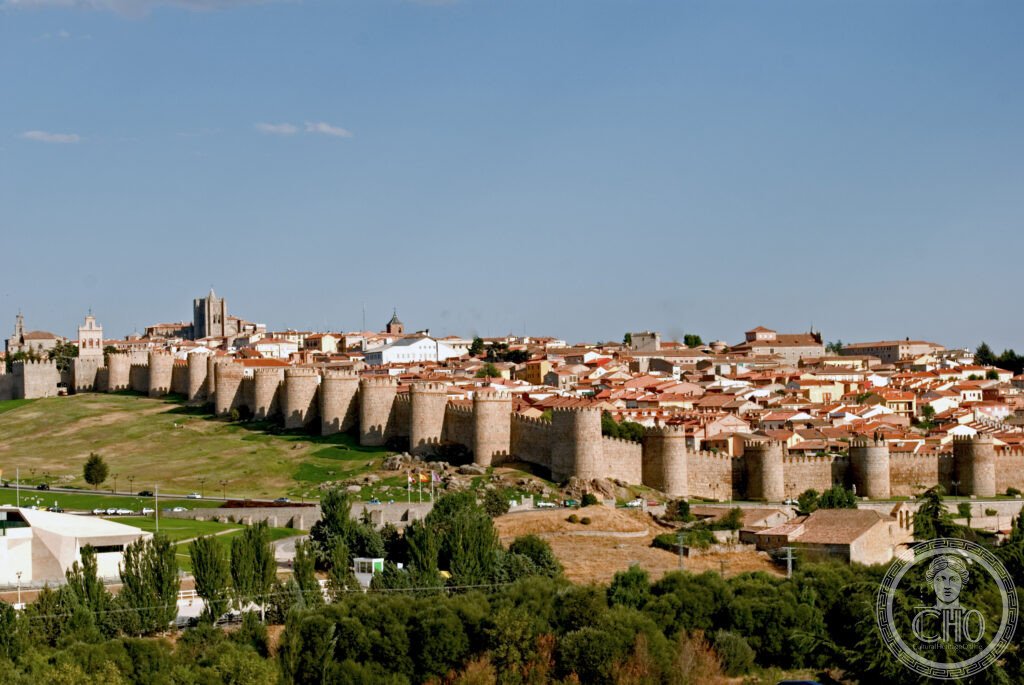
The most complete surviving medieval walled city in Spain and one of the best-preserved fortified cities in Europe — Ávila (founded on a granite plateau at 1,130 metres, the highest provincial capital in Spain, 110 km north-west of Madrid) is enclosed within an extraordinary circuit of 2.5 km of medieval walls with 88 towers and 9 gates, built by order of King Alfonso VI of Castile from 1090 and completed with additions through the 14th century, and retains a compact historic centre of Romanesque churches, Renaissance palaces, and Gothic convents largely untouched by modern development.
At a glance
Ávila (population approximately 56,000) is the capital of the Province of Ávila and one of the most dramatically sited historic cities in the Iberian Peninsula, on a granite tableland above the Río Adaja in the western foothills of the Sierra de Gredos. The city walls (begun 1090 under the engineer Casandro Romano and the geographer Florín de Pituenga after the Christian reconquest of the site from the Moors) are the finest surviving example of Romanesque military architecture in Spain; UNESCO inscribed the Old Town of Ávila with its Extra-Muros Churches in 1985, recognising both the walls and the churches outside the walls (Santo Tomás, San Vicente, San Pedro) as part of an outstanding ensemble. Ávila is famous as the birthplace of Teresa de Cepeda y Ahumada (St Teresa of Ávila, 1515–1582), the mystic, reformer of the Carmelite Order, writer, and Doctor of the Church (designated 1970 — the first woman to receive this title, alongside her contemporary St John of the Cross).
Key facts
- The City Walls (1090–14th century): the most complete and best-preserved medieval city wall circuit in Spain — 2.5 km of granite ashlar walls, an average of 3 metres thick and 12 metres high (some towers reach 20 metres), with 88 semicircular towers (cubos) projecting from the wall face at regular intervals and 9 gates (puertas), built in a single unified campaign (approximately 1090–1099) on the orders of King Alfonso VI of Castile after his reconquest of the city; the remarkable homogeneity of the walls (unusual in European medieval fortifications, where additions and reconstructions over centuries create stylistic inconsistency) is due to this rapid unified construction; approximately 2 km of the wall circuit can be walked as a promenade on the top of the wall (the walkway is open to visitors, with two sections accessible from the Puerta del Alcázar and the Puerta del Puente Adaja); the best overall views of the walls are from the Cuatro Postes viewpoint (a 16th-century granite marker 2 km north-west of the city) and from the Río Adaja meadows to the south
- Cathedral of Ávila (Catedral de Ávila, begun c.1150): the oldest Gothic cathedral in Spain and the only fortified cathedral in the Iberian Peninsula — the apse of the Cathedral (the easternmost structure of the building, hemispherical and massively built in granite) is physically incorporated into the city wall (it forms one of the towers/cimorra of the wall circuit, reinforced as a war machine with arrow loops and crenellations) — a unique configuration in European ecclesiastical architecture where the house of God and the defensive fortification are the same structure; construction began approximately 1150 in the Transitional Romanesque-Gothic style; the nave (mid-13th century) is the first properly Gothic nave in Spain, preceding the cathedrals of Burgos, Toledo, and León by a generation; the carved altarpiece (retablo mayor, 16th century, by the painter Pedro Berruguete and the sculptor Vasco de la Zarza) and the alabaster tomb of Bishop Alonso de Madrigal (“El Tostado”, by Vasco de la Zarza, c.1520) are the finest works of art in the cathedral; El Tostado was reputed to write the most voluminous amount of any Spanish author of the 15th century
- Teresa de Jesús (St Teresa of Ávila, 1515–1582): the most important woman in Spanish religious and literary history and one of the great mystics of the Christian tradition — born in Ávila on 28 March 1515 (the family house, now the Convento de Santa Teresa, was built over her birthplace in 1636), she entered the Carmelite Convent of the Incarnation at age 20, experienced a series of visions and mystical ecstasies that she described in her autobiography (Vida), and in 1562 founded the Convent of San José in Ávila (the first of the 17 convents of the Reformed/Discalced Carmelite Order she would go on to found throughout Spain); her most important theological and literary works — El Camino de Perfección, Las Moradas (The Interior Castle, her greatest mystical treatise), and her correspondence with St John of the Cross — were written in a colloquial Spanish prose of extraordinary clarity and warmth; she was canonised in 1622 and declared the first female Doctor of the Church in 1970; her relics are preserved at the Carmelite Convent in Ávila and the Alba de Tormes; her image appears throughout Ávila, and the city’s emblem sweet — yemas de Santa Teresa (confections of egg yolk and sugar, a recipe created in the 19th century and attributed to the nuns of the Ávila convents) — is sold at every pastry shop
- Convento de Santo Tomás (1482–1493): the royal convent of the Catholic Monarchs outside the walls of Ávila — built by the Dominican Order at the expense of Fernando II of Aragon and Isabel I of Castile (who made Ávila one of their principal residences during the Reconquista campaigns) as a summer palace, royal pantheon, and inquisitorial tribunal; Tomás de Torquemada (the first Grand Inquisitor of the Spanish Inquisition, 1483–1498, responsible for approximately 2,000 executions during his tenure) was prior of the Santo Tomás convent and is buried in its Gothic sacristy; the tomb of the Infante Juan (the only son of Fernando and Isabel, who died at 19 in 1497, breaking the succession plan of the Catholic Monarchs) in the church is one of the finest Renaissance sepulchral monuments in Spain; the three Gothic cloisters of the convent are considered the masterwork of the Isabelline Gothic style
- The climate and gastronomy: at 1,130 metres, Ávila has the most extreme climate of any provincial capital in Spain — summer temperatures rarely exceed 30°C (pleasant) but winters are harsh (average January temperature 2°C, regular snow); the phrase “nueve meses de invierno y tres de infierno” (“nine months of winter and three of hell”) is applied ironically to Ávila; the Ávila beef (ternera de Ávila, a PGI-protected beef from the local Avileña-Negra Ibérica breed, raised on the pastures of the Sierra de Gredos) is widely considered the finest beef in Castile; the judías del Barco (white beans from the nearby Barco de Ávila, a local denomination) are the essential vegetable ingredient; winter game (pheasant, partridge, woodcock) from the Gredos mountains are on every restaurant menu from November to February
- Heritage: UNESCO World Heritage Site, Old Town of Ávila with its Extra-Muros Churches, inscribed 1985
- GPS: 40.6564° N, 4.7005° W
History
The plateau on which Ávila stands was occupied before the Roman conquest (the Vettones, a Celtic-Iberian people, built oppida — fortified hilltop settlements — throughout this area; the most important surviving example is the Verracos sculpture group, granite pig-like animal sculptures whose purpose is debated, scattered throughout the province); the Roman municipium of Abula/Abila grew on the site; the Visigoths and then the Moors controlled the region (711–1085, though the site may not have been densely settled in the early Islamic period, given its altitude and cold climate); Alfonso VI of Castile reconquered the site after the fall of Toledo (1085) and ordered the construction of the walls (1090) to establish a permanent Castilian presence in the southern Meseta between the Sierra de Guadarrama and the River Tagus.
Ávila remained a frontier fortress city for most of the medieval period but gained political importance as a royal residence under Fernando and Isabel (who used Santo Tomás as their summer court); the city’s greatest moment of historical significance came on 5 June 1520, when the Comunero leaders of the city of Ávila convened the Junta Santa (the revolutionary council of the Castilian Comunero uprising against Charles I) in Ávila — the single most important act of the Castilian Revolt of the Comuneros (1520–1521), the first major challenge to Habsburg rule in Spain. The city’s prosperity declined after the 16th century as Castile’s population moved to the new imperial capitals of Madrid and Valladolid; this economic stagnation — as in Évora — paradoxically preserved the historic centre from the 19th-century urban redevelopments that destroyed so much medieval Europe.
What you see
The city walls are best seen as a complete circuit on foot (1.5–2h) from the Puerta del Alcázar (the main eastern gate, adjacent to the Cathedral apse-tower) along the exterior circuit to the north, past the Puerta del Carmen, along the western stretch, and back via the Puerta de San Vicente; the elevated walkway on top of the walls gives views out over the plain and in over the rooftops of the historic city. Within the walls, the standard circuit: Cathedral (the apse tower from the exterior showing its defensive integration with the wall; interior for the retablo and the El Tostado tomb) → Plaza Mayor (the main square, unusually modest for a Castilian town of this importance — the square was created only in the 18th century) → Convento de Santa Teresa (on the site of the saint’s birthplace, with a museum of her relics, manuscripts, and personal objects; the ring of gold she received from Christ in a mystical vision is preserved here) → Basílica de San Vicente (outside the walls, 12th century, the most important Romanesque building in Ávila; the south portal has the finest Romanesque sculptural programme in Castile).
The Cuatro Postes viewpoint (2 km north-west, on the road to Salamanca, freely accessible at all times) gives the most famous view of Ávila — the city walls seen from the north, with the Cathedral towers visible above the wall line and the Sierra de Gredos in the background; this is the image that appears on virtually all photographs and postcards of Ávila; the viewpoint is named for the four granite columns (cuatro postes, literally “four posts”, a 16th-century marble cross) beside which Teresa de Jesús (age 7) and her brother Rodrigo were intercepted by their uncle when they attempted to run away to Moorish territory to seek martyrdom for their faith.
Practical information
- Admission: City walls walkway approximately €5 (two sections open, starting from Puerta del Alcázar and Puerta del Puente Adaja); Cathedral approximately €7 (or free at mass times, 10am, 11am, 12pm); Convento de Santa Teresa museum approximately €2; Convento de Santo Tomás and royal tombs approximately €3; Basílica de San Vicente free; most town-centre churches free; the Cuatro Postes viewpoint is freely accessible at all times (drive or 30 min walk from the city centre on the road to Salamanca); combined tickets available for cathedral + walls
- Getting there: Ávila is on the main Madrid–Salamanca railway and receives direct Alvia and Media Distancia trains from Madrid (Chamartín, 1h 30 min to 2h depending on service; Alvia approximately €12–25 advance booking); direct trains from Salamanca (1h 15 min); from Segovia (1h 15 min by bus, no direct train via the valley route); by car from Madrid (105 km west on the A-6 and N-110; 1h 15 min); from Salamanca (95 km north-east, 1h by car); from Segovia (67 km south-east, 55 min by car via the Puerto de Villatoro mountain pass — a scenic route through the Sierra de la Paramera); Ávila’s railway station is 1 km east of the city walls (15 min walk); taxis are few but sufficient for the short distances involved
- The Castile triangle: Ávila is the third corner of the essential Castilian cities triangle (Madrid → Segovia → Ávila → Salamanca → Madrid, a circuit of approximately 400 km feasible in 2–3 days by car or train); each city has a distinctive contribution to the Castilian heritage narrative: Segovia (the Roman aqueduct, the Alcázar, the Herreran architecture of the Cathedral and the Escorial nearby); Ávila (the medieval fortification circuit, Teresa the mystic, the Isabelline Gothic of Santo Tomás); Salamanca (the Universidad de Salamanca, the oldest university in Spain, 1218; the Plateresque façade of the university building; the Plaza Mayor, the finest Baroque square in Spain)
Getting there
Train from Madrid (1h 30min–2h, Alvia/MD, ~€12–25). From Salamanca (1h 15min). By car from Madrid (1h 15min, A-6 then N-110). GPS: 40.6564, -4.7005.
Nearby
- Segovia — 67 km south-east of Ávila (55 min by car via Puerto de Villatoro; 1h 15 min by bus, no direct train from Ávila); one of the great Castilian heritage cities — the Roman Aqueduct of Segovia (1st–2nd century AD, 20,400 granite blocks without mortar, 728 m long, 28.5 m high at the highest point — the most complete surviving Roman aqueduct in the western Roman Empire in terms of original fabric; still used to supply the city with water until 1973; UNESCO WHS 1985); the Alcázar of Segovia (the turreted royal fortress at the tip of the rock spur, which inspired the design of Sleeping Beauty’s castle at Disneyland); the Cathedral of Segovia (1525, the last Gothic cathedral built in Spain, with the most elegant interior of any Castilian cathedral)
- Salamanca — 95 km north-west of Ávila (1h by car or 1h 15 min by train); the great university city of the Castilian Golden Age — the Universidad de Salamanca (founded 1218 by Alfonso IX of León, the oldest university in Spain and one of the oldest in Europe; the Plateresque façade of 1529 is the finest example of the Spanish Renaissance decorative style, with the famous frog hidden in its tangle of carvings — tradition holds that students who find the frog will pass their examinations); the Plaza Mayor (1729–1755, by Alberto de Churriguera, the finest Baroque public square in Spain, with its uniform arcaded perimeter and warm golden Villamayor stone); the two cathedrals (the Romanesque Old Cathedral, 1140, and the New Cathedral, 1513, their naves joined internally through a doorway)
- El Escorial — 85 km south-east of Ávila (1h by car or 1h by train from Madrid to San Lorenzo de El Escorial); the Monastery of El Escorial (Monasterio de El Escorial, UNESCO WHS 1984), built by Philip II between 1563 and 1584 to the design of Juan de Herrera, is the grandest building of the Spanish Renaissance and the principal expression of the Herreran style — a severe, unornamented granite building of 4,000 rooms, 16 courtyards, 88 fountains, 9 towers, and 16 kilometres of corridors; the royal pantheon (beneath the altar of the basilica) contains the tombs of 26 Spanish kings and queens; the Escorial library is one of the most important manuscript libraries in Europe; El Escorial is also the gateway to the Valle de los Caídos (a monument built by Franco-era forced labour in a nearby valley — politically contested and transformed into a civil war memorial in 2023)
Sources
- Wikipedia, Ávila, Spain; Walls of Ávila; Teresa of Ávila; Cathedral of Ávila, accessed June 2026
- UNESCO, Old Town of Ávila with its Extra-Muros Churches, WHS reference 348, inscribed 1985
- Teresa of Ávila, El libro de la vida (1565); Las Moradas del Castillo Interior (1577)
- Leopoldo Torres Balbás, Ciudades Hispanomusulmanas, Instituto Hispano-Árabe de Cultura, 1971
Find it on the map
See this place and what’s around it →
📷 Become a Cultural Heritage Online photographer
Share your photos of places: they stay published under your name as the author. The more they're seen, the more you get noticed — and soon a contest will reward the most appreciated photos.
Log in or sign up free to add a photo