

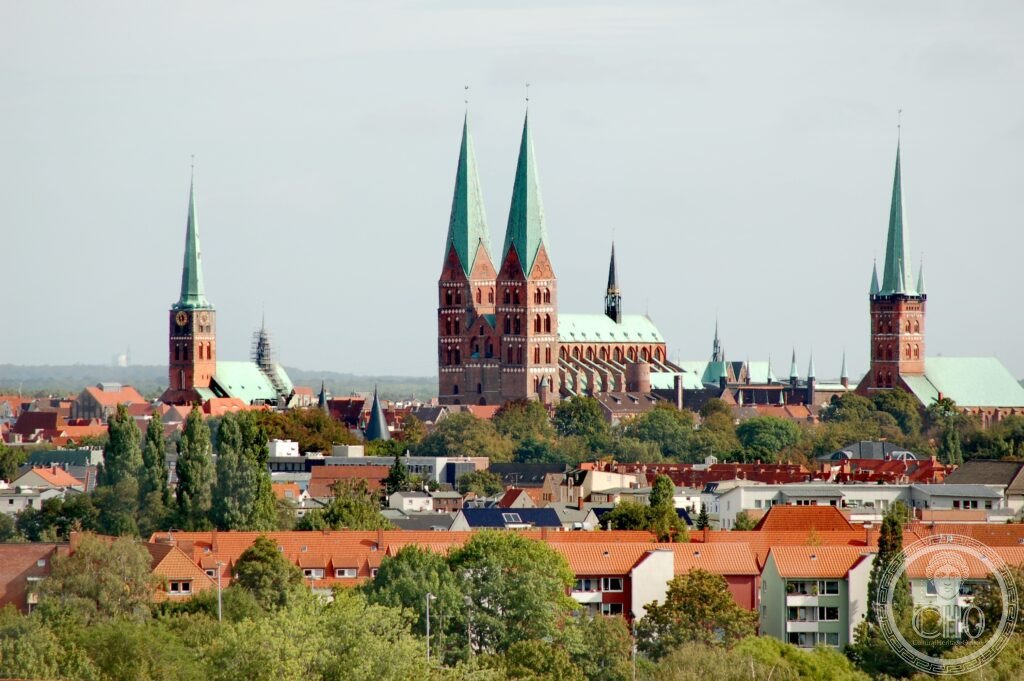
The queen city of the Hanseatic League and the finest surviving example of North German Brick Gothic architecture. Lübeck (founded 1143, the oldest German city on the Baltic coast) grew under the Counts of Holstein and the bishops of Oldenburg into the dominant commercial power of the medieval northern European trade network, controlling the flow of salt, herring, furs, grain, and cloth between the Baltic and the North Sea for nearly 400 years. Its church spires, its twin-towered gate, and its seven great brick churches still define the silhouette of its oval island Altstadt above the Trave River.
At a glance
Lübeck (population approximately 218,000) is the second largest city in Schleswig-Holstein and the most important historic city on the German Baltic coast. The Altstadt (old town) is built on an oval river island approximately 1.5 km by 700 m between the Trave River to the west and the smaller Wakenitz to the east. A natural defensive position that made Lübeck one of the most impregnable trading cities in medieval northern Europe and that is still intact today. UNESCO inscribed the Hanseatic City of Lübeck in 1987, citing its unique preservation of the Brick Gothic urban form developed in the 13th–15th centuries and its role as the model for the development of the Hanseatic cities of the eastern Baltic (Talinn, Riga, Rostock, Stralsund, Wismar, and Danzig all followed the Lübeck model).
Key facts
- Holstentor (Holstein Gate, 1464–1478): Lübeck’s defining monument and the emblem of the city. The twin circular towers of the Holstentor (built by Heinrich Helmstede in 1464–1478 as the western land gate of the city, in the distinctive North German Brick Gothic style of fired red brick with decorative blind tracery and limestone details) have become one of the most photographed and reproduced architectural images in Germany. The gate appeared on the West German 50 Mark banknote (1960–1991). The interior is now the Holstentor Museum, with a scale model of 16th-century Lübeck and the surviving iron torture instruments from the medieval city jail. The gate leans perceptibly (approximately 80 cm) due to the waterlogged soil on which its foundations rest. The adjacent salt warehouses (Salzspeicher, six 16th–17th century brick granary buildings on the Trave quayside, used to store the Luneburg salt that was Lübeck’s most important traded commodity) form the most photogenic group of waterside industrial architecture in Germany.
- Marienkirche (Church of St Mary, 1277–1351): the mother church of the Hanseatic merchant patricians and the most influential Gothic church in North Germany. Begun in 1277 as a replacement for an earlier Romanesque church and completed approximately 1351, the Marienkirche was the first major application of the French Gothic structural system (flying buttresses, high pointed nave with twin side aisles, large windows) in red brick. At 125 metres long and 38.5 metres high (the third tallest church in the world by nave height at the time of completion), the Marienkirche became the model for church construction throughout the Hanseatic zone, from Tallinn to Gdańsk. The twin towers (108.5 m, the tallest towers in Lübeck) were damaged in the RAF bombing raid of Palm Sunday 1942, when incendiary bombs brought the bells crashing from the south tower to the floor, where they lie to this day as a war memorial. The church was restored between 1947 and 1982. Dietrich Buxtehude served as organist here from 1668 to 1707, and the young Johann Sebastian Bach walked from Arnstadt to Lübeck (approximately 400 km) in 1705 specifically to hear Buxtehude play.
- Cathedral (Dom, founded 1173): the oldest church in Lübeck and the seat of the Lübeck bishopric, founded by Henry the Lion (Duke of Saxony and Bavaria, the founder of modern Lübeck) in 1173. A Romanesque basilica substantially rebuilt and enlarged in the Gothic period (13th–15th centuries). The triumphal cross group in the choir (a 4.5-metre wooden crucifix by Bernt Notke, 1477, with the two thieves and the figures of Mary and John — one of the most monumental late-Gothic wood sculptures in Germany) is the cathedral’s most important artwork. The Dom’s nave combines Romanesque round arches in the lower zone with Gothic pointed arches above. The architectural join between the two building phases is visible in the vaulting.
- Buddenbrookhaus: the family home of the Nobel Prize-winning author Thomas Mann (1875–1955) and his brother Heinrich Mann (1871–1950). The house at Mengstraße 4 was the model for the ancestral home of the Buddenbrook family in Thomas Mann’s first novel Buddenbrooks (1901; Mann won the Nobel Prize for Literature 1929 partly on the strength of this novel). The building is now a museum dedicated to the Mann brothers (extensively renovated 2019–2023 and reopened with a dramatically expanded exhibition). Thomas Mann’s novel (subtitled “The Decline of a Family”) traces four generations of a Lübeck merchant dynasty from patrician prosperity to artistic decline. A narrative arc that simultaneously described the arc of Lübeck’s own commercial history. Günter Grass (Nobel Prize 1999), though born in Danzig, lived in Lübeck for the last decades of his life (the Günter Grass House at Glockengiesserstasse 21 is now a museum of his manuscripts, sculptures, and graphic work).
- Niederegger Marzipan (founded 1806): the most famous marzipan in the world and Lübeck’s sweetest export. Niederegger (founded in 1806 by Johann Georg Niederegger, a confectioner from Ulm, at the Café Niederegger directly opposite the Rathaus on the Breite Straße) produces approximately 30 tonnes of marzipan per day from the highest-quality almonds (from the Marcona almond crop of Valencia) and no artificial flavourings. Lübeck marzipan (officially Lübecker Marzipan, protected geographical indication) differs from other regional marzipan traditions by having a higher proportion of almonds to sugar (typically 2:1, versus 1:1 for most commercial marzipan) and a sweeter, more delicate texture. The tradition of marzipan in Lübeck predates Niederegger by several centuries (the earliest documentary reference to Lübeck marzipan is 1530). The Niederegger café and shop at Breite Straße 89 (opposite the Rathaus) is one of the great historic confectioner-cafés of Germany.
- Heritage: UNESCO World Heritage Site, Hanseatic City of Lübeck, inscribed 1987.
- GPS: 53.8655° N, 10.6866° E.
History
The site at the confluence of the Wakenitz and Trave rivers was settled by Slav peoples (the Wagri) before German colonisation. Count Adolf II of Holstein founded a permanent German town on the island in 1143 (the year considered Lübeck’s founding date). Henry the Lion (the Guelf Duke of Saxony) refounded the town in 1159 on a new plan with a market, a cathedral, and a harbour, giving it trading privileges that made it the base for German commercial colonisation of the Baltic coast. Emperor Frederick Barbarossa granted Lübeck the status of Imperial Free City in 1226, removing it from ducal control and giving it the right to self-governance that would underpin its Hanseatic power. The Hanseatic League (the association of merchant cities that coordinated Baltic and North Sea trade from the 13th to the 17th centuries) was effectively founded at Lübeck (the first known charter of the League was signed at Lübeck in 1241). Lübeck served as the “Queen of the Hanse” (the presiding city of the League) for most of its existence. The League’s power began to decline in the 16th century as Atlantic trade routes shifted commercial gravity away from the Baltic.
Lübeck’s greatest physical threat came on the night of 28–29 March 1942, when the RAF firebombed the city (the first British strategic bombing raid on a German city, undertaken specifically because Lübeck’s old timber buildings made it more combustible than industrial targets). Approximately 320 Lübeck citizens were killed and about 30% of the old town buildings destroyed or severely damaged, including the Marienkirche, the Petrikirche, and the Cathedral. The city was substantially rebuilt after the war, with most damaged buildings restored to their pre-war appearance. Thomas Mann, in exile in California when he heard the news, wrote in his diary that he felt the bombing “as a personal blow”.
What you see
The Altstadt island is best experienced on foot in a single day. Standard circuit: Holstentor and salt warehouses (the western waterfront approach, best photographed from the Puppenbrücke bridge). Rathaus (the Town Hall, one of the finest Gothic civic buildings in North Germany, its north façade on the Marktplatz has a blind arcade of black-glazed bricks and white limestone details that is the visual template for hundreds of smaller town halls across the Hanseatic zone). Marienkirche (the merchant patricians’ church; the dented bells lying on the south nave floor since 1942 are the most moving war memorial in Germany). Buddenbrookhaus (the Thomas Mann museum; buy the Reclam paperback of Buddenbrooks in German if you read German). Breite Straße (the main pedestrian shopping street, with the Niederegger café). Dom (the cathedral, quieter than the Marienkirche and often less crowded, with the Bernt Notke crucifixion). The Trave waterfront on the south side (the medieval harbour area, with views back toward the Holstentor and the salt warehouses).
The seven Gothic brick churches of Lübeck (Marienkirche, Dom, Petrikirche — which has a tower lift to the best panoramic view — Aegidienkirche, Jakobikirche, Katharinenkirche, and Burgkirche) together constitute the most complete surviving group of brick Gothic ecclesiastical architecture in the world. Walking between them is the most efficient way to understand the Hanseatic brick-Gothic style and its variations across nearly 200 years of construction.
Practical information
- Admission: Holstentor Museum approximately €7. Marienkirche approximately €2 (donation). Dom free. Petrikirche tower lift approximately €3. Buddenbrookhaus approximately €8 (closed for renovation periods — check ahead). Niederegger café free to enter. The Altstadt island is freely walkable at all times. The best view of the Holstentor is from the Puppenbücke bridge on the Trave, which is free. Most of the brick Gothic churches charge small donations of €1–2.
- Getting there: Lübeck Hauptbahnhof is 10 min walk (700 m) from the Holstentor (the best approach — the view of the Holstentor from the approach bridge after arriving by train is the classic first impression of Lübeck). Direct ICE/IC trains from Hamburg Hauptbahnhof (40 min, frequent, approximately €12–25). Direct train from Hamburg Airport (Flughafen S-Bahn → Hamburg Hbf) approximately 1h total. From Berlin approximately 2.5h by ICE (change at Hamburg). No Lübeck airport for scheduled flights (Hamburg Airport is 70 km away; Lübeck Airport formerly served low-cost carriers, now closed). The A1 motorway connects Lübeck to Hamburg (55 km, 45 min), Bremen (240 km), and Hanover. From Lübeck the Baltic resort town of Travemünde (Lübeck’s historic port outlet to the sea) is 20 min by car or regional train. Ferries from Travemünde to Helsinki (Finnlines, 28h), Stockholm (TT-Line, 32h), and Trelleborg Sweden (TT-Line, 8h).
- Thomas Mann Trail: the Thomas Mann Geburtshaus (birth house) at Breite Straße 38 (now apartments, small plaque outside) → Buddenbrookhaus, Mengstraße 4 (the Mann family ancestral home, now the Mann museum) → the Cathedral (where the Mann family attended services) → the old German Writers’ pilgrimage to Lübeck now includes both the Buddenbrookhaus and the Günter Grass House (Glockengiesserstasse 21 — Grass, though a Danzig/Gdańsk man by birth, lived in Lübeck in his final years and specifically chose the city of Thomas Mann for his last home).
Getting there
Lübeck Hauptbahnhof: 700m from Holstentor. Direct trains from Hamburg (40 min). Ferries to Helsinki/Stockholm from Travemünde 20 min away. GPS: 53.8655, 10.6866.
Nearby
- Wismar and Stralsund. 55 km east of Lübeck (Wismar, 45 min by regional train) and 200 km east (Stralsund, 2h by regional train). Both are UNESCO-inscribed Hanseatic cities (2002, as “Historic Centres of Stralsund and Wismar”). Wismar (population 45,000) has the most intact medieval market square in North Germany, with the Fürstenhof (a remarkable Italian Renaissance-style palace built in 1553 beside a medieval church, the stylistic contrast is extraordinary). Stralsund (population 58,000) faces the island of Rügen across the Strelasund strait and has an extraordinarily complete medieval street grid with the Nikolaikirche and the Rathaus as its central monuments. Both cities are much smaller and less touristed than Lübeck, with correspondingly more authentic street life.
- Hamburg. 65 km south-west of Lübeck (50 min by train). Germany’s largest port city and second largest city (population 1.8 million). The Speicherstadt (“warehouse city”, UNESCO WHS 2015 jointly with the Kontorhausviertel — a massive brick warehouse district built 1885–1927 on 1.5 km of piles over the tidal Elbe, now converted to museums, design agencies, and the spectacular Elbphilharmonie concert hall by Herzog & de Meuron, 2017). The Hamburger Kunsthalle (one of the largest fine art museums in Germany). The Fish Market (Fischmarkt, open 5–9.30am Sunday, the best Sunday market in Germany). The Miniatur Wunderland (the world’s largest model railway, with approximately 15,000 trains and 930 m of track — the single most visited privately operated tourist attraction in Germany).
- Rügen. 80 km north-east of Lübeck (connected to Stralsund by bridge; 2h by regional train from Lübeck). The largest island in Germany (926 km²), with the white chalk cliffs of Jasmund (the Königsstuhl chalk cliff, 118 m, the most photographed natural landscape in Germany after the Rhine valley, UNESCO WHS 2011 as “Ancient Beech Forests of Germany”) and the 19th-century resort architecture of Binz and Sellin (the Bäderstil — white Neo-Gothic beach resort architecture — comparable to the Regency architecture of Brighton or the Second Empire resorts of Normandy).
Sources
- Wikipedia, Lübeck. Holstentor. Lübeck Cathedral. Church of Our Lady, Lübeck (Marienkirche), accessed June 2026.
- UNESCO, Hanseatic City of Lübeck, WHS reference 272, inscribed 1987.
- Wilhelm Stich, Die Backsteingotik Norddeutschlands, Koehler & Amelang, 1965.
- Thomas Mann, Buddenbrooks: Verfall einer Familie (1901). Heinrich Mann, Der Untertan (1918).
Find it on the map
See this place and what’s around it →📷 Become a Cultural Heritage Online photographer
Share your photos of places: they stay published under your name as the author. The more they're seen, the more you get noticed — and soon a contest will reward the most appreciated photos.
Log in or sign up free to add a photo