
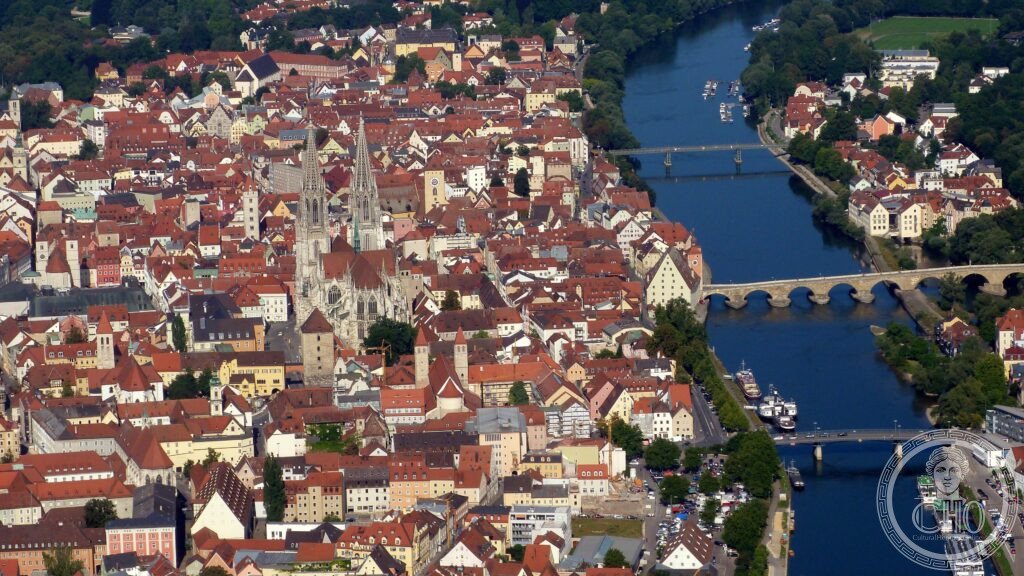
The most completely preserved medieval city in Germany and the only large German city to have survived the Second World War without significant aerial bombardment. Regensburg (Roman Castra Regina, founded 179 AD as the principal legionary fortress on the upper Danube) grew from the end of Roman power to become the most important city of the Carolingian Empire north of the Alps, the seat of the Reichstag of the Holy Roman Empire for 143 years (1663–1806), and one of the most prosperous trading cities on the medieval Danube, all within a historic core that remains today as the most intact medieval urban landscape of any German city of comparable historical importance.
At a glance
Regensburg (population approximately 160,000) is the capital of the Upper Palatinate administrative region of Bavaria and the fourth largest city in Bavaria after Munich, Nuremberg, and Augsburg. The Altstadt (old town) is built on the south bank of the Danube at the point where the river turns north before flowing on toward Passau and Vienna. It retains the rectangular street grid of the Roman legionary fortress overlaid with medieval streets and buildings of the 12th–16th centuries. UNESCO inscribed the Old Town of Regensburg with Stadtamhof (the historic suburb on the north bank of the Danube, connected by the Stone Bridge) in 2006, citing the extraordinary density and integrity of its medieval architecture and its role as the only seat of a permanent diet of the Holy Roman Empire.
Key facts
- Steinerne Brücke (Stone Bridge, 1135–1146): the oldest large stone bridge in Germany and north of the Alps, built between 1135 and 1146 on the orders of Duke Henry the Black of Bavaria across the Danube at Regensburg. 310 metres long and 8 metres wide, with 16 arches (originally 15 plus a drawbridge on the north tower), built in a single construction campaign that took only 11 years (an extraordinary achievement for a bridge of this scale and the reason it was considered by medieval contemporaries to have been built with the aid of the Devil — a legend preserved in the adjacent Devil’s painting in the Wurstküchl kitchen). The bridge was designed as a single unified structure (no rebuild or extension) and uses the same limestone blocks cut from the Kelheim quarries from start to finish. The Charles Bridge in Prague (1357–1402) was explicitly modelled on the Steinerne Brücke. The Wurstküchl (sausage kitchen) is directly beside the northern pier of the bridge.
- Historische Wurstküchl (the Historic Sausage Kitchen, c.1135): the oldest operational public restaurant in the world. A small stone building attached to the northern pier of the Stone Bridge, in continuous operation since approximately 1135 (when the builders of the bridge required a catering facility for the construction workers). The Wurstküchl serves a single menu: Regensburger bratwurst (short, pork-and-veal sausages, 6 or 8 per portion) grilled on a beechwood fire, served with sauerkraut and mustard. The restaurant is built directly into the stone of the bridge pier and has no kitchen facilities beyond the grilling stations. It has no indoor seating (the wooden benches on the Danube waterfront, directly below the Steinerne Brücke, are the most atmospheric outdoor eating position in Germany). It is permanently listed in the Guinness World Records as the world’s oldest restaurant. Advance arrival recommended as queues form.
- Cathedral of St Peter (Dom, begun 1273): the greatest Gothic cathedral in Bavaria and the seat of the Bishop of Regensburg. Begun in 1273 on the site of a Romanesque cathedral (of which the Eselsturm, “Donkey Tower”, the Romanesque tower, is still visible on the north-west corner of the nave, incorporated into the Gothic building) and built over the following 500 years in successive campaigns. The twin west towers (105 metres, completed 1869 — one of the last additions to a medieval German cathedral) are the dominant feature of the Regensburg skyline. The nave interior (38 metres high) is remarkable for its slender columns and the warm golden light coming through the extensive stained glass programme (the 14th-century windows in the choir ambulatory, preserved through the Second World War, are among the finest surviving 14th-century stained glass in Germany). The Domschatz (cathedral treasury) has the most important medieval episcopal metalwork collection in Bavaria.
- The Reichstag and the Thurn und Taxis: two institutions that defined Regensburg’s 17th–18th century significance. (1) the Immerwährender Reichstag (Permanent Diet of the Holy Roman Empire, 1663–1806): the only permanently sitting imperial diet in German history, held in the Regensburg Altes Rathaus from 1663 until the dissolution of the Holy Roman Empire in 1806. The Altes Rathaus (Old Town Hall) in Regensburg is now a museum of the Imperial Diet, with the Reichssaal (Imperial Hall) preserved in its 14th–17th century state. (2) the Fürst Thurn und Taxis Schloss (1748–1812): the palace of the Princes of Thurn und Taxis, the family that controlled the postal network of the Holy Roman Empire from the 16th century (the family name derives from the Italian tasso, badger — their coat of arms). The palace (built in the secularised complex of the former St Emmeram Abbey) is still inhabited by the current head of the Thurn und Taxis family and is the largest inhabited palace in Germany. Tours of the state rooms and the cloister are available. The family’s stables have been converted into a shopping centre and the annual Thurn und Taxis Palace Festival (an open-air classical music festival) is held in the palace courtyard.
- Porta Praetoria and Roman Regensburg: the most complete surviving Roman city gate in Germany. The Porta Praetoria (built approximately 179 AD as the northern gate of the Castra Regina legionary fortress) preserves one of its original towers to full height in a side street behind the Cathedral. The Roman street grid of the Castra Regina (the approximately 540 x 450 metre rectangular legionary fortress) is the underlying structural framework of the modern Altstadt, with the via praetoria (the main north-south axis of the fortress) corresponding closely to the modern Maximilianstraße. The legionary fortress of Regensburg was the principal Roman installation on the upper Danube and the headquarters of Legio III Italica from 179 AD until the collapse of Roman power in the region c.400 AD.
- Heritage: UNESCO World Heritage Site, Old Town of Regensburg with Stadtamhof, inscribed 2006.
- GPS: 49.0220° N, 12.1015° E.
History
The Danube crossing at Regensburg was one of the most strategically important points in the Roman defensive system. Emperor Marcus Aurelius established the legionary fortress of Castra Regina (“Fort of the Queen [River]”, the Danube) in 179 AD, and the city grew continuously from that point. When Roman power fragmented in the 5th century, the Agilolfing dynasty of Bavaria maintained Regensburg as their capital. The Carolingian emperors (Charlemagne and his successors) used Regensburg as their principal administrative base east of the Rhine (the Carolingian imperial palace was on the site of the later Thurn und Taxis palace). At its 11th–12th century peak, Regensburg (Ratisbona in Latin) was the largest and most prosperous city in the German lands, with a population of approximately 40,000 (larger than Cologne or Mainz) and a network of trade contacts reaching from Russia to Italy via the Danube and the Alpine passes.
The city’s commercial importance declined from the 13th century as the Italian trade routes shifted from the Brenner Pass (Regensburg’s traditional Alpine gateway) to the Simplon and St Gotthard passes (which gave greater advantage to the Rhine cities). Regensburg was surpassed in importance by Nuremberg, Augsburg, and eventually Munich. But this declining economic importance also meant the city was never subjected to the large-scale urban renewal programmes that destroyed medieval fabric in the rising cities. Its medieval buildings were simply maintained rather than replaced, giving Regensburg the extraordinary survival rate of historic structures that UNESCO recognised in 2006.
What you see
The Altstadt circuit from the Stone Bridge: Steinerne Brücke and Wurstküchl (the bridge and the sausage kitchen are best visited at opening time to avoid queues; the view from the bridge looking south to the Cathedral towers is the definitive Regensburg image). Porta Praetoria (in the side street behind the Cathedral; the Roman tower visible from the street, freely accessible). Cathedral of St Peter (exterior towers and the 14th-century stained glass choir ambulatory). Altes Rathaus and Reichssaal (the Imperial Diet hall, guided tour recommended to understand the procedure of the diet — the 18th-century diplomatic seating arrangement in the hall is preserved exactly as it was during the diet sessions). Goldene Turm (the Golden Tower, the finest of the approximately 20 surviving patrician tower-houses of medieval Regensburg — a residential tower 53 metres tall, built c.1260 by a Regensburg merchant patrician; there are several such towers in the Altstadt, erected to signal wealth and provide a defensible upper-storey refuge in times of civil conflict). Thurn und Taxis Palace (afternoon tour of the state rooms, approximately 1h; the baroque library and the basilica of St Emmeram Abbey within the palace complex are outstanding).
The Jewish Heritage Site: Regensburg had one of the oldest documented Jewish communities in Germany (first documented 981 AD). The medieval Jewish quarter (centred on the Neupfarrplatz, with the Alte Synagoge beneath the square — a 11th-12th century synagogue excavated and visible through a glass floor in the square) and the tombstones in the lapidarium at the Historisches Museum Regensburg tell the story of a community repeatedly expelled and returned until the final expulsion in 1519.
Practical information
- Admission: Stone Bridge free. Wurstküchl (food, approximately €12 for 6 sausages, outdoor seating). Cathedral free. Altes Rathaus and Reichssaal approximately €8 (guided tour, German/English). Porta Praetoria free external view. Thurn und Taxis Palace approximately €13.50 (state rooms guided tour, €18 with treasury). Historisches Museum Regensburg approximately €4. Jewish Quarter excavations at Neupfarrplatz free. The Altstadt is freely walkable at all times.
- Getting there: Regensburg Hauptbahnhof (central station) is 1 km south of the Stone Bridge (15 min walk to the Altstadt). Direct ICE/IC trains from Munich (1h 15 min, approximately €20–35 advance), Nuremberg (55 min, approximately €15–25), and Frankfurt (2h 45 min). Also direct EC trains from Vienna (4h) and Prague (4.5h via Nuremberg). By car from Munich (120 km north-east, 1h 15 min via A9 then A93). From Nuremberg (100 km south-east, 1h via A3). From Passau (120 km east, 1h 15 min via A3). The Walhalla (the Neo-Greek memorial temple to Germanic cultural heroes, built 1830–1842 by Leo von Klenze on a cliff above the Danube, 15 km east of Regensburg) is accessible by boat from the Stone Bridge landing stage (April–October) or by bus (year-round). The Bavarian motorway network makes Regensburg a convenient single-day excursion from Munich.
- Danube cycling and boating: Regensburg is the most important hub on the EuroVelo 6. The trans-European long-distance cycling route from Saint-Nazaire on the Atlantic to Constanța on the Black Sea, which follows the Rhine, the Main (via the Main-Danube Canal), and then the Danube all the way to the delta. The Danube cycling path (Donauradweg) from Passau to Vienna via Regensburg is the most popular long-distance cycling route in Europe, with approximately 100,000 cyclists per year. River cruises from Regensburg to Passau (downstream, 4h) or to Walhalla (2h return, April–October) depart from the Steinerne Brücke landing stage. The annual Regensburg International Jazz Weekend (June) and the Christmas market (December, one of the most atmospheric in Bavaria due to the medieval setting of the Neupfarrplatz and the Haidplatz) are the major annual events.
Getting there
Regensburg Hauptbahnhof: 15 min walk from Stone Bridge. ICE from Munich (1h 15min), Nuremberg (55min). By car from Munich (1h 15min, A9/A93). GPS: 49.0220, 12.1015.
Nearby
- Walhalla. 15 km east of Regensburg (boat April–October from the Stone Bridge landing stage, 1h each way; or bus 5 from the central bus station, 30 min). The most grandiose monument of German Romantic nationalism. A Neo-Doric marble temple modelled on the Athenian Parthenon, designed by Leo von Klenze and built 1830–1842 on the orders of Crown Prince Ludwig I of Bavaria on a cliff 100 metres above the Danube east of Regensburg. The interior contains 130 marble busts of “distinguished Germans and German-speaking individuals” from Arminius (the Germanic tribal leader who defeated the Roman general Varus at the Battle of Teutoburg Forest in 9 AD, the founding event of German national mythology) to recent additions including Sophie Scholl (2003), Albert Einstein (1990), and Heinrich Heine (2010). The terrace in front of the temple gives the best panoramic view of the Danube valley between Regensburg and Kelheim.
- Weltenburg Abbey. 25 km west of Regensburg (boat from Kelheim through the Danube Gorge, the most scenic stretch of the river in Bavaria, 45 min; or by car 40 min). The oldest monastery in Bavaria (founded approximately 617 AD by Irish monks), with the most important Baroque church interior in Bavaria. The Asam brothers (Cosmas Damian Asam and Egid Quirin Asam) built the church between 1716 and 1721 as a showcase of their unified Gesamtkunstwerk approach to Baroque interior design. The frescoed ceiling, the theatrical high-altar sculpture of St George and the Dragon (lit from a hidden skylight above), and the integrated architecture, painting, and gilded stucco work are the most brilliant example of the Bavarian Rococo style. The monastery operates its own brewery (Klosterbrauerei Weltenburg, established c.1050, disputed claim to be the world’s oldest monastic brewery; the Weltenburger Kloster Barock Dunkel is considered one of the finest dark lagers in the world).
- Nuremberg (Nürnberg). 100 km north-west of Regensburg (55 min by train). Bavaria’s second largest city and the most important medieval commercial city of southern Germany. The Kaiserburg (Imperial Castle, 1050–1571, the most imposing German imperial castle after the Wartburg; Frederick Barbarossa held his Diet here; the castle towers give a panoramic view of the old town). The Altstadt (though heavily bombed in 1945 and reconstructed, the reconstruction was more faithful than most German postwar rebuilds, and the result reads as a convincingly medieval townscape). The Germanisches Nationalmuseum (the largest museum of Germanic cultural history in the world, with collections from the Stone Age to the present). Albrecht Dürer’s house (the Dürer-Haus, the painter’s actual dwelling from 1509 to 1528, furnished in period style).
Sources
- Wikipedia, Regensburg. Steinerne Brücke. Regensburg Cathedral. Historische Wurstküchl, accessed June 2026.
- UNESCO, Old Town of Regensburg with Stadtamhof, WHS reference 1155, inscribed 2006.
- Peter Schmid, Regensburg: Stadt der Könige und Herzöge im Mittelalter, Pustet, 1977.
- Karl Möseneder and Adolf Hofstetter, Regensburg: Kunst und Geschichte, Schnell & Steiner, 2010.
Find it on the map
See this place and what’s around it →📷 Become a Cultural Heritage Online photographer
Share your photos of places: they stay published under your name as the author. The more they're seen, the more you get noticed — and soon a contest will reward the most appreciated photos.
Log in or sign up free to add a photo