
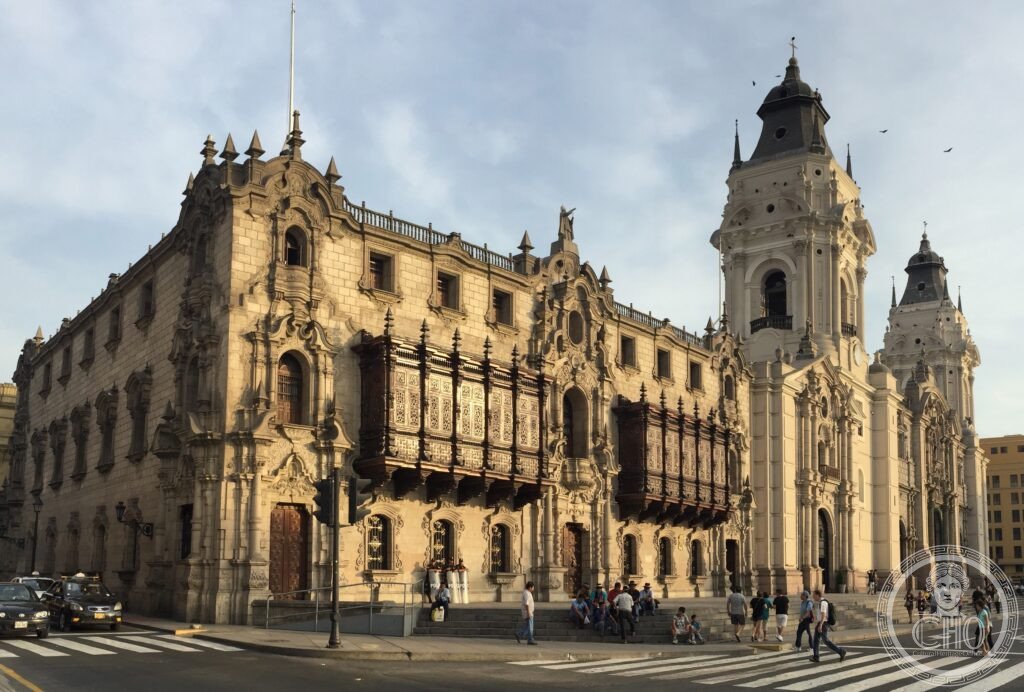
The capital of the most powerful colonial jurisdiction in the Americas. Lima (City of Kings, Ciudad de los Reyes, founded by Francisco Pizarro on 18 January 1535) was the seat of the Viceroyalty of Peru, which at its greatest extent administered all of Spanish South America, and the city where the silver of Potosí, the gold of Chile, and the trade goods of the Pacific were channelled through the most elaborate Baroque religious architecture in South America. The Monastery of San Francisco and its catacombs are the largest and most extraordinary colonial monastic complex in the Americas.
At a glance
Lima (population of the metropolitan area approximately 11 million, the largest city in the Andean region) is the capital of Peru, on the Pacific coast at the mouth of the Rímac River, a desert city that receives virtually no rainfall (average annual rainfall approximately 8 mm — Lima’s colonial buildings are built without waterproofing for this reason, which makes them uniquely vulnerable to the “garúa” coastal fog that instead blankets the city from May to November). The historic centre (approximately 5 km²) retains the original 1535 grid plan of Francisco Pizarro. UNESCO inscribed the Historic Centre of Lima in 1988 (and extended the inscription in 1991 to include additional monuments).
Key facts
- Convento de San Francisco and the catacombs: the largest and most complete colonial monastic complex in the Americas, and the most visited heritage site in Lima. Built between 1546 and 1774 by the Franciscan Order, the complex includes the church (with its Baroque-Mudéjar (Muslim-influenced) ceiling of the main nave — one of the finest examples of the Mudéjar coffered ceiling technique outside Spain and North Africa), the cloister (with Seville tile panels depicting the Life of Saint Francis), the library (with 25,000 books and manuscripts, including some of the earliest printed books brought to the Americas), and the catacombs. The underground burial complex where approximately 75,000 people (the population of Lima for its first 250 years of existence) were buried between 1546 and 1810. The catacombs (discovered during an earthquake in 1951 when the floor of the sacristy collapsed into them) contain the ossified remains arranged in geometric patterns (circles of femurs, piles of skulls) in the bone-sorting galleries. Guided tours (30 min, in Spanish and English) depart every 15 minutes from the entrance of the complex.
- The Plaza Mayor (Plaza de Armas): the central square and the spatial heart of the historic centre. The square was laid out by Francisco Pizarro on the day he founded the city (18 January 1535, the feast of the Kings — giving the city its original name “City of Kings”). The four buildings that surround the square (the Cathedral, the Government Palace, the Municipalidad, and the Archbishop’s Palace) are all colonial constructions (substantially rebuilt after the 1746 earthquake). The central fountain of the plaza (bronze, 1650) is the oldest civic fountain in the Americas still in its original position. The Cambio de la Guardia (changing of the Presidential Guard, 12 noon daily) in front of the Government Palace is the best free spectacle in downtown Lima.
- Monastery of Santo Domingo and the Shrine of Santa Rosa: the first Dominican convent established in Lima (1535, immediately after the city’s founding) and the burial place of three of Lima’s most important religious figures. Santa Rosa de Lima (1586–1617, the first person born in the Americas to be canonised, 1671), San Martín de Porres (1579–1639, the first black saint in the Americas, canonised 1962), and Juan Macías (1585–1645, Spanish Dominican lay brother, beatified 1975). The complex includes the Shrine of Santa Rosa in her childhood home (300 metres from Santo Domingo), where the well from which she reportedly drew water that miraculously became roses is preserved. Lima’s patron saint Rosa is the patron saint of all the Americas and the Philippines, and her feast day (30 August) is a national holiday throughout Latin America.
- Peruvian Baroque art. The Lima School: Lima was the cultural capital of Spanish South America and the centre of a distinctive Baroque art tradition (the “Lima School” or “Peruvian Baroque”) that synthesised Spanish Baroque with indigenous Andean (Inca and pre-Inca) artistic motifs, particularly in altarpiece carving, gilded retablos, and the distinctive Andean Baroque painting style that uses gold-leaf backgrounds and indigenous figures in Christian narrative scenes. The Cathedral treasury and the Museo Nacional de Arte (on the Plaza de la Exposición, 1 km south of the historic centre) have the finest collections. The Casa de Riva-Agüero (18th-century Baroque colonial mansion on the Jirón Camaná) houses an important folk art collection.
- Peruvian gastronomy capital: Lima is the gastronomic capital of Latin America and one of the world’s premier culinary destinations. The convergence of Pacific coastal cuisine (ceviche, the national dish — raw fish marinated in lime juice with ají amarillo, red onion, and coriander, served within minutes of preparation; Peru’s unique climate of cold Humboldt Current waters producing the richest fish and shellfish in the Americas), Andean highland cuisine (guinea pig, freeze-dried potato in chuño, corn varieties not found elsewhere), and the fusion tradition (Chinese immigrants — the “chifa” cuisine — and Japanese immigrants — the “Nikkei” cuisine) has produced a culinary scene of extraordinary diversity. Gastón Acurio (born Lima 1967) and his restaurant Astrid y Gastón (in the Miraflores district, consistently in the World’s 50 Best Restaurants list) have been the primary drivers of Peru’s transformation into a global culinary destination since the 1990s.
- Heritage: UNESCO World Heritage Site, Historic Centre of Lima, inscribed 1988 (extended 1991).
- GPS: 12.0464° S, 77.0428° W.
History
Francisco Pizarro founded the City of Kings (Ciudad de los Reyes, later called Lima, from the Rimac River name) on 18 January 1535, three years after his capture of the Inca emperor Atahualpa and the subsequent collapse of the Inca Empire. The Spanish chose a coastal site (unlike the Inca capital of Cusco in the highlands) because Lima’s position at the mouth of the Rímac River provided both a harbour and access to the interior. The Viceroyalty of Peru (established 1542) administered all of Spanish South America from Lima and made it the largest city in the Americas after Mexico City. The silver of Potosí (present-day Bolivia) passed through Lima (via a road from Potosí to Arica, then by sea to Callao port, then overland to Lima for the trade fair) before being shipped to Spain, making Lima’s merchant class fabulously wealthy and financing the construction of the most elaborate Baroque churches and palaces in South America.
The earthquake of 28 October 1746 (Mw 8.0 or above) destroyed approximately 90% of Lima’s buildings and killed approximately 4,000 people. The reconstruction (supervised by the viceroy José Antonio Manso de Velasco) rebuilt the city in a more uniform Baroque-Neoclassical style that is what the historic centre preserves today. The independence period (1820–24, when Lima was the last major Spanish colonial capital to fall to the independence forces) left the colonial fabric intact. The 20th-century expansion of Lima (population growth from 500,000 in 1940 to 11 million today, almost entirely in informal settlements on the desert coastal plain) surrounded but did not destroy the colonial centre.
What you see
The historic centre is most easily approached from the Plaza Mayor (the central square). From here the main circuit covers the Cathedral and cathedral museum (allow 45 min), the Government Palace exterior (changing of the guard at noon), the Municipalidad (entrance courtyard and salon are open to visitors), and the Archbishop’s Palace (its 16th-century carved wooden balconies are the finest woodwork in Lima). The Convento de San Francisco (3 blocks east of the Plaza Mayor on the Jirón Ancash) is the essential single visit. Allow 1.5 hours including the catacombs. The Monastery of Santo Domingo (2 blocks west of San Francisco) and the Shrine of Santa Rosa (a 5-minute walk from Santo Domingo) complete the religious heritage circuit.
The Barrio Chino (Chinatown). Immediately south-east of the historic centre, centred on the Calle Capón. Is the largest and most active Chinatown in South America (established by Chinese coolies who came to work the guano islands in the 1850s and stayed). The Sunday markets (particularly the herb markets) and the Chifa restaurants (Cantonese-Peruvian fusion cuisine) around the Portón de Chinatown are the best introduction.
Practical information
- Admission: Plaza Mayor and streets free. Cathedral approximately PEN 20 (about €5). Convento de San Francisco and catacombs approximately PEN 20. Santo Domingo approximately PEN 10. Shrine of Santa Rosa free. The Museo de Arte de Lima (MALI, in the Palacio de la Exposición, 1 km south) approximately PEN 30. Safety note: carry minimal valuables in the historic centre. The area is well-patrolled during the day but pick-pocketing is common in crowds.
- Getting there: Jorge Chávez International Airport (LIM). Major international hub. Direct flights from Madrid (11.5h, Iberia and Air Europa), Miami (6h), New York (8.5h), Los Angeles (9h), São Paulo (5h), Bogotá (2h), Santiago (3.5h), and dozens of other cities. The airport is 16 km north of the historic centre and 11 km north of the Miraflores tourist district. Taxi from airport to historic centre approximately $20 (40–60 min). To Miraflores approximately $18 (30–45 min). The green Metropolitano bus (BRT system) connects the airport area to the city.
- Miraflores and Barranco: the tourist accommodation hub is Miraflores (8 km south of the historic centre, on the Pacific coastal cliffs), with the best restaurants, hotels, and the Larcomar shopping centre on the clifftop. The adjacent Barranco district (2 km south of Miraflores) is Lima’s bohemian neighbourhood, with the best bars and the highest concentration of contemporary art galleries. The combination of Barranco evening + historic centre daytime + Miraflores hotel base is the standard tourist structure for a 2–3 day Lima visit.
Getting there
Lima Airport (LIM): 16 km from historic centre. Major hub with direct flights from Madrid (11.5h), Miami (6h), NYC (8.5h). GPS: -12.0464, -77.0428.
Nearby
- Pachacamac. 30 km south of Lima (1h by bus). The largest pre-Inca and Inca ceremonial complex on the Peruvian coast. A pilgrimage centre dedicated to Pachacamac (the creator deity of the Ychsma culture, later adopted and expanded by the Inca) active from approximately 200 AD to the Spanish conquest. The site (open daily, excellent on-site museum opened 2016) contains the Pyramid of the Sun (Inca, 1470s), the Painted Temple (Ychsma culture, 8th–10th century, with surviving red-and-yellow geometric paintings), and the Acllawasi (Inca women’s house). The oracle of Pachacamac was consulted by the Inca emperor Atahualpa before the arrival of Pizarro.
- Cusco and Machu Picchu. 1,100 km south-east of Lima by air (1.25h from Lima Airport to Alejandro Velasco Astete Airport, Cusco). The former Inca capital and the most visited heritage site in South America. The Inca city of Cusco (UNESCO WHS 1983, jointly with the Valle Sagrado and Machu Picchu) is built on the ruins of the Inca capital Qusqu, with the Spanish colonial buildings constructed directly on Inca walls (the Templo del Sol — Inca Coricancha temple — with the Church of Santo Domingo built on its foundations is the most dramatic example). Machu Picchu (90 min by train from Cusco, 1.5h by bus from Aguas Calientes) is the most iconic heritage site in the Americas.
- Nazca Lines. 450 km south of Lima (7h by bus or 1h by domestic plane). The Nazca Lines (UNESCO WHS 1994). 300 geoglyphs (figures of animals, plants, and geometric shapes, the largest up to 370 metres long) scratched into the desert surface by the Nazca culture (100 BC–800 AD). Are visible only from the air. Small-plane overflights (30 min, from Nazca airport, approximately $100) are the standard visit format. The figures (the hummingbird, the condor, the spider, the whale, the monkey) are the most mysterious and debated pre-Columbian heritage site in Peru.
Sources
- Wikipedia, Lima. Convento de San Francisco, Lima. Basilica Cathedral of Lima, accessed June 2026.
- UNESCO, Historic Centre of Lima, WHS reference 500, inscribed 1988, extended 1991.
- Patricia Majluf, Lima: Patrimonio, Identidad y Futuro, Municipalidad Metropolitana de Lima, 2016.
- Rubén Vargas Ugarte SJ, Historia del Culto de María en Iberoamérica, 3rd ed., Guadalupe, 1956.
Find it on the map
See this place and what’s around it →📷 Become a Cultural Heritage Online photographer
Share your photos of places: they stay published under your name as the author. The more they're seen, the more you get noticed — and soon a contest will reward the most appreciated photos.
Log in or sign up free to add a photo