

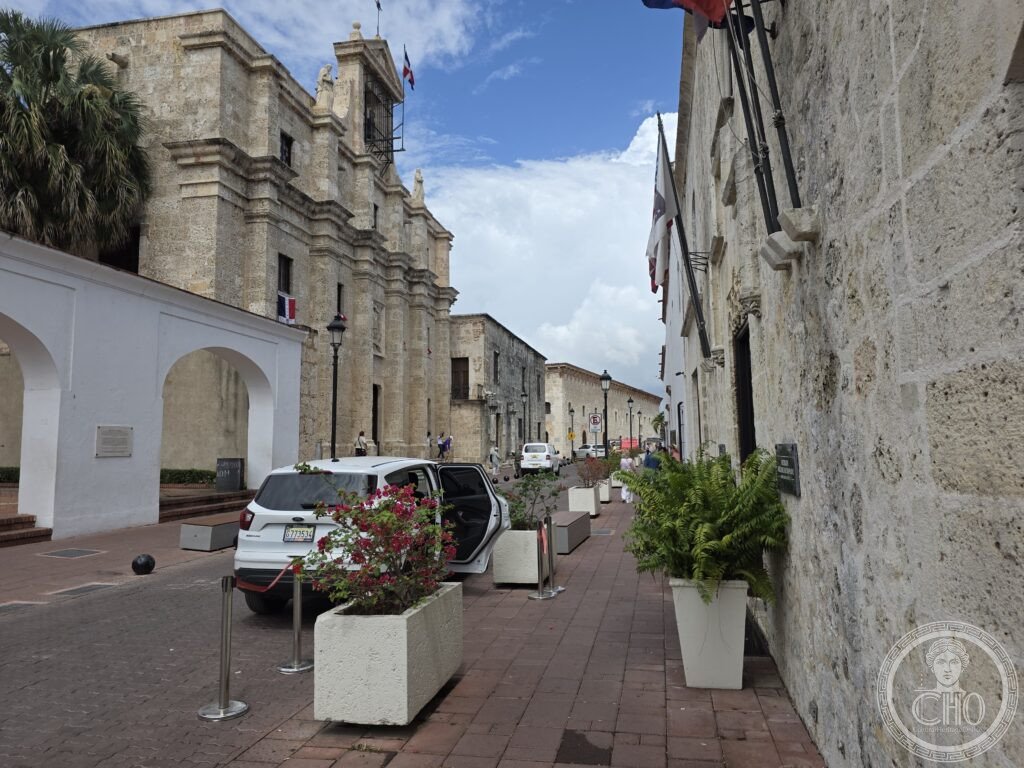
The original European city. Founded in 1498 by Bartholomew Columbus (Christopher’s brother) on the west bank of the Ozama River in the island of Hispaniola, the Zona Colonial of Santo Domingo was the first planned European city in the Americas and the site where every institution of the New World was created first: the first European university, the first cathedral, the first hospital, the first paved street, the first European fortress, and the first formal urban grid in the Americas.
At a glance
Santo Domingo (population of the metropolitan area approximately 3.5 million) is the capital of the Dominican Republic and the oldest permanently occupied European city in the Americas. The Zona Colonial (Colonial Zone, approximately 1.06 km²) on the west bank of the Ozama River is the historic core of the city, laid out in 1502 by the governor Nicolás de Ovando on a regular grid plan. The urban template that was subsequently used for all Spanish colonial cities in the Americas, from Havana to Buenos Aires. UNESCO inscribed the Colonial City of Santo Domingo in 1990.
Key facts
- Catedral Primada de América (Cathedral of Santa María la Menor): the first cathedral built in the Americas. Construction began in 1514 and was completed in 1541. The cathedral is in a simplified Late Gothic style with Plateresque decorative elements on the main portal (the Plateresque — “silversmith” style — was the Spanish equivalent of Italian Early Renaissance decoration, applied to Gothic structural forms). The tomb of Christopher Columbus was located here from 1537 to 1898 (when Spain transferred it to Seville). A competing claim for the remains was resolved ambiguously when both the Sevilla Cathedral (Spain) and the Columbus Lighthouse (Faro a Colón, Dominican Republic, 1992) claim to hold the genuine remains. The current scholarly consensus (based on DNA analysis conducted in 2006) holds that Seville has the primary remains. The Primada is still an active cathedral and services are held daily.
- Fortaleza Ozama: the oldest surviving European fortress in the Americas. Construction began in 1502 under orders from the Spanish Crown to defend the mouth of the Ozama River. The Torre del Homenaje (Tower of Homage, 1507) is the oldest military building in the Americas still standing. The fortress’s design (a round tower with crenellated battlements and a separate curtain wall) preceded the systematic military architecture of the 16th century and shows the transition from medieval castle design to Renaissance fortification principles. The fortress was used as a political prison from the colonial period through the Trujillo dictatorship (1930–61). The grounds (now a public park) give the best view over the Ozama River mouth and the Caribbean.
- Alcázar de Colón (Columbus’s Palace): the palace built by Diego Columbus (Christopher’s son and the first hereditary Governor-General of the Americas) between 1510 and 1514. Diego Columbus lived here with his wife, the Spanish noblewoman María de Toledo (niece of the Duke of Alba), until the Spanish Crown recalled him to Spain in 1523. The palace (now the Columbus Museum) is a two-storey ashlar limestone building with an elegant open gallery of pointed arches on the upper floor, its architectural vocabulary entirely Spanish Gothic. It is the oldest gubernatorial residence in the Americas. Excavations beneath the palace have revealed the earlier Ovando house (1502) which preceded it.
- Hernán Cortés connection: the Casa de las Gárgolas / Casa de Francia (on Calle las Damas, 1503) was the house where Hernán Cortés lived from approximately 1509 until he departed for Cuba (and ultimately for the conquest of Mexico) in 1511. Cortés came to Santo Domingo at age 19 (having failed to board the fleet of Nicolás de Ovando in 1502 due to a broken leg sustained while climbing a wall to visit a woman), worked for several years as a notary and minor official, and departed for the conquest of Cuba with Diego Velázquez in 1511. From Cuba he launched the conquest of Mexico in 1519. The Santo Domingo years were the period where Cortés developed the administrative and military skills he would use in Mexico.
- Universidad Autónoma de Santo Domingo (UASD): the oldest university in the Americas, founded 1538 by Pope Paul III (as the Universidad de Santiago de la Paz, later reorganised multiple times). The institution is still in operation today (as the Universidad Autónoma de Santo Domingo, the largest university in the Dominican Republic, with approximately 180,000 students). The original university building was in the Zona Colonial. The UASD now has multiple campuses across the country.
- Heritage: UNESCO World Heritage Site, Colonial City of Santo Domingo, inscribed 1990.
- GPS: 18.4742° N, 69.8855° W.
History
Bartholomew Columbus founded the original settlement of La Nueva Isabela on the east bank of the Ozama River in 1498 (Christopher Columbus had established the first attempt at La Isabela on the north coast of Hispaniola in 1494, but it was abandoned). A hurricane destroyed La Nueva Isabela in 1502 and the governor Nicolás de Ovando moved the settlement to the west bank and laid out the new city on a rectangular grid. The first planned European city in the Americas. Giving it the name Santo Domingo. The city served as the base for the Spanish conquest of the Caribbean and mainland Americas for the next three decades (Cuba was conquered from here, Puerto Rico settled from here, Jamaica occupied from here, the conquest of Florida launched from here, and Hernán Cortés departed from here for the conquest of Mexico). All the institutions of the Spanish New World. The first Royal Audiencia (colonial court of appeals, 1511), the first cathedral, the first university, the first hospital (Hospital Nicolás de Ovando, 1502). Were created in Santo Domingo first.
The city’s importance declined after the conquest of Mexico and Peru (whose mineral wealth shifted the centre of gravity of the Spanish Empire westward). A series of disasters. Francis Drake’s sack (1586), the partition of Hispaniola (the western third becoming French Saint-Domingue / Haiti in 1697), and the Haitian Revolution (1791–1804). Reduced the colony to poverty. The Trujillo dictatorship (1930–61, the longest-lasting dictator in Latin American history) was responsible for the most dramatic modernisation of the city (Avenida George Washington and the modern seafront promenade, the Malecón, date from this period) and the most violent repression. The Zona Colonial was rehabilitated as a tourism and heritage district from the 1990s.
What you see
The Zona Colonial is compact and walkable (the entire heritage area is approximately 10 blocks by 10 blocks). The central axis is Calle las Damas (Street of the Ladies, the first paved street in the Americas), which runs north-south between the Fortaleza Ozama and the Cathedral, with the Alcázar de Colón on the Plaza de España (the largest open square in the colonial zone, overlooking the Ozama River) immediately adjacent. The Parque Colón (Columbus Park, with its bronze statue of Christopher Columbus) in front of the Cathedral is the social heart of the Zona. The Fortaleza Ozama (park and Torre del Homenaje, daily, approximately $1 entry) is at the south end. The Convento de los Dominicos (1510 — the oldest surviving conventual church in the Americas; where Pope Paul III’s bull establishing the first American university was read) is three blocks west of the Alcázar.
The Zona Colonial has developed a lively restaurant and bar scene centred on Calle El Conde (the main pedestrian shopping street) and the streets around the Parque Colón. The evening atmosphere (tables outside, music, the lit-up Cathedral towers) is one of the most pleasant in the Caribbean. The Museo de las Casas Reales (in the former colonial Royal Court building on Calle las Damas, the best museum of the colonial period in the Dominican Republic) is worth half a day.
Practical information
- Admission: Zona Colonial streets free. Catedral Primada de América free (during Mass). Alcázar de Colón approximately RD$100 (about €1.60). Fortaleza Ozama approximately RD$100. Museo de las Casas Reales approximately RD$100. Faro a Colón (Columbus Lighthouse, outside the Zona Colonial, approximately 5 km to the east) approximately RD$100. All museums are approximately RD$50–150 range. Free on Sundays for Dominican nationals.
- Getting there: Las Américas International Airport (SDQ). The primary international airport, 30 km east of the Zona Colonial (taxi approximately RD$1,500/€24, 40–60 min depending on traffic). Direct flights from New York (JFK, American and JetBlue, 3.5h), Miami (2h), San Juan PR (1h), Madrid (8.5h), London (10h with stop), and many Caribbean and North American cities. La Isabela International Airport (JBQ). A smaller airport 12 km north of the city, used by some domestic and charter flights. The MetroSD mass transit (2 lines, under construction) does not currently serve the airport.
- The Dominican Republic tourist circuit: the Zona Colonial is typically combined with the resort beaches of Punta Cana (200 km east, 3h by bus or 45 min by domestic flight). Which receive the large majority of international tourists. Travellers willing to spend more time in the country will find the Samaná Peninsula (whale watching January–March, humpback whale breeding ground), the Cibao Valley tobacco and rum culture (the Brugal and Barceló rum distilleries are open for visits), and the Jarabacoa mountain resort area (2h north of Santo Domingo, hiking in the Cordillera Central) to be among the least touristy heritage and nature experiences in the Caribbean.
Getting there
Las Américas Airport (SDQ): 30 km from Zona Colonial. Flights from New York (3.5h), Miami (2h), Madrid (8.5h). GPS: 18.4742, -69.8855.
Nearby
- Punta Cana and the Coconut Coast. 200 km east (3h by bus or 45 min by domestic plane). The Dominican Republic’s primary international beach resort destination, with approximately 60 km of coral-sand beaches, an average of 300 sunny days per year, and a large concentration of all-inclusive resorts. The Punta Cana region (Bávaro beach, Cabeza de Toro, Cap Cana) has been the fastest-growing Caribbean tourism destination over the past two decades. Punta Cana International Airport (PUJ) receives more international flights than any other airport in the Caribbean.
- Santiago de los Caballeros. 165 km north-west of Santo Domingo (2.5h by bus). The second city of the Dominican Republic and the capital of the Cibao Valley. The Dominican cigars (the country is the world’s largest exporter of premium cigars, primarily from the Cibao Valley) can be seen being made at the Fuente, Davidoff, and León Jimenes factories (several offer tours). The Carnaval de Santiago (February, one of the most elaborate carnival traditions in the Caribbean) features the distinctive lechón character (devil figure in a spiked mask) in processions through the colonial centre.
- Haiti and the Citadelle Laferrière. The western border of the Dominican Republic. The Citadelle Laferrière (Haiti, UNESCO WHS 1982). The mountain fortress built by the Haitian King Henri Christophe between 1805 and 1820 on a 900-metre peak north of Cap-Haïtien. Is one of the most dramatic architectural achievements in the Americas (a star-shaped fortress for 10,000 soldiers, constructed by the formerly enslaved people of Haiti in the immediate aftermath of the revolution). Access from Santo Domingo requires a border crossing and several hours of travel. The political situation in Haiti has made tourism visits difficult since 2020.
Sources
- Wikipedia, Colonial City of Santo Domingo. Zona Colonial. Fortaleza Ozama, accessed June 2026.
- UNESCO, Colonial City of Santo Domingo, WHS reference 526, inscribed 1990.
- Erwin Walter Palm, Los monumentos arquitectónicos de la Española, Universidad de Santo Domingo, 1955.
- Frank Moya Pons, The Dominican Republic: A National History, Markus Wiener Publishers, 1998.
Find it on the map
See this place and what’s around it →📷 Become a Cultural Heritage Online photographer
Share your photos of places: they stay published under your name as the author. The more they're seen, the more you get noticed — and soon a contest will reward the most appreciated photos.
Log in or sign up free to add a photo