
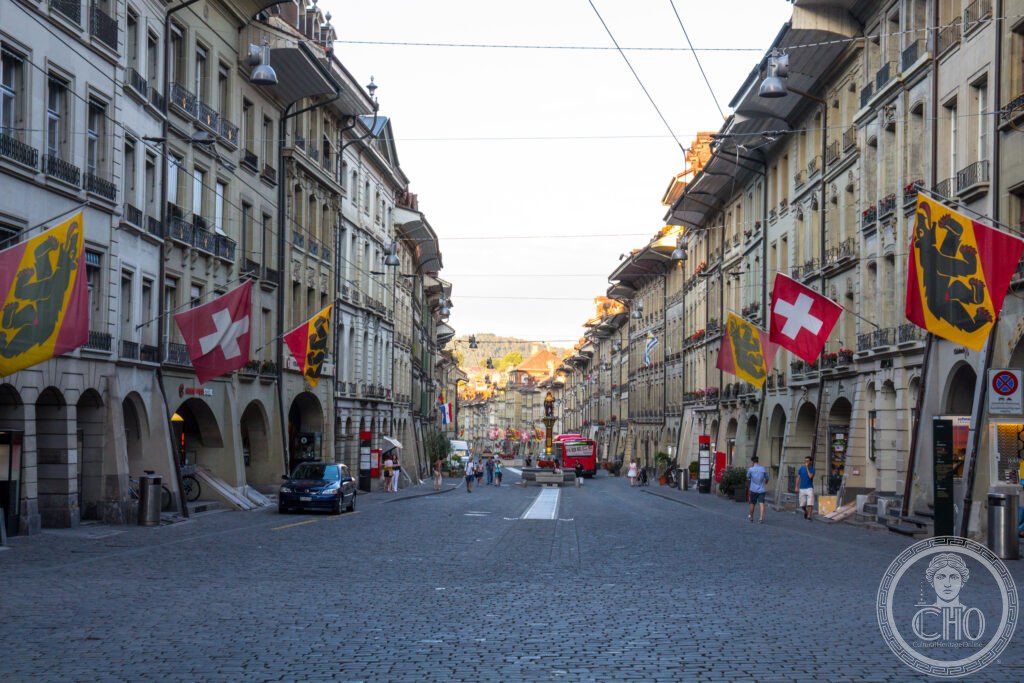
The medieval city with the longest covered arcade system in the world. Bern was founded by the Duke of Zähringen in 1191 on a dramatic loop of the Aare River, planned from the outset with a unified street plan of arcaded houses (the “Lauben”) that provide 6 km of covered pedestrian walkways through the old city, protecting residents and shoppers from Alpine rain and snow since the 13th century and creating the most extraordinary continuous medieval streetscape in Northern Europe. The city has been the Swiss federal capital since 1848 and remains fundamentally unchanged from its medieval layout.
At a glance
Bern (population approximately 135,000; de facto capital of the Swiss Confederation; altitude 542 m) is in the Canton of Bern, western Switzerland, at the southern edge of the Swiss Plateau (Mittelland), on a promontory almost completely enclosed by a loop of the Aare River. Founded in 1191 by Berchtold V, Duke of Zähringen, as a military outpost and trading town, Bern grew to become the most powerful city-state in Switzerland and, since the founding of the modern Swiss Confederation in 1848, the de jure “federal city” (Bundesstadt). Switzerland has no single official capital, but all federal institutions are based in Bern. UNESCO inscribed the Old City of Bern in 1983.
Key facts
- The arcades (Lauben): the architectural signature of Bern and the feature that earned its UNESCO inscription. From the moment of the city’s foundation in 1191, the duke mandated that all buildings on the main streets be built with ground-floor arcades on the street side. The result is approximately 6 km of continuous covered walkways lining the main streets of the old city (Gerechtigkeitsgasse, Kramgasse, Marktgasse, Spitalgasse). The longest surviving medieval arcade in Europe. The arcades are formed by the first floor of each house projecting out over the pavement on stone pillars, creating a covered walkway approximately 3 metres wide and 2.5 metres tall. Each section of arcade is individually owned by the building above it but mandatorily public by city law. The combination of the arcade depth and the consistent sandstone colour (all buildings are in the local Bernese sandstone) gives the old city an unusually unified monumental character for a medieval town.
- The Zytglogge (Time Bell Tower / Berne Clock Tower): the symbolic centre of the old city and the most famous clock mechanism in Switzerland. The tower originally formed the western gate of the first city wall (1191). It was rebuilt in the 14th century and the astronomical clock mechanism was added in 1530 by the clockmaker Caspar Brunner. The clock mechanism (visible from the street) displays on separate dials the time, the day of the week, the month, the Zodiac position of the sun, and the phase of the moon. At 4 minutes before each hour, mechanical figures animate. A procession of bears, a rooster crowing, a jester ringing bells, the figure of Father Time turning his hourglass. In a clockwork show that has attracted visitors since 1530. Guided tours of the clock mechanism interior depart from the tower (in German, French, and English).
- Albert Einstein in Bern (1902–1905): the years during which Einstein produced his most important scientific work. Einstein arrived in Bern in 1902 to take a patent examiner position at the Swiss Federal Institute of Intellectual Property (the patent office, still operating in Bern). He lived in an apartment at Kramgasse 49 (3 minutes walk from the Zytglogge, the building now the Einstein Museum). In 1905 (the “Annus Mirabilis”). While working full-time at the patent office. Einstein published four papers that transformed physics: the photoelectric effect (for which he was awarded the Nobel Prize in Physics 1921), Brownian motion, special relativity, and mass-energy equivalence (E = mc²). The Einstein Museum at the Bern Historical Museum (in the Helvetiaplatz, south-east of the old city) has the most complete permanent exhibition on Einstein’s life and work.
- The Bundeshaus (Federal Palace): the seat of the Swiss federal government and the symbol of Swiss democracy. Built between 1852 and 1902 on the south-western edge of the old city, the Federal Palace houses the two chambers of the Swiss Parliament (Nationalrat and Ständerat) and the offices of the Federal Council (the seven-member executive council that collectively acts as the head of government). The building (in Italian High Renaissance style with Swiss nationalist sculptural programme) is open to the public for guided tours when Parliament is not in session (frequent — Swiss Parliament typically meets in four three-week sessions per year). The terrace behind the Bundeshaus gives the best view of the Aare River bend and the Bernese Alps (including the Eiger, Mönch, and Jungfrau) on clear days.
- The Bern Bear Park (Bärenpark): the bears of Bern. The city of Bern has maintained live bears as its heraldic symbol since at least 1441 (the legend of the city’s founding has the Duke of Zähringen naming the city after the first animal he hunted in the forest — a bear). The original bear pit (Bärengraben, 1857, a circular sunken enclosure) was replaced in 2009 by the Bärenpark (Bear Park). A 6,000 m² riverside enclosure on the Aare bank immediately below the Nydegg Bridge, with a naturally landscaped habitat, pools, and climbing trees. Currently home to a family of brown bears. The park is free and open daily. The bears can be seen at close range from the riverside path.
- Heritage: UNESCO World Heritage Site, Old City of Berne, inscribed 1983.
- GPS: 46.9481° N, 7.4446° E.
History
Berchtold V, Duke of Zähringen, founded Bern in 1191 as the fourth and most easterly of his new towns on the Swiss Plateau (the others were Fribourg, Murten, and Thun). The site on the Aare promontory was chosen for its defensibility (the river on three sides forms a natural moat) and its position on the route between the Burgundian lowlands and the Alpine passes. The city was laid out on a regular grid of parallel streets (the Gassen) running east-west, each with the arcade-fronted houses that the duke mandated. The city expanded westward in three successive phases (each adding a new city gate — the Zytglogge was originally the western gate of the first phase) until the final expansion of 1345.
Bern grew into the most powerful city-state in Switzerland, acquiring the surrounding rural cantons (the Bernese Oberland) and becoming one of the principal powers of the Swiss Confederation (founded 1291). The Bernese Republic was the largest republic in Europe at the time of the French Revolution. The French occupied Bern in 1798 and looted the state treasury (1.2 million Swiss francs in gold, some of which funded Bonaparte’s Egypt campaign). The post-Napoleonic restoration (1814) and the founding of the Swiss Confederation in 1848 established Bern as the de facto federal capital, while preserving its medieval character by building the federal institutions outside the historic city (the Bundeshaus on the hill above the Aare, the ETH precursor institutions to the south).
What you see
The old city is entirely walkable (approximately 1 km east-west, less than 500 m north-south on the promontory). The main street (Marktgasse → Kramgasse → Gerechtigkeitsgasse) runs the full east-west length of the old city under continuous arcades from the Käfigturm (Prison Tower) to the Nydegg Bridge. Along this axis: the Käfigturm (13th-century tower gate, 2nd city wall, free climb) → the Zytglogge (4 min before each hour for the automata, guided tours hourly) → Kramgasse 49 (the Einstein apartment, ground floor museum) → the Marktgasse fountain sequence (six monumental fountains of the 16th century — the most elaborate set of Mannerist stone fountains in any medieval city, each with a painted heraldic figure: the Samson Fountain, the Justice Fountain, the Pfeifer Fountain) → the Nydegg Bridge overlook of the Bear Park and the Aare. The Bern Münster (Cathedral of Saint Vincent, begun 1421, completed 1893 when the 100-metre spire was finally finished — the tallest church tower in Switzerland) is one block south of the main street axis, with a vertiginous staircase climb to the top for the best panorama of the old city and the Alps.
Practical information
- Admission: all streets and arcades free. Zytglogge guided tour approximately CHF 20 (about €21). Bern Münster tower climb approximately CHF 5 (about €5.30). Einstein Museum approximately CHF 16. Bern Historical Museum approximately CHF 13. Bear Park free. Bundeshaus tour free (ID required). The Bern Card (24h/48h/72h; approximately CHF 28/38/48) covers all public transport within the city and most museum entrances.
- Getting there: Bern-Belp Airport (BRN). A small regional airport with limited connections (currently direct flights from Munich, Palma, Nice, and some seasonal destinations). Most visitors use Zurich Airport (ZRH, 1.5h by direct InterCity train, CHF 52 one-way) or Geneva Airport (GVA, 1h 45 min by direct IC train, CHF 50 one-way). Bern Hauptbahnhof (the main train station) is at the western edge of the old city and connects directly to the covered arcade system. From the station, the Zytglogge is 10 minutes walk through the arcades. The SBB Swiss Railways direct IC trains from Zurich (1h), Geneva (1.75h), Basel (55 min), and Lausanne (1h) make Bern easily accessible as a day trip or short stay from any Swiss city.
- Best time to visit: Bern is pleasant year-round. The summer (June–August) has the most sunshine and the Bundeshaus square is most lively. Winter (December–February) brings snow to the old city and the view of the Bernese Alps from the Bundeshaus terrace is at its most dramatic. The Bernese Carnival (Fasnacht, the Tuesday before Ash Wednesday) is smaller than Basel’s famous Carnival but more traditional in character. The Zibelemärit (Onion Market, fourth Monday of November) is the most beloved local festival. The old city fills with farmers selling plaited onion braids and costumed figures throwing confetti since time immemorial.
Getting there
Train from Zurich (1h), Geneva (1h 45min). Bern Hauptbahnhof is at the edge of the old city. No significant direct international flights. Use Zurich or Geneva airports. GPS: 46.9481, 7.4446.
Nearby
- Interlaken and the Bernese Oberland. 55 km south of Bern (1.5h by train). The gateway to the most spectacular Alpine scenery in Switzerland. The Eiger (3,967 m), Mönch (4,107 m), and Jungfrau (4,158 m) massif, the Jungfraujoch railway (3,454 m — the highest railway station in Europe, the “Top of Europe”, UNESCO WHS 2001), the Schilthorn (2,970 m, accessible by cable car from Mürren, the James Bond On Her Majesty’s Secret Service location), and the valley resort of Grindelwald. The Bernese Oberland circuit (Interlaken → Grindelwald → Lauterbrunnen → Wengen → Mürren or Gimmelwald) is one of the classic Alpine travel itineraries.
- Fribourg. 35 km south-west of Bern (25 min by train). The cultural frontier between German-speaking and French-speaking Switzerland. A medieval city built on a dramatic canyon of the Saane River (100 m deep cliffs visible from the old city bridges), with a perfectly preserved medieval centre of Gothic churches, fountains, and the spectacular Cathedral of Saint Nicholas (13th–15th century, with its tympanum of the Last Judgment — the finest Gothic sculptural programme in Switzerland). The Tinguely Fountain (1983, a steel sculpture by Jean Tinguely with mechanical water-spouting animals) in front of the Canton Theatre is a landmark of Swiss kinetic art.
- Thun and Lake Thun. 30 km south of Bern (25 min by train). The medieval town of Thun at the northern end of Lake Thun, with Thun Castle (1182, one of the oldest surviving Zähringen castles, with panoramic tower view over the lake to the Alps), the lakeside Niesen pyramid (2,362 m, accessible by funicular railway), and the lake steamer circuit connecting to Interlaken (2h by boat, one of the most scenic lake journeys in Europe) combine for a perfect half-day or full-day Bern day trip.
Sources
- Wikipedia, Bern. Zytglogge. Kramgasse, accessed June 2026.
- UNESCO, Old City of Berne, WHS reference 267, inscribed 1983.
- Rainer Christoph Schwinges (ed.), Berns mutige Zeit: Das 13. und 14. Jahrhundert neu entdeckt, Stämpfli Verlag, 2003.
- Roger Highfield and Paul Carter, The Private Lives of Albert Einstein, Faber and Faber, 1993.
Find it on the map
See this place and what’s around it →📷 Become a Cultural Heritage Online photographer
Share your photos of places: they stay published under your name as the author. The more they're seen, the more you get noticed — and soon a contest will reward the most appreciated photos.
Log in or sign up free to add a photo