
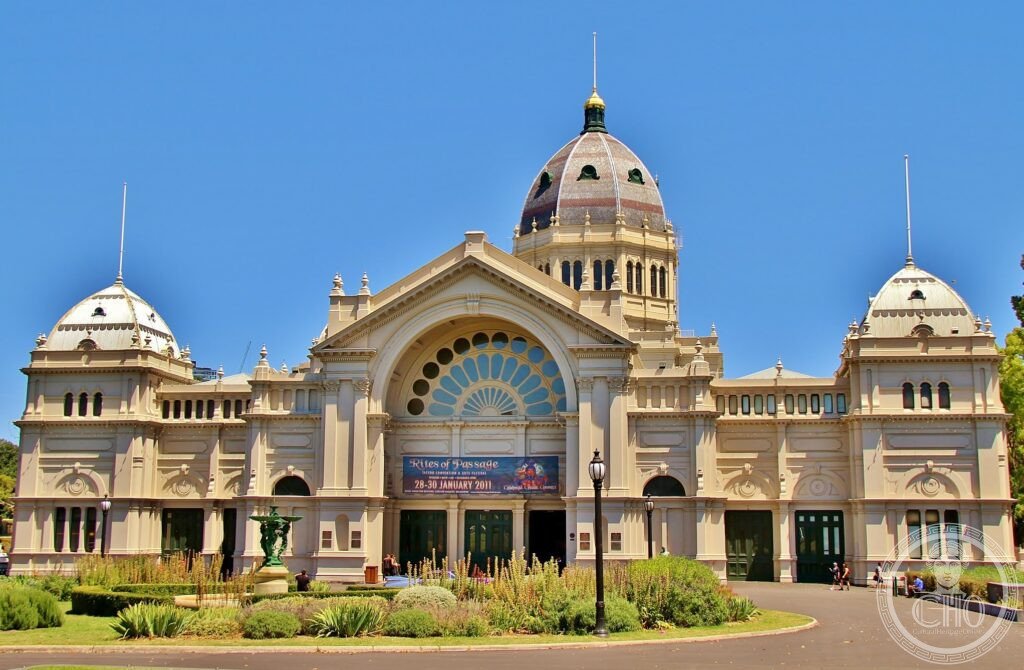
Joseph Reed’s 1880 dome-crowned exhibition palace in Carlton Gardens was the venue for the first sitting of the Australian Parliament in 1901 — and became, in 2004, the first Australian building inscribed as a UNESCO World Heritage Site.
At a glance
The Royal Exhibition Building rises above the plane trees of Carlton Gardens in central Melbourne, its central dome — modelled on Brunelleschi’s Florence Cathedral — visible from across the city. Designed by the Melbourne architect Joseph Reed and completed in 1880 for the Melbourne International Exhibition, the building subsequently hosted the Great Exhibition of 1888 and, on 9 May 1901, the inauguration of the Commonwealth of Australia and the first sitting of the Australian Parliament. Reed’s design synthesised Lombardic Romanesque, Byzantine, and Italian Renaissance elements in a vocabulary of red brick and cream terracotta that had no precise European precedent. Together with the Carlton Gardens that surround it, the Royal Exhibition Building was inscribed as a UNESCO World Heritage Site in 2004 — the first building on the Australian continent to receive that designation.
Key facts
- Architect: Joseph Reed (1823–1890); English-born Melbourne architect; also designed Melbourne Town Hall and State Library of Victoria
- Built: 1879–1880; the dome and north–south wings completed for the Melbourne International Exhibition, 1 October 1880
- Style: Lombardic Romanesque with Byzantine and Italian Renaissance elements; red brick with cream terracotta ornament
- Dome: 60 metres high; modelled on Brunelleschi’s Santa Maria del Fiore, Florence
- Historical significance: venue of the first Australian Parliament, 9 May 1901, presided over by the Duke of Cornwall and York (future George V)
- Heritage: UNESCO World Heritage Site (2004, inscribed together with Carlton Gardens); Victorian Heritage Register
- GPS: 37.8039° S, 144.9714° E
History
Melbourne in 1880 was one of the fastest-growing cities in the world, its wealth built on the Victorian gold rushes of the 1850s and the land boom of the 1870s and 1880s. The colonial government wished to demonstrate Melbourne’s arrival as a world city through an international exhibition on the model of London’s Great Exhibition of 1851. A site in Carlton Gardens was chosen; Reed was commissioned in 1879; and the central hall and dome were built in eleven months for the opening on 1 October 1880. Over 1.3 million visitors attended the five-month Melbourne International Exhibition.
Reed chose a composite historical style that consciously avoided the iron-and-glass prefabrication of Paxton’s Crystal Palace, favouring instead permanent masonry that would outlast the exhibition. The dome — 60 metres high, modelled directly on Brunelleschi’s Florentine lantern — asserted Melbourne’s ambitions in the most direct architectural reference available: the first dome of the Renaissance, transplanted to the southern hemisphere. The decision proved prophetic: the building survived while similar exhibition structures elsewhere were demolished. A second Great Exhibition in 1888 attracted 2 million visitors. In 1901, the building served as the venue for Federation — the inauguration of the Commonwealth of Australia — the most significant constitutional event in the country’s history.
The Royal Exhibition Building continued to serve as a general-purpose civic venue through the 20th century: it housed the first Australian Parliament until Parliament moved to Canberra, then the Victorian Parliament while Parliament House was under construction, then exhibitions, trade shows, and university examinations. The UNESCO inscription in 2004 — the first in Australia — recognised both the architectural integrity of the building and the Carlton Gardens as an ensemble, and triggered a comprehensive restoration.
What you see
The main north facade on Rathdowne Street presents a three-arched entrance loggia in red brick and cream terracotta, the arches Lombardic in profile, the spandrels filled with mosaic rosettes. Above the facade the central tower — an octagonal lantern-drum on a square base — rises to the drum of the dome, which is tiled in contrasting light and dark terracotta squares in a chevron pattern before stepping to the round drum and Brunelleschian lantern. The flanking wings, added for the 1888 exhibition, mirror the central block’s Lombardic vocabulary. The whole sits in Carlton Gardens, a Victorian-era ornamental garden with broad formal avenues and the ornamental fountain — itself an original feature — at the south entrance.
The interior Great Hall runs 100 metres on the main axis, a barrel-vaulted nave in polychrome brick and painted plaster, with side aisles and a transept crossing beneath the dome. The dome interior, plastered and painted, carries a rosette centrepiece at the lantern and is lit by the drum’s windows. The ornamental ironwork of the galleries, the encaustic tile floors of the transept, and the stained glass of the clerestory windows are all original 1880 fabric, restored after the UNESCO listing.
Practical information
- Address: 9 Nicholson Street, Carlton, Melbourne VIC 3053, Australia
- Status: still in active use (exhibitions, events, university examinations); interior access varies by event schedule
- Guided tours: offered by Museum Victoria (Melbourne Museum, adjacent); book online at museumsvictoria.com.au
- Admission: tours from AUD 8–15; exterior and Carlton Gardens always accessible free
- Time needed: 30–60 minutes for exterior and gardens; 1.5 hours for guided interior tour
Getting there
The Royal Exhibition Building is in Carlton, adjacent to Melbourne’s CBD. Tram route 96 (Nicholson Street) stops directly outside. Melbourne CBD is a 10-minute walk south. Melbourne Airport (Tullamarine) is 22 km north-west; SkyBus connects to the CBD in 30 minutes. GPS: -37.8039, 144.9714.
Nearby
- Melbourne Museum — a large natural history, science, and cultural museum directly adjacent in Carlton Gardens; combined visit recommended
- State Library of Victoria — also designed by Joseph Reed (1856), a 10-minute walk south; free admission; the La Trobe Reading Room has the same domed ambition as the Exhibition Building
- Lygon Street — Melbourne’s Italian precinct, five minutes west on foot; espresso and pasta culture since the 1950s
- Melbourne Zoo — 20 minutes north by tram; opened 1862, oldest zoo in Australia
Sources
- Wikipedia, Royal Exhibition Building, accessed June 2026
- Museum Victoria, Royal Exhibition Building heritage documentation
- UNESCO, Royal Exhibition Building and Carlton Gardens, WHS reference 1131, inscribed 2004
- Miles Lewis, Melbourne: The City’s History and Development, City of Melbourne, 1995
Find it on the map
See this place and what’s around it →📷 Become a Cultural Heritage Online photographer
Share your photos of places: they stay published under your name as the author. The more they're seen, the more you get noticed — and soon a contest will reward the most appreciated photos.
Log in or sign up free to add a photoIs this page about you?
This page is read by travellers and heritage enthusiasts who find it on Google. Tell us how you are connected to this place and we will take it from there.