
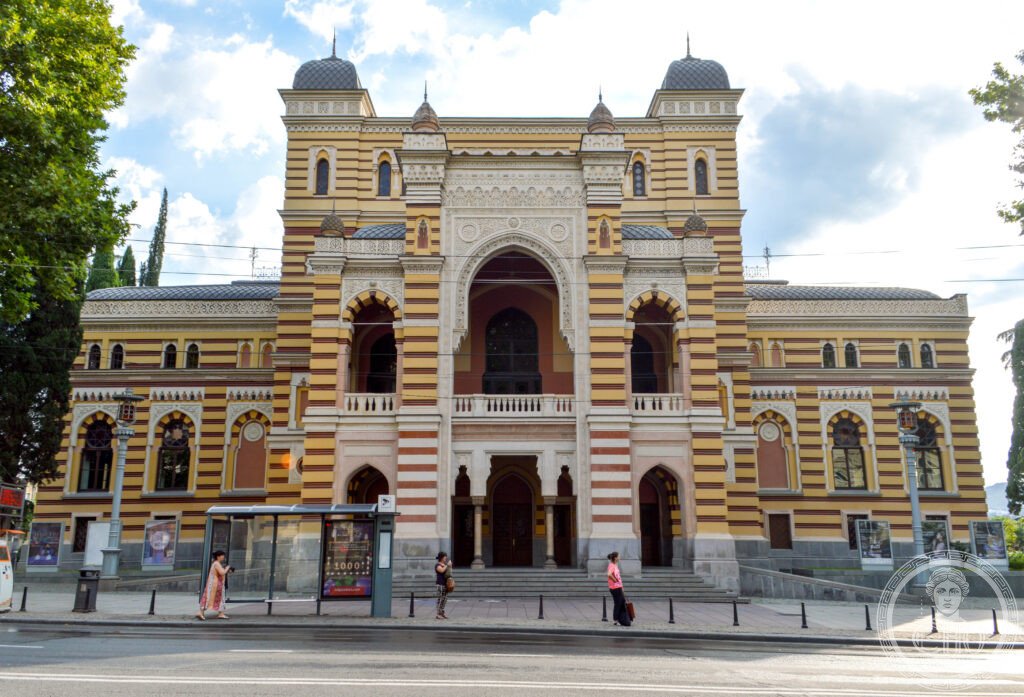
Victor Schröter’s 1880 Moorish Revival opera house on Rustaveli Avenue is Georgia’s principal stage for opera and ballet — a horseshoe auditorium with gilded loggias where Zakaria Paliashvili premiered the operas that defined Georgian classical music.
At a glance
The Georgian National Opera Theater stands on Rustaveli Avenue, the main cultural boulevard of Tbilisi, its horseshoe-arched facade and polychrome terracotta banding constituting one of the most distinctive Moorish Revival buildings in the Caucasus. The original theatre on this site, built in 1851, burned in 1874; the Russian imperial architect Victor Schröter won the commission to rebuild it and inaugurated the new house in 1880. The building became the home stage of Zakaria Paliashvili (1871–1933), the composer whose three operas — Abesalom da Eteri, Daisi, and Latavra — established the canon of Georgian opera. Today the theatre operates under the name Zakaria Paliashvili Tbilisi State Opera and Ballet Theatre.
Key facts
- Architect: Victor Schröter (1839–1901), Russian imperial architect known for theatre design
- Original building: 1851, architect unknown; burned 1874
- Rebuilt: 1880; current structure is Schröter’s Moorish Revival design
- Style: Moorish Revival with Renaissance and Byzantine elements; polychrome terracotta and marble cladding
- Named for: Zakaria Paliashvili (1871–1933), Georgia’s foremost composer, who premiered his major operas here
- Capacity: approximately 1,200 seats
- GPS: 41.7013° N, 44.7962° E
History
Tbilisi in the early 19th century was the administrative capital of Russian Transcaucasia and a meeting point of European, Persian, and Ottoman cultural traditions. A civic theatre opened on the current site in 1851, designed to serve the growing Russian officer and merchant class as well as the Georgian and Armenian bourgeoisie of the city. The repertoire was mixed: Italian opera, Russian drama, and occasional works in Georgian. The building was destroyed by fire in 1874, a common fate for 19th-century theatres lit by oil lamps and heated by open stoves.
Victor Schröter, a St. Petersburg architect who had already built theatres in Riga and Kiev, received the commission to design the replacement. He chose a Moorish Revival programme — unusual for a Russian imperial commission, but appropriate for a city that stood at the interface of Christian and Islamic architectural traditions. The new building, inaugurated in 1880 with a performance of Meyerbeer’s Robert le diable, used horseshoe arches, interlaced geometric tilework, and muqarnas-derived corbels throughout the facade and interior public spaces.
The theatre became closely associated with Zakaria Paliashvili after the premiere of Abesalom da Eteri in 1919 — the first Georgian opera to achieve lasting repertoire status. The building survived the Soviet period with its fabric largely intact, undergoing renovations in the 1970s and again in the 2000s that preserved Schröter’s Moorish exterior while upgrading the stage machinery. Georgia formally renamed the theatre for Paliashvili in 1933, the year of his death.
What you see
The facade on Rustaveli Avenue presents a five-bay elevation of horseshoe-arched windows separated by Moorish colonettes, the spandrels filled with geometric stone carvings and polychrome tilework in ochre, terracotta, and cream. The central projecting bay, capped with a shallow dome and framed by minarets at its corners, establishes the building’s unmistakably oriental silhouette on an otherwise European boulevard. The entrance portico uses muqarnas vaulting above the main doors, a detail that Schröter borrowed from Alhambra precedents via the published engravings of Owen Jones’s Grammar of Ornament (1856).
Inside, the horseshoe auditorium runs four tiers of boxes and open galleries in gilded plasterwork. The ceiling fresco — allegorical figures of Music, Drama, and the Arts — was restored in the 2000s. The curtain and stage machinery have been modernised for contemporary production, but the auditorium retains its 1880 spatial proportion, producing the warm acoustic that 19th-century opera houses achieved through wood, plaster, and fabric.
Practical information
- Address: 25 Rustaveli Avenue, Tbilisi 0108, Georgia
- Season: September to June; some summer performances
- Tickets: available online and at the box office; international cards accepted
- Dress code: smart casual to formal; evening dress for premieres
- Time needed: 2.5–3.5 hours for most productions
- Languages: Georgian with surtitles; visiting productions may use original language
Getting there
The opera house stands on Rustaveli Avenue, 15 minutes on foot from Tbilisi’s Old Town (Narikala fortress area). Metro station Rustaveli is five minutes on foot. Tbilisi International Airport is 18 km south-east; taxi takes 25–35 minutes. GPS: 41.7013, 44.7962.
Nearby
- Georgian National Museum — one of the finest collections of Caucasian archaeology, five minutes along Rustaveli
- Parliament of Georgia — 1930s functionalist building, facing the opera from across the avenue
- Narikala Fortress and Sulphur Baths — medieval fortification and traditional Tbilisi sulphur bath district, 20 minutes on foot through the Old Town
- Mtatsminda Pantheon — hilltop cemetery and funicular terminus with city panorama, 30 minutes on foot
Sources
- Wikipedia, Tbilisi Opera and Ballet Theatre, accessed June 2026
- Official theatre website: opera.ge
- UNESCO, Historical Monuments of Mtskheta (related Georgian WHS), reference 708
- Donald Rayfield, Edge of Empires: A History of Georgia, Reaktion Books, 2012
Find it on the map
See this place and what’s around it →📷 Become a Cultural Heritage Online photographer
Share your photos of places: they stay published under your name as the author. The more they're seen, the more you get noticed — and soon a contest will reward the most appreciated photos.
Log in or sign up free to add a photoIs this page about you?
This page is read by travellers and heritage enthusiasts who find it on Google. Tell us how you are connected to this place and we will take it from there.