
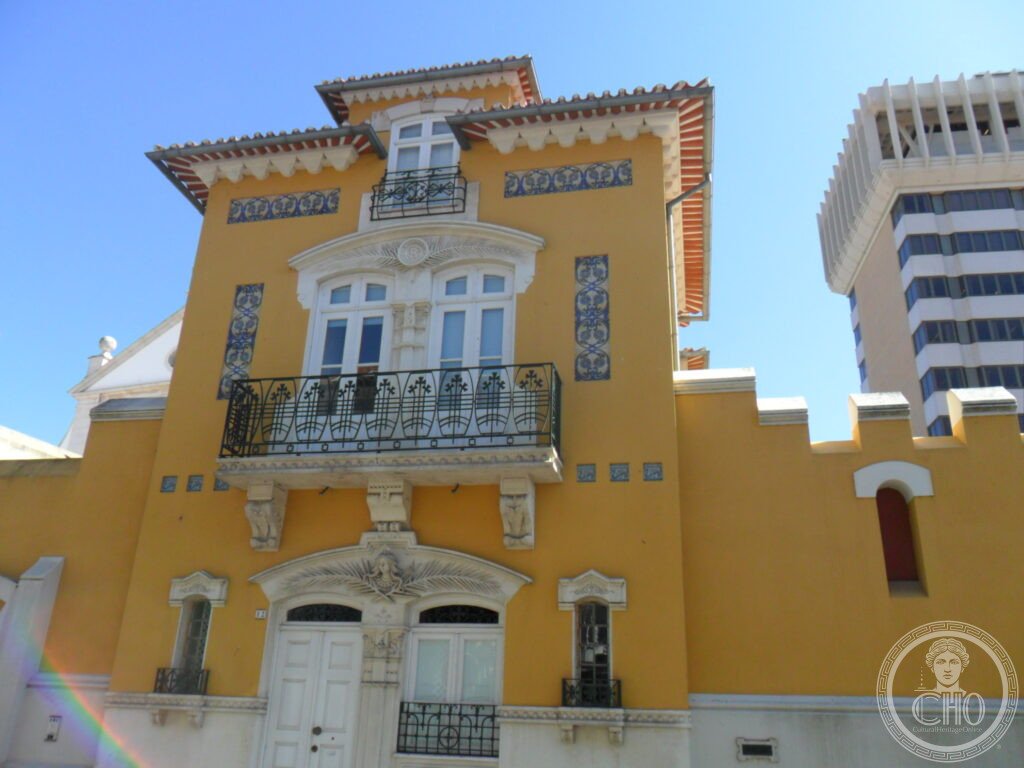
When the man who taught Aveiro the new style built his own house, he held nothing back.
At a glance
The Residência Silva Rocha is the house that Francisco Augusto da Silva Rocha — the architect who gave Aveiro its Art Nouveau accent — designed and built for himself, on Rua do Carmo at numbers 12 and 14. Raised around 1904–1906, it is an exuberant display of the style: curved stone mouldings frame the windows and balconies, ironwork follows the same flowing lines, and panels of azulejo carry interlaced and floral compositions. It is frequently described as the most expressive Arte Nova residence in the city, and as a self-portrait of the architect who shaped so much of the surrounding centre.
Key facts
- Architect: Francisco Augusto da Silva Rocha (1864–1957), for his own use
- Built: around 1904–1906
- Address: Rua do Carmo, nºs 12–14
- Features: curved stone mouldings, flowing ironwork, interlaced and floral azulejo panels
- Reputation: often called the most expressive Art Nouveau house in Aveiro
- Status: classified cultural-heritage building
History
Francisco Augusto da Silva Rocha was born in Mealhada in 1864 and made his career in Aveiro, where he directed the school of industrial design and designed building after building in the historic centre. His originality earned him the nickname “the Portuguese Gaudí”, and his influence is the reason Aveiro carries more Art Nouveau than any other Portuguese town.
Around 1904–1906 he built his own residence on Rua do Carmo. Freed from a client’s caution, he treated the facade as a manifesto, combining the curved stonework, ironwork and tiled panels that define his manner into a single, concentrated composition. The house remained a touchstone for the style in the city; a contemporary house built nearby was even designed in homage to it.
It survives as a classified heritage building and as the clearest single statement of the architect’s personal language, a short walk from the canal and the Casa do Major Pessoa.
What you see
The front is dense with incident. Window and balcony openings are framed in stone that curves rather than squares off, the iron of the balconies repeats the motion, and flat panels of azulejo are worked into interlaced, floral patterns rather than plain fields of colour.
It rewards a slow look: where many Aveiro facades carry a single bold gesture, Silva Rocha layered several, which is why his own house is so often singled out as the richest of them all.
Practical information
- The house is a private residence; it is appreciated from the street.
- It lies on Rua do Carmo, slightly off the main canal cluster — worth the short detour.
- Morning light favours the facade.
- Time needed: a few minutes.
Getting there
Rua do Carmo is in the historic centre of Aveiro, a short walk from the central canal and from the railway station on the Porto–Coimbra line.
Nearby
- Casa do Major Pessoa, now the Museu Arte Nova.
- The canal cluster: Casa dos Arcos, Casa da Cooperativa Agrícola and Casa dos Ovos Moles.
- Aveiro — the capital of Portuguese Arte Nova (city guide).
Sources
- e-cultura.pt, “Aveiro, cidade Arte Nova”.
- Câmara Municipal de Aveiro, “Residência Silva Rocha”.
- Portuguese cultural-heritage inventory (DGPC / SIPA).
Find it on the map
See this place and what’s around it →📷 Become a Cultural Heritage Online photographer
Share your photos of places: they stay published under your name as the author. The more they're seen, the more you get noticed — and soon a contest will reward the most appreciated photos.
Log in or sign up free to add a photoIs this page about you?
This page is read by travellers and heritage enthusiasts who find it on Google. Tell us how you are connected to this place and we will take it from there.