
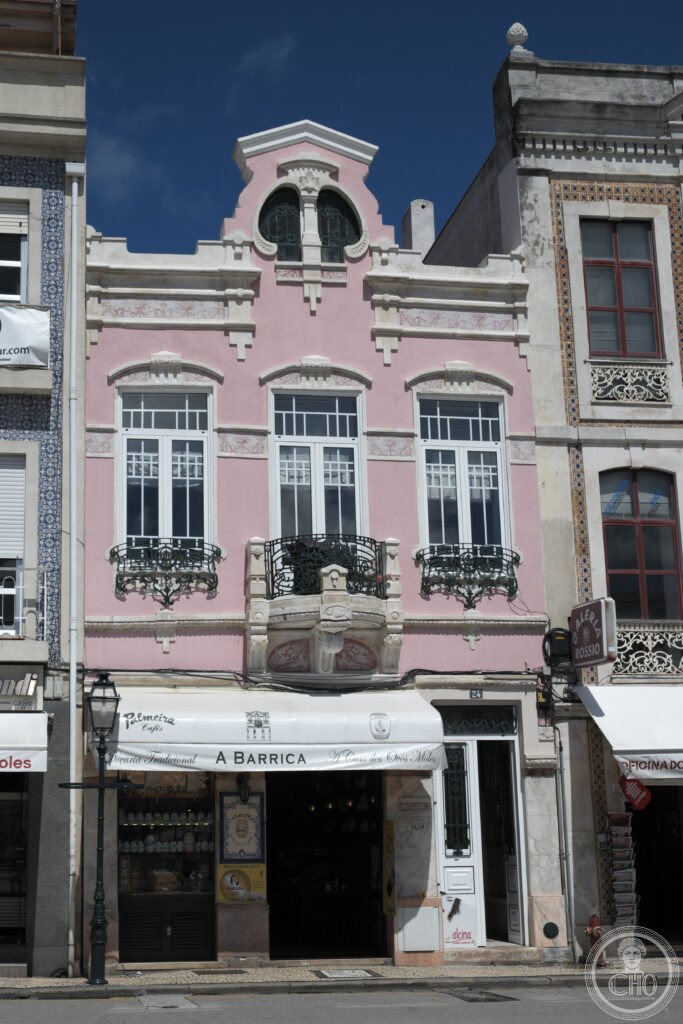
A barber below, a doctor above — and a curving Art Nouveau front that now sells the city’s favourite sweet.
At a glance
The Casa dos Ovos Moles stands at numbers 24 and 25 on Rua João Mendonça, in the Arte Nova heart of Aveiro. Built in 1923, late in the life of the style, it is a small commercial and residential building whose upper floor is the showpiece: curving windows, wrought-iron balconettes and floral detail run across the front, crowned by a gabled attic in the form locals call a “Japanese” arch, a recurring motif in Aveiro’s Art Nouveau. The house takes its present name from its current use — it is a shop selling ovos moles, the egg-yolk-and-sugar sweet that is Aveiro’s culinary emblem.
Key facts
- Architect: José de Pinho
- Built: 1923
- Address: Rua João Mendonça, nºs 24–25
- Original use: a barber’s shop on the ground floor, a doctor’s surgery above
- Detail: “Japanese” arched attic gable, a regional Aveiro motif; coloured glass and floral ironwork
- Now: a shop selling ovos moles de Aveiro
History
By the early 1920s Art Nouveau was already giving way to other fashions across Europe, but in Aveiro the local idiom held on, carried by architects such as José de Pinho. His house on Rua João Mendonça, built in 1923, was conceived for trade and lodging at once: a barber’s shop opened on the ground floor and a doctor kept a surgery on the floor above.
The building has kept much of its original detail — the coloured glass in the first-floor doors, the wrought iron of the balconettes, the floral accents across the front — and it is now best known as a point of sale for ovos moles, the conventual sweet of egg yolk and sugar, sealed in a thin wafer shell, that Aveiro has made since at least the convent kitchens of the eighteenth century.
It belongs to the dense run of Arte Nova facades along this street, a few doors from the Casa da Cooperativa Agrícola, that makes Rua João Mendonça one of the best short walks in Art Nouveau Aveiro.
What you see
The upper floor carries the design. Its windows are set under depressed, curving arches, their balconettes wrapped in ironwork of vegetal inspiration, and floral motifs are scattered across the wall. Above the cornice the attic rises in the gently pointed gable that Aveiro builders favoured, the so-called Japanese arch.
At street level the shopfront still shows wood and tinted glass; inside, the worked door handles are said to take the shape of a butterfly, a small flourish typical of the style’s attention to every fitting.
Practical information
- The ground floor is a working shop; the facade can be seen from the street at any time.
- It is a good place to buy ovos moles to take away.
- A few doors from the Casa da Cooperativa Agrícola on the same street.
- Time needed: a few minutes, longer if you stop to taste.
Getting there
Rua João Mendonça is in central Aveiro, a short walk from the canal and from the railway station on the Porto–Coimbra line. The historic centre is compact and walkable.
Nearby
- Casa da Cooperativa Agrícola, a few doors along the same street.
- Casa do Major Pessoa (Museu Arte Nova) and the Casa dos Arcos.
- Aveiro — the capital of Portuguese Arte Nova (city guide).
Sources
- e-cultura.pt, “Aveiro, cidade Arte Nova” (architect José de Pinho).
- All About Portugal, “Edifício da Casa dos Ovos Moles / A Barrica”.
- Câmara Municipal de Aveiro, Arte Nova route.
Find it on the map
See this place and what’s around it →📷 Become a Cultural Heritage Online photographer
Share your photos of places: they stay published under your name as the author. The more they're seen, the more you get noticed — and soon a contest will reward the most appreciated photos.
Log in or sign up free to add a photoIs this page about you?
This page is read by travellers and heritage enthusiasts who find it on Google. Tell us how you are connected to this place and we will take it from there.