
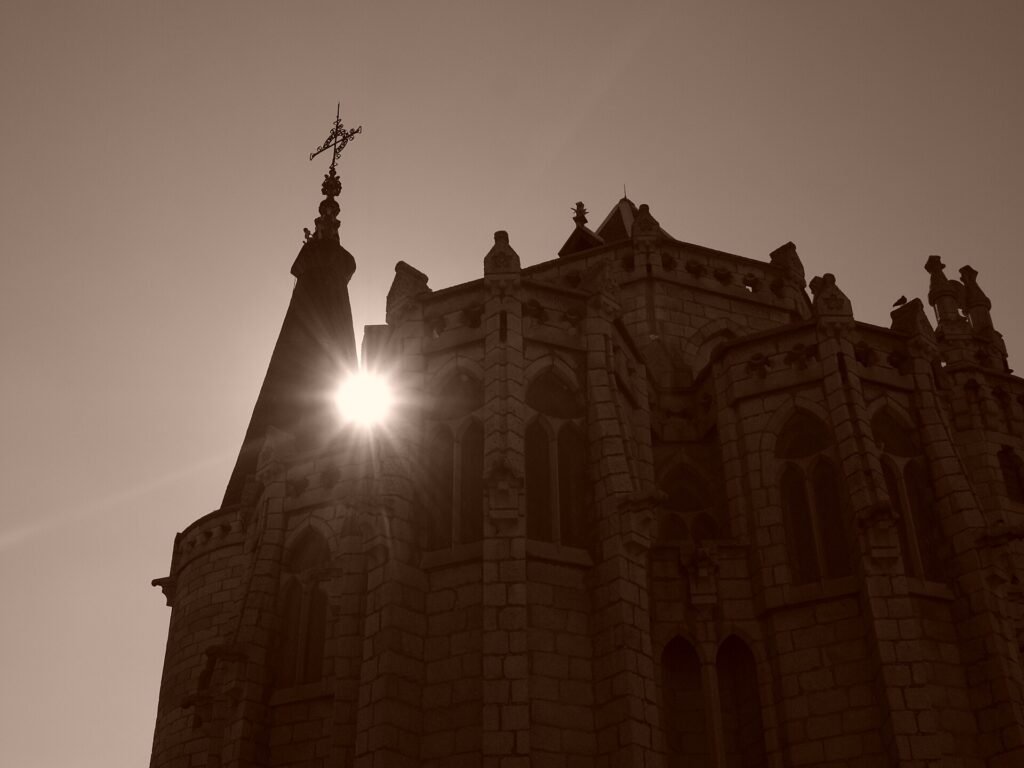
A white-granite castle Gaudí raised for a bishop and never saw finished, now a museum of the pilgrim roads.
At a glance
The Palacio Episcopal de Astorga is one of the few works Antoni Gaudí built outside Catalonia, together with El Capricho and Casa Botines. After fire destroyed the old palace in 1886, the bishop of Astorga, Joan Baptista Grau, a Catalan like Gaudí, asked his fellow countryman to design a new one. The first stone was laid in 1889. Gaudí left the work in 1893, and it was completed by Ricardo García-Guereta in 1913. The palace was never used by a bishop; since 1954 it has held the Museo de los Caminos.
Key facts
- Location: Plaza Eduardo de Castro, Astorga, León
- Architects: Antoni Gaudí (1889–1893), completed by Ricardo García-Guereta (to 1913)
- Built: 1889–1913
- Style: Gaudí neo-Gothic, in white Bierzo granite
- Today: the Museo de los Caminos (Museum of the Ways), since 1954
History
When the medieval bishop’s palace of Astorga burned in 1886, the new bishop, Joan Baptista Grau i Vallespinós, turned to a fellow Catalan he trusted, Antoni Gaudí. Gaudí came to see the town in 1888, the project was approved early in 1889, and the foundation stone was laid on the bishop’s feast day, 24 June 1889.
Grau died in 1893, and without his protector Gaudí fell out with the diocesan board over costs and control. He resigned that year, and work stopped for a long time. The palace was eventually finished by Ricardo García-Guereta, the diocesan architect of León, with the building completed in 1913.
No bishop ever lived in it. After standing empty and even serving other uses, the palace was given over in 1954 to the Museo de los Caminos, devoted to the Camino de Santiago that passes through Astorga, with religious art and pilgrimage objects. The result is one of the strangest civic museums in Spain, a Gaudí castle full of medieval saints.
What you see
The palace looks like a castle out of a story. Built of pale grey-white granite from El Bierzo, it rises in pointed gables and round corner turrets, ringed by a dry moat that opens the basement to light. Tall lancet windows and ribbed vaults inside carry the Gothic theme through, while keeping Gaudí’s feeling for clean, soaring space.
Look for the zinc angels: figures designed for the roofline that were never set there, and now stand in the grounds. Inside, the chapel and the main halls glow with Gaudí’s pale stone and coloured glass. Because two architects built it, the palace mixes Gaudí’s daring lower storeys with García-Guereta’s more conventional upper work, a seam you can read in the walls.
Practical information
- Open: as a museum (Museo de los Caminos); closed some days
- Cost: museum admission
- Best for: the white-granite turrets and the vaulted interior
- Time needed: 1 hour
Getting there
Astorga lies about 45 km west of León on the Camino de Santiago; the palace stands beside the cathedral, a short walk from the bus and train stations.
Nearby
- Catedral de Astorga — the Gothic cathedral next door
- Casa Botines — Gaudí’s warehouse-palace in León, about 45 km east
- Roman Astorga — the Roman remains of ancient Asturica Augusta
Sources
- Museo de los Caminos / Diócesis de Astorga (diocesisastorga.es) — the palace
- Palacio de Gaudí (palaciodegaudi.es) — history
- Wikimedia Commons — image source and licence
Find it on the map
See this place and what’s around it →Record researched and written by Luigi De Marchi for Cultural Heritage Online, 2026.

📷 Become a Cultural Heritage Online photographer
Share your photos of places: they stay published under your name as the author. The more they're seen, the more you get noticed — and soon a contest will reward the most appreciated photos.
Log in or sign up free to add a photoIs this page about you?
This page is read by travellers and heritage enthusiasts who find it on Google. Tell us how you are connected to this place and we will take it from there.