
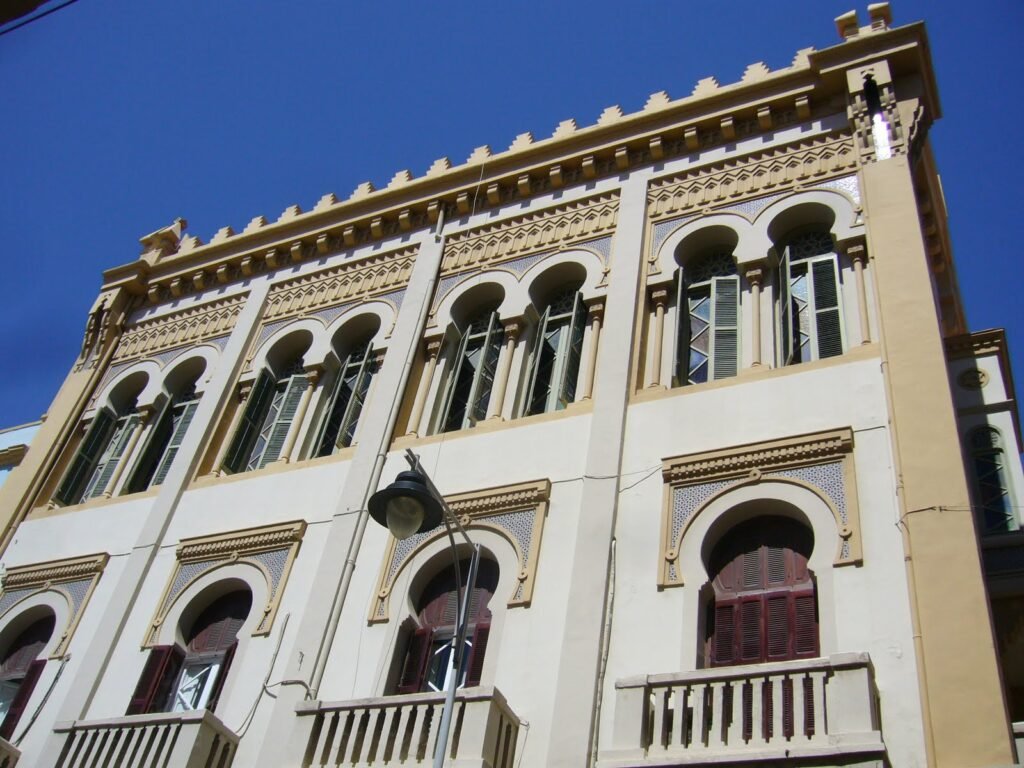
A synagogue raised by Gaudí’s pupil in North Africa, where Modernisme meets the horseshoe arch.
At a glance
The Or Zaruah synagogue occupies the Casa de Yamín Benarroch, a building in the Modernista quarter of Melilla, the Spanish enclave on the North African coast. It was designed by Enrique Nieto, the architect who had worked alongside Antoni Gaudí in Barcelona before settling in Melilla and filling its new districts with Modernista buildings. Nieto drew up the plans in 1924; the synagogue was inaugurated that year and the building constructed between 1925 and 1927. It was funded by the patron Yamín Benarroch, and remains the most important temple of Melilla’s Sephardic community.
Key facts
- Location: Calle López Moreno, Ensanche Modernista, Melilla
- Architect: Enrique Nieto
- Built: design 1924; constructed 1925–1927
- Style: Modernismo with neo-Arab and Mozarabic detail
- Today: an active synagogue and part of Melilla’s protected historic ensemble
History
Melilla grew rapidly in the early twentieth century, and its new Ensanche became an open-air gallery of Modernismo, thanks largely to one man. Enrique Nieto had been part of Gaudí’s team in Barcelona; he moved to Melilla in 1909 and spent the rest of his life building there, for the city’s Catholic, Muslim and Jewish communities alike.
The Or Zaruah synagogue was the personal initiative of Yamín Benarroch, who paid for it in memory of his father; the name means roughly “the sacred light.” Nieto signed the design in September 1924, the synagogue was inaugurated that year, and the surrounding building, the Casa de Yamín Benarroch, was put up between 1925 and 1927 by the contractor Lázaro Torres, with decorative work by Vicente Maeso and ironwork by Vicente Palomo.
The synagogue still serves the Sephardic Jews of Melilla, a community with deep roots in the city, and it is counted among the finest in Spain. It forms part of the historic-artistic ensemble of Melilla, protected as cultural heritage.
What you see
From the street the building belongs to Nieto’s Modernista city, its façade lined up with the galleries and bays of the Ensanche. But the detailing turns east: horseshoe and lobed arches, geometric patterning and Mozarabic motifs give the temple a neo-Arab character suited to its North African setting and its Sephardic congregation.
Inside, the prayer hall is richly worked, the decoration by Vicente Maeso and the ironwork by Vicente Palomo bringing colour and pattern to the worship space. The building is a meeting of worlds, the Catalan Modernisme that Nieto carried from Gaudí’s studio, blended with the visual language of Sefarad, on the southern shore of the Mediterranean.
Practical information
- Open: visits possible, often by arrangement; it is an active synagogue
- Cost: free or by donation; confirm access locally
- Best for: the neo-Arab detailing and the decorated prayer hall
- Time needed: 30 minutes
Getting there
The synagogue is in the Ensanche Modernista of Melilla, the early-twentieth-century centre, within walking distance of the Plaza de España and the other Nieto buildings.
Nearby
- Mezquita Central — Nieto’s great mosque, another of the enclave’s religious landmarks
- Casino Militar — Nieto’s Modernista club on the Plaza de España
- The Ensanche Modernista — Melilla’s quarter of Nieto façades
Sources
- Melilla Turismo (melillaturismo.com) — Modernismo and the Or Zaruah synagogue
- Melilla Monumental (melillamonumental.es) — Sinagoga Or Zaruah
- Wikimedia Commons — image source and licence
Find it on the map
See this place and what’s around it →Record researched and written by Luigi De Marchi for Cultural Heritage Online, 2026.
📷 Become a Cultural Heritage Online photographer
Share your photos of places: they stay published under your name as the author. The more they're seen, the more you get noticed — and soon a contest will reward the most appreciated photos.
Log in or sign up free to add a photoIs this page about you?
This page is read by travellers and heritage enthusiasts who find it on Google. Tell us how you are connected to this place and we will take it from there.