
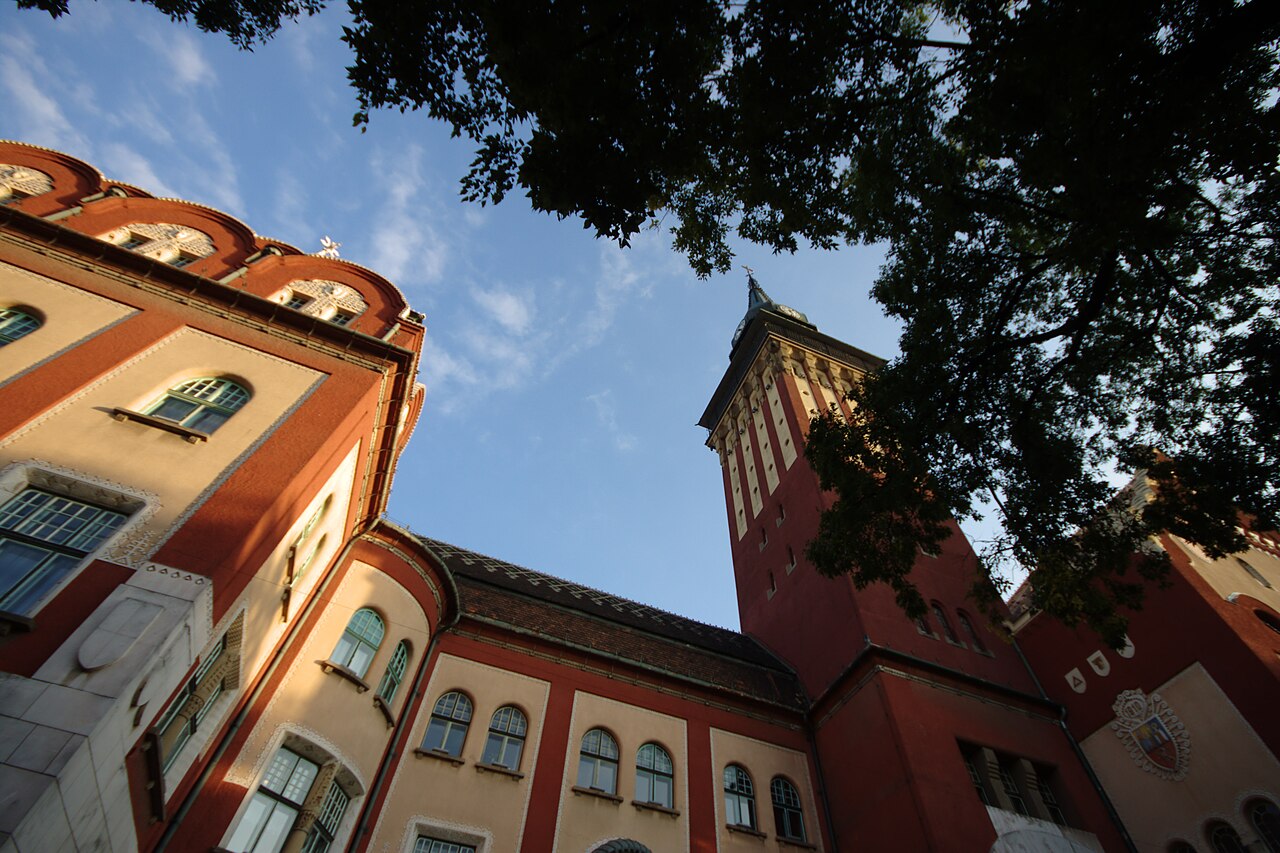
Colour everywhere: a town hall built when Subotica was rich, in the folk-flavoured Hungarian Art Nouveau.
At a glance
The City Hall of Subotica, in the Vojvodina region of northern Serbia, is one of the great monuments of Hungarian Art Nouveau, the Secession. Marcell Komor and Dezső Jakab built it between 1908 and 1910, when the town was a prosperous part of Hungary. It glows with Zsolnay ceramic tiles, folk-art motifs and stained glass, crowned by a tall tower.
Key facts
- Location: Trg slobode, Subotica
- Architects: Marcell Komor and Dezső Jakab
- Built: 1908–1910
- Style: Hungarian Secession (Art Nouveau)
- Function: city hall
History
Around 1900 Subotica was a wealthy market town, and its leaders wanted a city hall to match. They turned to Komor and Jakab, who specialised in the new Hungarian Secession, a national take on Art Nouveau drawing on folk art and the glazed ceramics of the Zsolnay works.
The pair gave the town a building of extraordinary colour and craft, finished in 1910. It remains the seat of the city and the centrepiece of Subotica’s Secession heritage.
What you see
The exterior is a play of patterned brick, ceramic and a soaring tower; inside, a ceremonial hall blazes with stained glass and gilded folk ornament. Tulips, hearts and peacock motifs from Hungarian folk art run through the detail. Few town halls anywhere wear their decoration so boldly.
Practical information
- Open: a working city hall; interior by guided tour
- Cost: free outside; tours ticketed
- Best for: the ceramics, the tower and the council hall
- Time needed: 30–45 minutes
Getting there
The City Hall stands on the main square of Subotica, in northern Serbia near the Hungarian border, a short walk from the railway station.
Nearby
- Subotica Synagogue — the Secession synagogue a few minutes away
- Trg slobode — the main square the city hall faces
Sources
- Wikipedia — Subotica City Hall
- City of Subotica / Serbian heritage register — building information
- Wikimedia Commons — image source and licence
Find it on the map
See this place and what’s around it →Record researched and written by Luigi De Marchi for Cultural Heritage Online, 2026.
📷 Become a Cultural Heritage Online photographer
Share your photos of places: they stay published under your name as the author. The more they're seen, the more you get noticed — and soon a contest will reward the most appreciated photos.
Log in or sign up free to add a photoIs this page about you?
This page is read by travellers and heritage enthusiasts who find it on Google. Tell us how you are connected to this place and we will take it from there.