
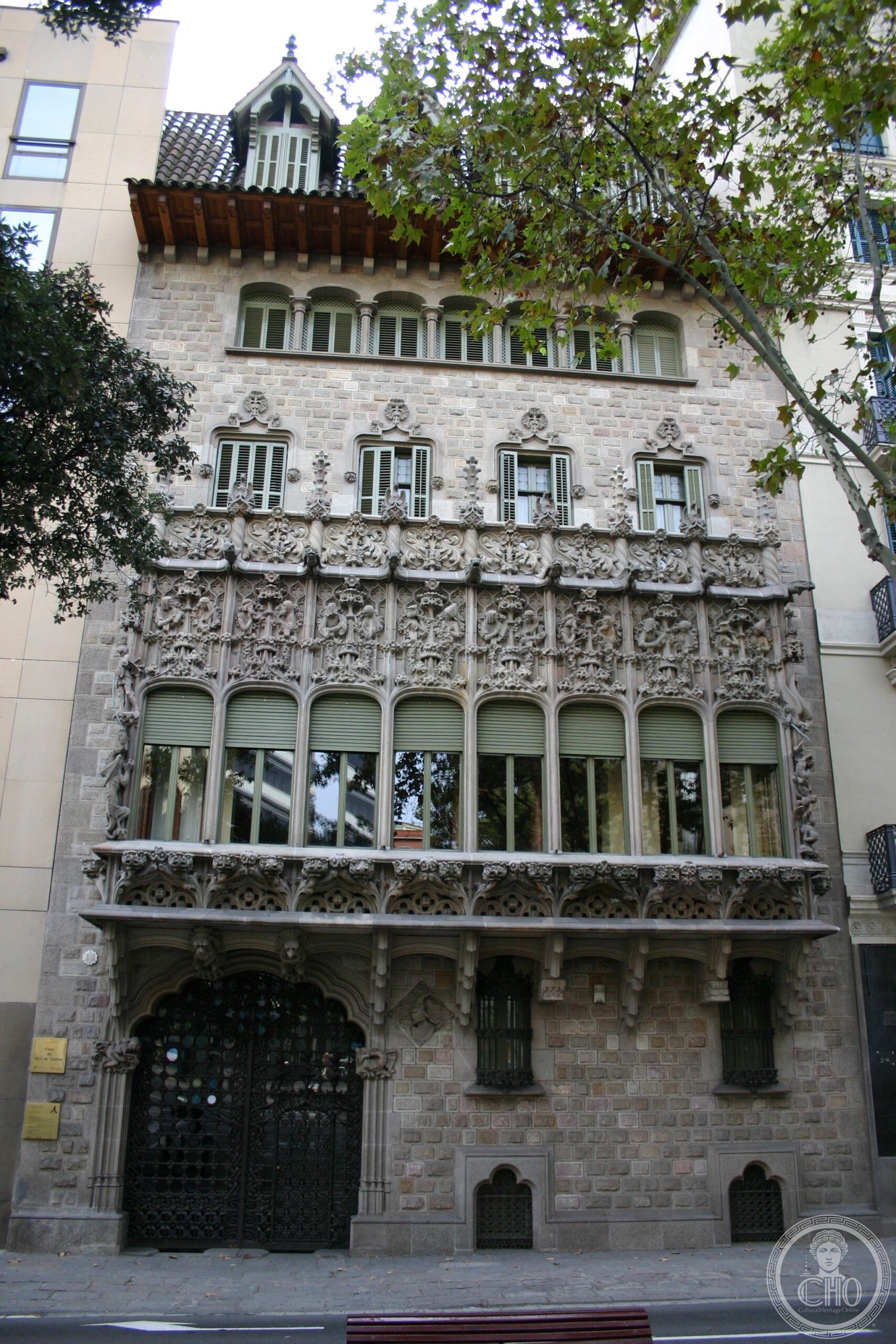
A merchant’s house remade into a fantasy palace — one facade a carved Gothic screen, the other an almost modern wall.
At a glance
The Palau del Baró de Quadras stands on the Avinguda Diagonal, in the “Golden Square” of Barcelona’s Eixample. Between 1903 and 1906 the architect Josep Puig i Cadafalch transformed an existing apartment block into a private palace for Manuel de Quadras, first baron of Quadras. The result is one of his richest Modernista works, gathering the finest craftsmen of the day around a carved stone gallery inspired by Catalan and Spanish Gothic. Declared a national cultural monument, it is now the seat of the Institut Ramon Llull, the body that promotes Catalan language and culture abroad.
Key facts
- Architect: Josep Puig i Cadafalch
- Remodelled: 1903–1906
- Client: Manuel de Quadras, first baron of Quadras
- Craftsmen: sculptors Eusebi Arnau and Alfons Juyol; ironwork Manuel Ballarín; mosaic Lluís Bru
- Address: Avinguda Diagonal 373
- Now: seat of the Institut Ramon Llull
History
The building began as a block of flats on Carrer del Rosselló, built in the 1880s. The industrialist Josep de Quadras acquired it, and at his death it passed to his son Manuel, who in 1902 asked Puig i Cadafalch to turn it into a family palace.
The works, carried out between 1903 and 1906, gave the Diagonal front a lavish new face and called on an exceptional team of sculptors, ironworkers and mosaicists. Puig had only shortly before designed the baron’s country residence.
In the twentieth century the palace housed the Museum of Music for some years and the cultural body Casa Àsia; since 2016 it has been the home of the Institut Ramon Llull.
What you see
The Diagonal facade is the showpiece: a stone screen carved with a deep first-floor gallery of pointed openings, dense with figures, foliage and heraldry drawn from late-Gothic models, the work of sculptors Eusebi Arnau and Alfons Juyol. Wrought iron and ceramic detail enrich the whole.
The rear facade on Carrer del Rosselló is far plainer, almost severe, showing how Puig concentrated his ornament where the city would see it. Inside survive decorated halls, mosaics and stained glass from the same campaign.
Practical information
- The palace is the seat of the Institut Ramon Llull; interior access depends on events and openings.
- The carved Diagonal facade can be admired at any time from the street.
- Time needed: a short stop, longer if an exhibition is open.
Getting there
The palace is on the Avinguda Diagonal at the corner of Carrer del Rosselló, beside the Diagonal metro station and a short walk from the Casa de les Punxes.
Nearby
- Casa de les Punxes, also by Puig i Cadafalch.
- The Passeig de Gràcia and its Modernista landmarks.
- Casa Milà (La Pedrera).
Sources
- Wikipedia (CA), “Palau del Baró de Quadras”.
- Catalan cultural heritage inventory (Bé Cultural d’Interès Nacional).
Find it on the map
See this place and what’s around it →Record researched and written by Luigi De Marchi for Cultural Heritage Online, 2026.

📷 Become a Cultural Heritage Online photographer
Share your photos of places: they stay published under your name as the author. The more they're seen, the more you get noticed — and soon a contest will reward the most appreciated photos.
Log in or sign up free to add a photoIs this page about you?
This page is read by travellers and heritage enthusiasts who find it on Google. Tell us how you are connected to this place and we will take it from there.