
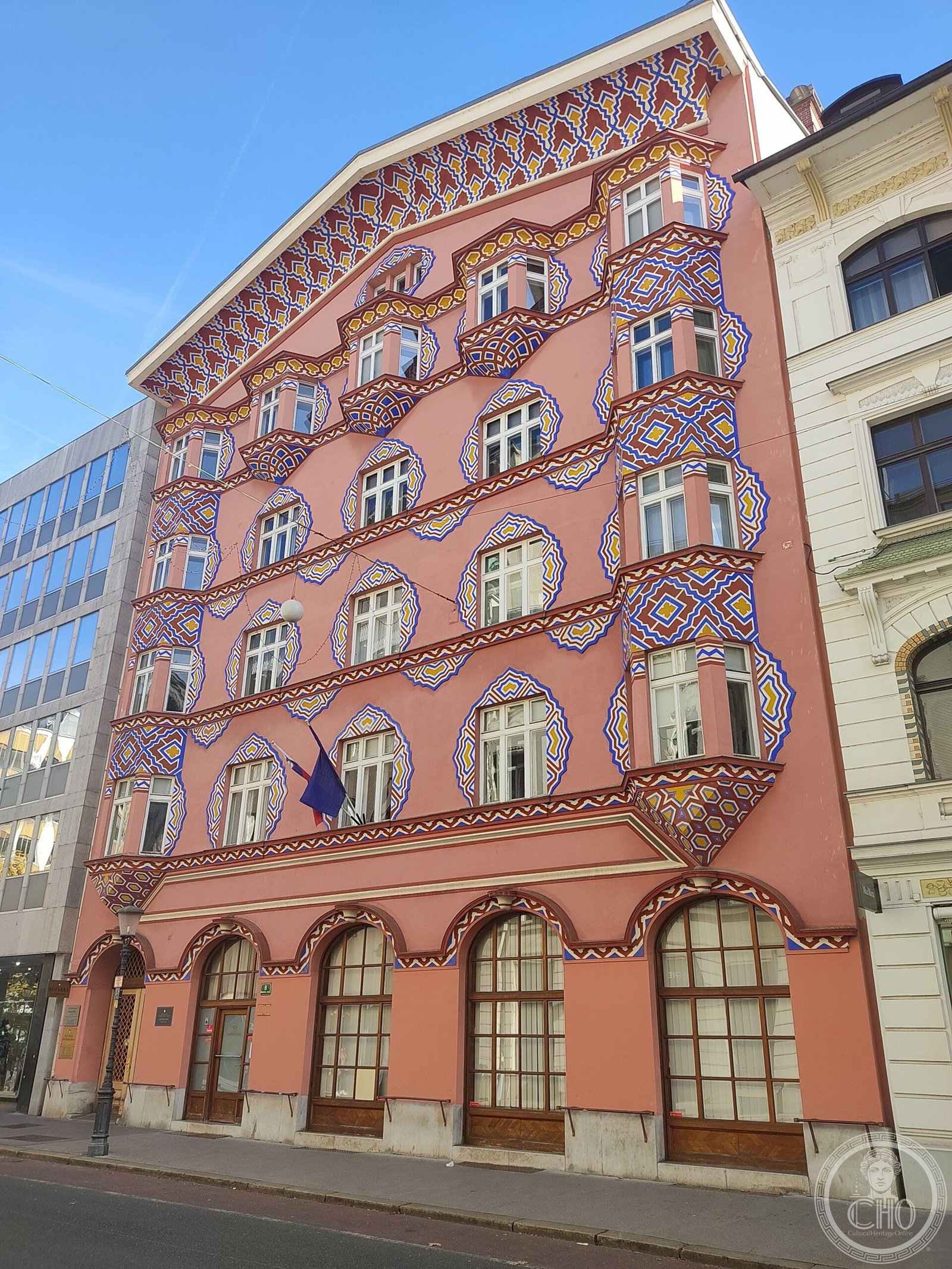
A bank dressed in the colours of a flag — the most joyful facade on a street full of Secession.
At a glance
The Cooperative Business Bank Building, often called the Vurnik House, stands on Miklosich Street in Ljubljana, the part of the city richest in Secession-era architecture. It was designed in 1921 by the architect Ivan Vurnik, with the painted decoration of his wife, the Viennese-trained artist Helena Vurnik. The facade is covered in geometric ornament in the red, blue and white of the Slovene tricolour, a deliberate “national style” descended from the Vienna Secession, the Austrian branch of Art Nouveau. It has often been called the most beautiful building in the city.
Key facts
- Architect: Ivan Vurnik
- Painted decoration: Helena Vurnik
- Designed: 1921
- Style: Slovene “national style”, rooted in the Vienna Secession
- Client: the Cooperative Business Bank (Zadružna gospodarska banka)
- Location: Miklosich Street, Ljubljana
History
After the First World War and the birth of the Yugoslav state, architects in Ljubljana looked for a way to express a Slovene identity in building. Ivan Vurnik, who had trained in Vienna, sought a national style by fusing Secession geometry with folk-derived colour and pattern.
The Cooperative Business Bank gave him the chance. Designed in 1921 for a local credit institution, the building’s exterior became a canvas for Helena Vurnik’s painted ornament in the national colours.
The experiment was short-lived — Vurnik himself soon turned toward a stripped, modern manner — which makes this facade a rare, concentrated monument of the idea.
What you see
Five storeys rise above the street, each with five windows, the whole surface organised into bands of bright geometric pattern in red, blue and white. The effect is flat and decorative, more textile than masonry, a building wrapped like a folk costume.
The richness continues inside, with wall paintings, stained-glass windows of geometric motifs on the staircase, and a glass ceiling set with rows of coloured bottles that scatter light across the banking hall.
Practical information
- The building is in use; the painted facade is the main thing to see and is always visible from the street.
- Miklosich Street as a whole is an open-air gallery of Secession architecture.
- Time needed: a short stop on a walk through central Ljubljana.
Getting there
Miklosich Street runs between Prešeren Square and the railway station in central Ljubljana, an easy walk from either.
Nearby
- The Secession buildings of Miklosich Street and Prešeren Square.
- The Dragon Bridge over the Ljubljanica.
- The riverside works of Jože Plečnik.
Sources
- Wikipedia (EN), “Cooperative Business Bank Building (Ljubljana)”.
- Slovene cultural heritage register (Register nepremične kulturne dediščine).
Find it on the map
See this place and what’s around it →Record researched and written by Luigi De Marchi for Cultural Heritage Online, 2026.
📷 Become a Cultural Heritage Online photographer
Share your photos of places: they stay published under your name as the author. The more they're seen, the more you get noticed — and soon a contest will reward the most appreciated photos.
Log in or sign up free to add a photoIs this page about you?
This page is read by travellers and heritage enthusiasts who find it on Google. Tell us how you are connected to this place and we will take it from there.