
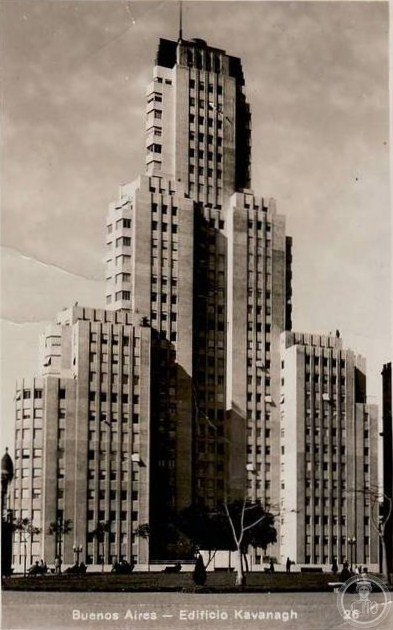
When the Edificio Kavanagh opened in Buenos Aires in 1936, it was simultaneously the tallest building in Latin America and the tallest reinforced-concrete structure in the world — a 120-metre, 33-storey residential tower that demonstrated what Argentine engineering and ambition could achieve at the height of the country’s golden decade. Commissioned by Corina Kavanagh, an Irish-Argentine heiress, and designed by the firm of Sanchez, Lagos y de la Torre, the building pioneered the setback facade in South America: each successive recessed tier is calibrated to maximise light and air for the apartments within while producing a silhouette of cascading horizontal bands that remains among the most recognisable in Buenos Aires. The building also carries one of the city’s most tenacious architectural legends — that Kavanagh positioned her tower precisely to block the Basilica del Santisimo Sacramento’s view of Plaza San Martin, revenge for the Mercedes Dorrego family’s opposition to her relationship with their son. Whether true or apocryphal, the story has become inseparable from the building itself.
At a glance
- Type
- Residential skyscraper
- Period
- 1934–1936
- Style
- Art Deco / International Style
- Location
- Florida 1065, Retiro, Buenos Aires, Argentina
- Coordinates
- 34.5954° S, 58.3747° W
- Architect(s)
- Gregorio Sanchez, Ernesto Lagos, Luis Maria de la Torre
Overview
The Kavanagh stands at the northern end of the Florida pedestrian axis where it meets Avenida del Libertador and Plaza San Martin, Buenos Aires’s most prestigious residential address. Its 33 floors contain 105 apartments of varying sizes, all originally fitted to the highest standard of 1930s luxury: parquet floors, marble bathrooms, servant quarters, and one of the first central-air conditioning systems installed in a South American residential building. The tower remained the tallest building in Argentina until 1995. It was declared a National Historic Monument in 1999 and a World Monument Fund site in 2000, protections that have kept its exterior intact while the interiors are privately maintained.
History
Corina Kavanagh, daughter of an Irish immigrant who made his fortune in agriculture, purchased the site on Florida and Avenida San Martin in 1934. She engaged Gregorio Sanchez, Ernesto Lagos, and Luis Maria de la Torre — a trio with strong Beaux-Arts credentials who had already designed several major Buenos Aires buildings — to create a tower that would surpass anything the city had seen. Construction proceeded at extraordinary speed: the building rose in less than fourteen months, a fact the architects attributed to meticulous pre-planning and the use of a single concrete supplier. At inauguration in 1936 the Kavanagh attracted international architectural press, including coverage in journals in France and the United States. Corina Kavanagh lived in the penthouse until her death in 1963.
Architecture & Design
The Kavanagh’s plan is a slender north-south rectangle that widens slightly at the base. The setback profile — mandatory in Buenos Aires under the 1928 building code for structures above a certain height — is deployed with exceptional elegance: seven distinct steps ascend from the broad street-level base to the narrow penthouse crown, each step precisely proportioned to the floor plates behind it. The facade is clad in polished grey cement rendered smooth, with horizontal banding and shallow recesses at the balcony lines giving a strong Art Deco rhythm. The ground-floor entrance hall features original terrazzo floors, bronze letterboxes, and high-speed electric lifts — still in service. The building is oriented so that its primary axis faces Plaza San Martin, maximising views for the main apartments toward the square and the Rio de la Plata beyond.
Cultural significance
The Kavanagh was a watershed in South American architecture and engineering, proving that the ambitious residential tower typology then transforming New York and Chicago was achievable in Buenos Aires with local materials and contractors. Its designation as a National Historic Monument in 1999 and recognition by the World Monument Fund acknowledged both its technical importance and its role as a marker of the cultural confidence of 1930s Argentina. The building has appeared in countless Argentine novels, films, and photographs, its stacked silhouette functioning as shorthand for the city’s cosmopolitan, European-inflected ambition in the pre-Peron era.
Visiting today
The Edificio Kavanagh is a private residential building and is not open to the public. The entrance lobby on Florida is sometimes visible through the glass doors, and the building’s exterior can be freely photographed from Plaza San Martin or from Florida Street. The Basilica del Santisimo Sacramento directly opposite provides a strong viewing angle for the tower’s profile. Several guided architectural tours of the Retiro and Microcentro neighbourhoods include a stop at the Kavanagh exterior; check local tour operators in San Telmo or Palermo for availability.
Getting there
The Kavanagh is in the Retiro neighbourhood, within easy walking distance of San Martin station (Line C metro) and Retiro bus and rail terminal. From the Microcentro, Florida Street is pedestrianised and runs directly to the building’s base — a flat 10-minute walk from the Obelisco. The Plaza San Martin is immediately adjacent. Taxis and Uber set down on Avenida del Libertador or Calle Paraguay on the building’s flanks.
Sources & resources
Find it on the map
See this place and what’s around it →📷 Become a Cultural Heritage Online photographer
Share your photos of places: they stay published under your name as the author. The more they're seen, the more you get noticed — and soon a contest will reward the most appreciated photos.
Log in or sign up free to add a photoDo you manage this place?
This page is read by travellers and heritage enthusiasts who find it on Google. Keep it accurate — and make it work for you. Free for non-profit heritage institutions.