

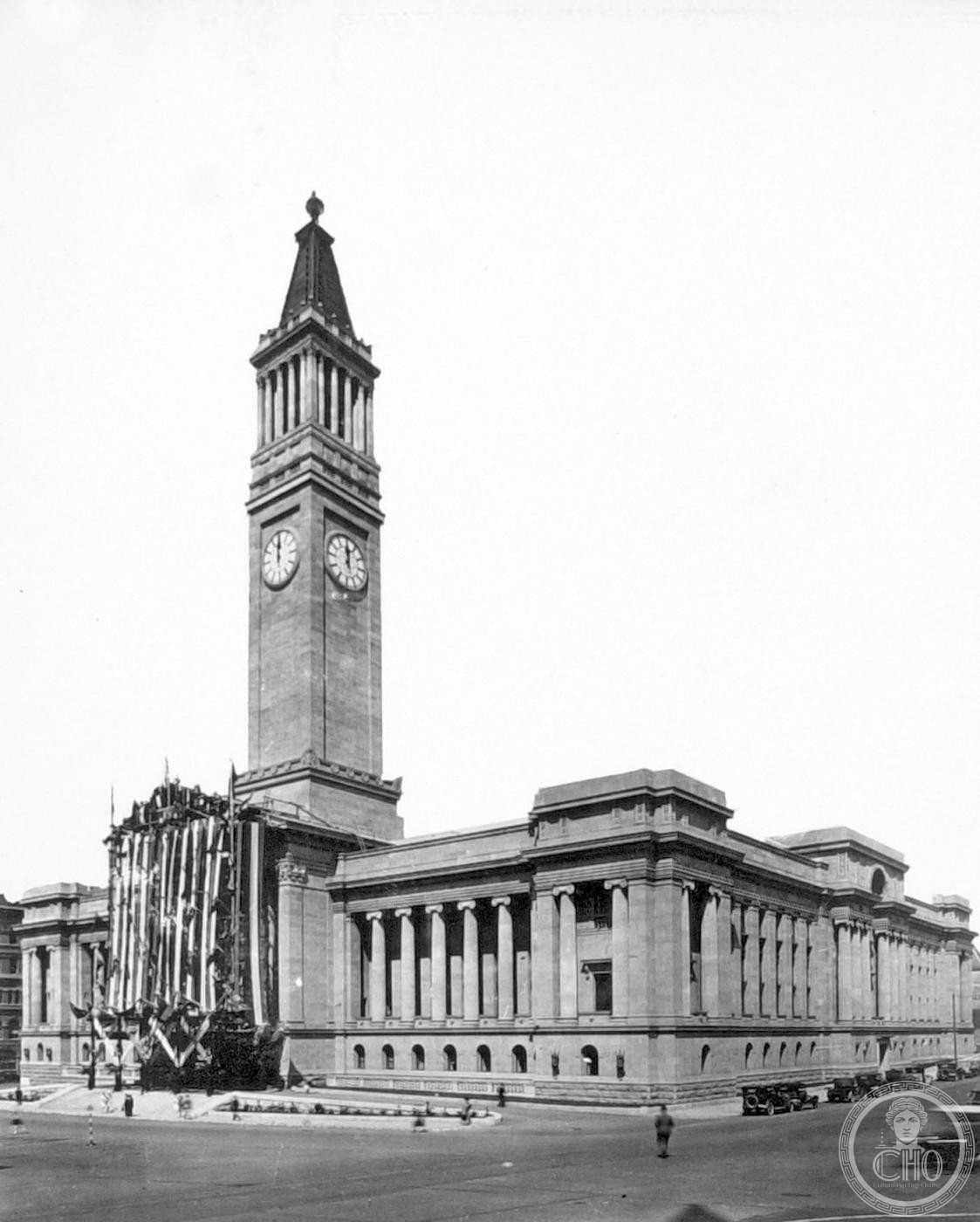
Brisbane City Hall stands on King George Square as Queensland's most celebrated civic monument — a confident synthesis of Italian Renaissance grandeur and interwar civic ambition that was, on its completion in 1930, one of the largest and most expensive public buildings in Australia. Designed by the firm Hall & Prentice, the building is anchored by a 91-metre clock tower modelled loosely on St Mark's Campanile in Venice, whose Westminster chimes still ring across the CBD every quarter-hour. The interior is no less impressive: a vast domed auditorium inspired by the Pantheon in Rome, a 4,391-pipe organ by Henry Willis & Sons, and an elaborate programme of plasterwork and terrazzo that reflects the craftsmanship available to an ambitious colonial city in the 1920s. Listed on the Queensland Heritage Register since 1992, the building underwent a thorough $215 million restoration between 2010 and 2013 and today hosts the Museum of Brisbane on its upper floors, offering free public access to exhibitions on the city's history and culture.
At a glance
- Type
- Municipal civic hall / museum
- Period
- 1920–1930 (opened 8 April 1930)
- Style
- Neoclassical / Interwar Baroque (Italian Renaissance)
- Location
- King George Square, Adelaide Street, Brisbane, Queensland, Australia
- Coordinates
- 27.4689° S, 153.0236° E
- Architect(s)
- Thomas Ramsay Hall & George Gray Prentice (Hall & Prentice)
Overview
Brisbane City Hall is the seat of Brisbane City Council and remains the ceremonial heart of Queensland's capital. Its clock tower is accessible by public lift and offers panoramic views over the CBD and Story Bridge. The Museum of Brisbane on the third floor provides free admission year-round, with changing exhibitions on urban history, design, and contemporary Queensland culture. The ground-floor auditorium — the building's original concert hall — continues to host major civic events, graduations, and performances.
History
The foundation stone was laid on 29 July 1920 by Edward, Prince of Wales, during his first visit to Australia. Construction extended over a decade, partly due to funding pressures during the economic disruptions of the early 1920s; portions of the building were occupied from 1927 before the formal opening on 8 April 1930. The building served as a major wartime venue during the Second World War when General Douglas MacArthur used Brisbane as his Pacific headquarters. Decades of incremental change and deferred maintenance eventually necessitated the 2010–2013 restoration — at $215 million, the most extensive conservation project in Queensland's history at the time — which returned all principal spaces to their original character.
Architecture & Design
The building's symmetrical facade on King George Square presents a colonnaded portico of Corinthian order in pale Queensland sandstone, topped by a wide entablature and a balustrade. Above the main block rises the tower, its Venetian campanile silhouette identifiable from across the city. The internal auditorium is covered by a coffered elliptical dome that recalls the Roman Pantheon; its curved walls are lined with Ionic pilasters in cream and gold. The Willis organ — originally built in 1891 — was incorporated into the hall and remains one of the finest pipe organs in Australia. The tympanum sculpture above the main entrance, depicting the European colonisation of Queensland by artist Daphne Mayo, has attracted ongoing critical debate since its installation.
Cultural significance
Brisbane City Hall occupies a symbolic role in Queensland public life disproportionate even to its considerable physical presence. It has hosted every major civic ceremony since 1930 — from wartime rallies to independence celebrations — and its clock tower image is synonymous with the city's identity. The 2010–2013 restoration triggered a broader civic conversation about heritage conservation and public investment in Queensland, and the building's reopening was treated as a civic event in itself. Its Queensland Heritage Register listing and the Museum of Brisbane's residence cement its status as the state's primary monument to civic pride.
Visiting today
The Museum of Brisbane is free and open daily. Clock tower tours depart regularly during museum hours and include a lift ride to the observation platform. Building tours focused on the architecture and history can be booked through the museum's website. The hall's ground-floor lobby and public areas are accessible without a ticket. Two cafes — the Red Cross Cafe and the Shingle Inn — operate within the building.
Getting there
Brisbane City Hall fronts King George Square, directly served by multiple bus routes along Adelaide and Ann streets. The closest train station is Central Station on Ann Street (3 min walk). CityCat ferries stop at Eagle Street Pier (12 min walk). Paid car parks are available beneath King George Square and in surrounding streets.
Sources & resources
Find it on the map
See this place and what’s around it →Record researched and written by Luigi De Marchi for Cultural Heritage Online, 2026.
📷 Become a Cultural Heritage Online photographer
Share your photos of places: they stay published under your name as the author. The more they're seen, the more you get noticed — and soon a contest will reward the most appreciated photos.
Log in or sign up free to add a photoIs this page about you?
This page is read by travellers and heritage enthusiasts who find it on Google. Tell us how you are connected to this place and we will take it from there.