
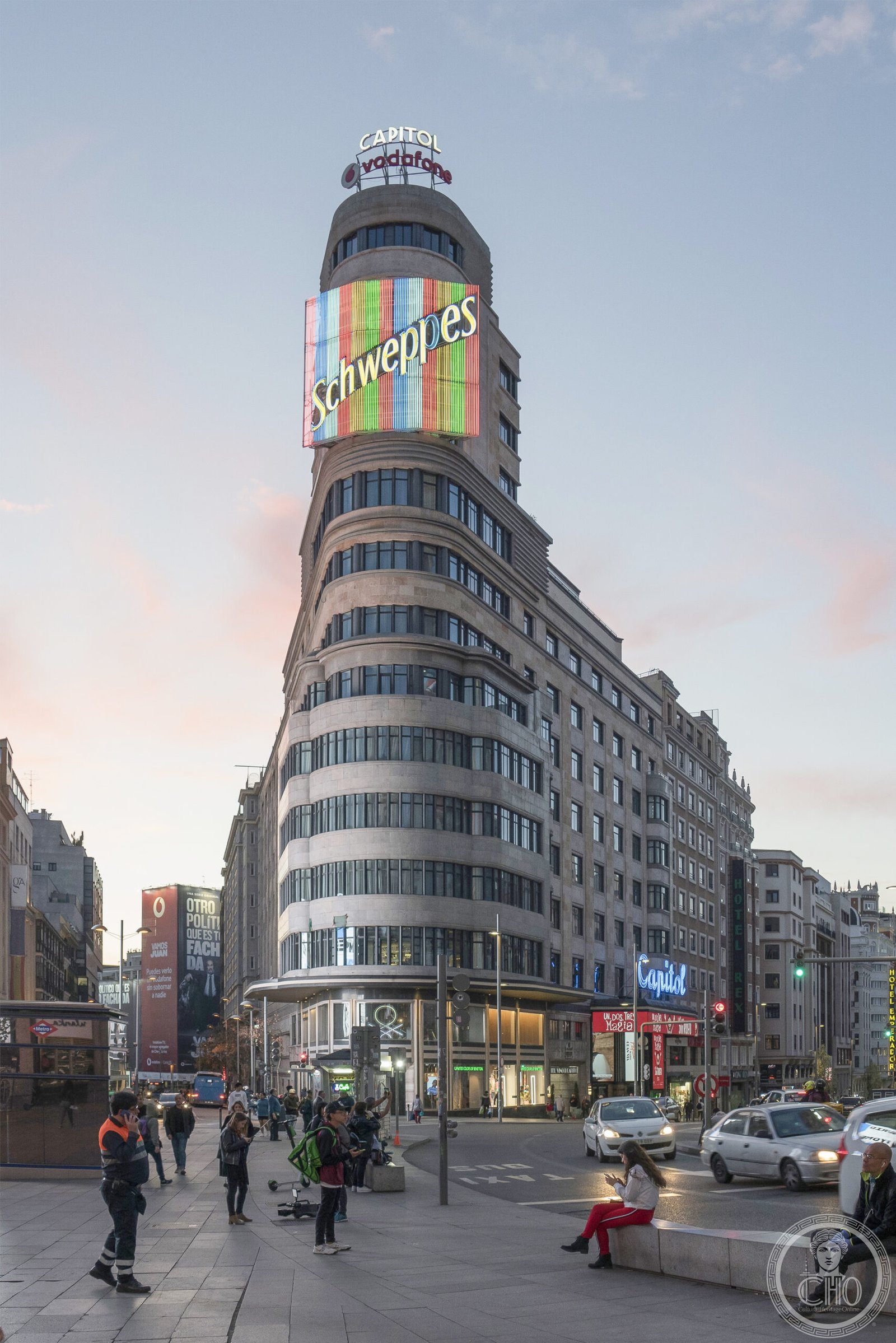
Rising above the Gran Vía at the corner of Calle de Jacometrezo, Edificio Capitol — also known as Edificio Carrión — stands as one of Madrid’s most celebrated interwar landmarks. Completed in 1933 to designs by Vicente Eced Eced and Luis Martínez-Feduchi, its boldly curved glass-and-concrete tower introduced a distinctly modernist vocabulary to a city still dominated by historicist ornament. The building drew on the Expressionist rationalism of Erich Mendelsohn, translating the German architect’s dynamic sweeping forms into a Spanish urban context. Its rounded corner tower, clad in a continuous band of windows and crowned by a copper-green roofline, gave Madrid its first recognisably contemporary skyline silhouette. Declared a Bien de Interés Cultural in 2018, it remains a living emblem of the cosmopolitan ambitions that animated the Spanish capital in the years before the Civil War.
At a glance
- Type
- Mixed-use commercial tower
- Period
- 1931–1933
- Style
- Art Deco / Spanish Rationalism (Expressionist inflection)
- Location
- Gran Vía 41, Madrid, Spain
- Coordinates
- 40.4204° N, 3.7065° W
- Architect(s)
- Vicente Eced Eced & Luis Martínez-Feduchi
Overview
Edificio Capitol occupies one of the most prominent intersections on the Gran Vía, Madrid’s great early-twentieth-century boulevard. Its slender, eleven-storey tower tapers upward in a series of set-backs before resolving into the rounded crown that has become the building’s visual signature. The street-level arcade and the continuous horizontal window bands above it established a new rhythm for commercial architecture in the Spanish capital, making Capitol a prototype for the generation of rationalist office and cinema buildings that followed across Spain during the 1930s.
History
Construction began on 11 April 1931, just days after the proclamation of the Second Spanish Republic — a coincidence that charged the building with the era’s atmosphere of democratic optimism. The Carrión family commissioned Eced and Martínez-Feduchi to create a prestige property that would house a cinema, shops, and offices. The architects spent time in Germany studying the work of Mendelsohn before finalising the design. The building opened on 15 October 1933, housing the Capitol cinema, which operated for decades as one of Madrid’s most fashionable venues. In 2018 the Spanish government formally recognised Capitol’s historical and cultural significance by listing it as a Bien de Interés Cultural.
Architecture & Design
The building’s most distinctive element is its curved glazed corner tower, which wraps continuously from the Gran Vía façade around to Jacometrezo without a single opaque interruption. Horizontal concrete bands separate each storey, creating a strong layered effect that anticipates later Streamline Moderne design. The roofline copper cladding, now weathered to a distinctive blue-green, forms a distinctive crown visible from much of central Madrid. At street level, a generous recessed arcade shelters pedestrians and draws the eye upward through the building’s full 54-metre height. The interiors once contained one of Madrid’s grandest cinema auditoria, its curved screen wall echoing the building’s exterior geometry.
Cultural significance
Edificio Capitol helped crystallise a specifically Spanish version of modernist urbanism that balanced Expressionist dynamism with Mediterranean clarity. It has featured in Spanish cinema — most memorably in Álex de la Iglesia’s cult film El día de la bestia (1995) — and its silhouette has become a default shorthand for Madrid in poster art and film. Its Bien de Interés Cultural listing places it in the same protection category as medieval cathedrals and Roman bridges, acknowledging that twentieth-century heritage deserves equivalent civic care.
Visiting today
The building functions as a mixed commercial and office property. The street-level arcade and ground floor can be visited freely; upper floors are not open to the public. The best views of the tower are obtained from the south side of Gran Vía and from Callao Square, which frames the full height of the rounded corner. Evening is the most photogenic time, when the illuminated glazing turns the curved tower into a luminous lantern above the boulevard.
Getting there
Metro: Callao (Lines 3 and 5) or Gran Vía (Line 1), both a two-minute walk. Numerous city bus routes serve Gran Vía. The building sits at the heart of central Madrid and is easily reached on foot from Sol, Chueca, or Tribunal.
Sources & resources
Find it on the map
See this place and what’s around it →📷 Diventa un fotografo di Cultural Heritage Online
Condividi le tue foto dei luoghi: restano pubblicate con la tua firma come autore. Più vengono viste, più ti fai conoscere — e presto un concorso premierà le foto più apprezzate.
Accedi o registrati gratis per aggiungere una fotoDo you manage this place?
This page is read by travellers and heritage enthusiasts who find it on Google. Keep it accurate — and make it work for you. Free for non-profit heritage institutions.