
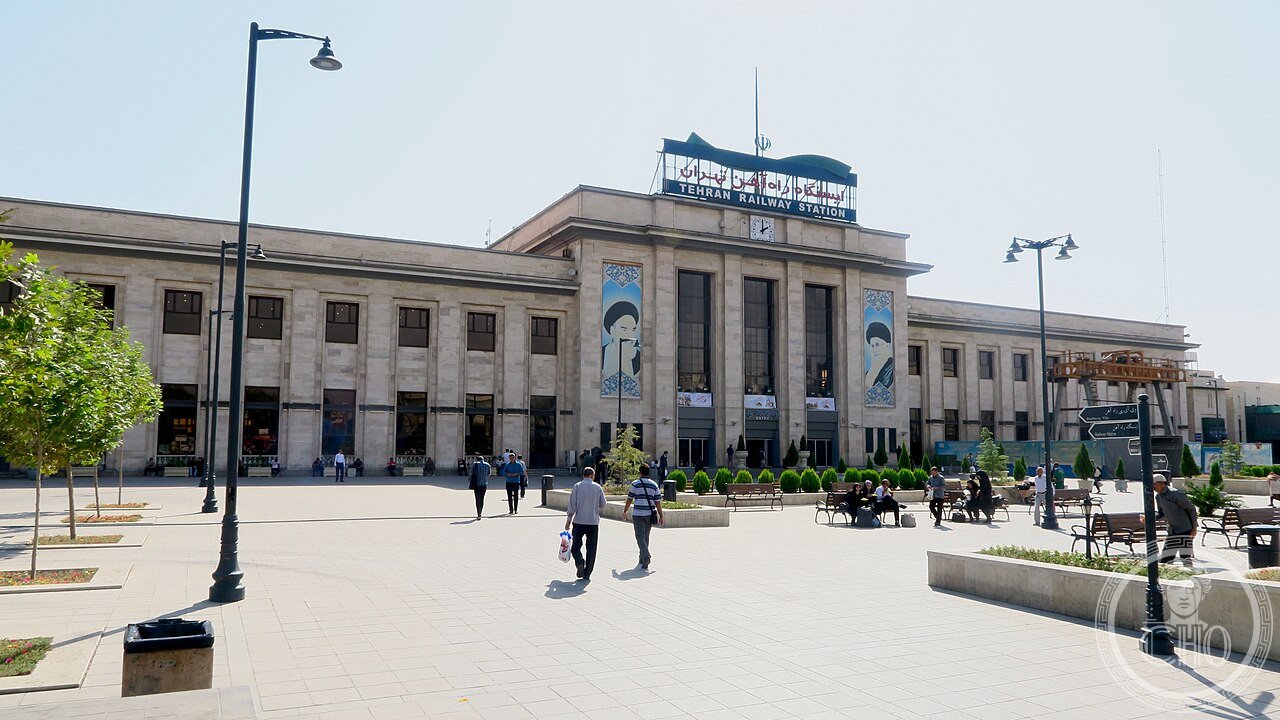
Rising at the foot of Valiasr Street in southern Tehran, Tehran Train Station is one of the most architecturally ambitious buildings of the Pahlavi era — a monumental fusion of Art Deco grandeur and Italian Fascist-influenced rationalism that announced a modernising Iran to the world. Commissioned by Reza Shah Pahlavi as part of the Trans-Iranian Railway project, the station was designed by Polish architect Wladyslaw Horodecki in 1928-29, then substantially redesigned and completed by Danish railway architect Knud Tanggaard Seest after Horodecki died before construction could begin. The result is a structure unlike anything else in the Middle East: twin baroque-inflected towers flanking a stern, symmetrical facade that mingles European modernist severity with ornamental gestures drawn from Persian and Islamic decorative tradition. Opened in 1938, it remains the busiest rail hub in Iran and a landmark of early 20th-century modernist design east of Europe.
At a glance
- Type
- Railway terminus
- Period
- 1930s (Pahlavi era)
- Style
- Art Deco / Pahlavi Modernism (Italian Fascist influence)
- Location
- Rah Ahan Square, District 16, Tehran, Iran
- Coordinates
- 35.6581 N, 51.3978 E
- Architect(s)
- Wladyslaw Horodecki (original design, 1928-29); Knud Tanggaard Seest (execution)
- Opened
- 1938
Overview
Tehran Train Station anchors the southern end of Valiasr Street — Tehran’s great north-south axis — and serves as the primary terminus of the Trans-Iranian Railway, one of the engineering marvels of the 20th century. The station handles intercity, regional and commuter rail services and connects to Tehran Metro Line 3 at Rahahan station. Its exterior presents a monumental symmetry characteristic of 1930s state architecture across Europe and the Middle East: a disciplined stone facade punctuated by tall arched windows, crowned by twin towers that lend the building a ceremonial weight befitting its role as the gateway to a modernising nation.
History
The station was conceived as the Tehran terminus of the Trans-Iranian Railway, Reza Shah Pahlavi’s flagship infrastructure project linking the Persian Gulf to the Caspian Sea. Wladyslaw Horodecki — the Polish-born architect who had already left his mark on Kyiv — received the commission in 1928-29 but died before construction could begin. Danish railway specialist Knud Tanggaard Seest took over and substantially reworked the design, steering it toward a more austere modernist idiom while preserving the ceremonial scale Horodecki had envisioned. Italian engineers and technical staff played a significant role in the railway’s construction, importing European expertise and, with it, the formal language of 1930s Italian architecture. The station opened in 1938, coinciding with the completion of the Trans-Iranian Railway itself — a project finished entirely without foreign loans, a point of national pride under Reza Shah.
Architecture & Design
The station’s facade exemplifies the monumental modernism favoured by Pahlavi-era state commissions: a rigorously symmetrical composition in dressed stone, with tall arched openings that recall both European railway classicism and Persian iwan gateways. The twin towers — baroque in their vertical emphasis yet restrained in ornament — give the building a distinctive silhouette that sets it apart from the plainer rationalismo being built in Italy at the same time. Interior spaces follow the hierarchy of a great European terminus: a grand concourse designed to process large volumes of passengers while projecting state authority. The influence of Italian Fascist architecture is visible in the massing and the preference for smooth stone surfaces over historicist decoration, yet the building never reads as a direct import — it was adapted for a Persian context by designers who understood both traditions.
Cultural significance
Tehran Train Station is one of the foundational monuments of modern Iranian national identity. The Trans-Iranian Railway it serves was Reza Shah’s most tangible demonstration that Iran could undertake a transformative infrastructure project on its own terms — connecting two seas, crossing the Alborz and Zagros mountain ranges, and doing so debt-free. The station building translated that ambition into architecture: a structure designed to impress foreign visitors arriving in the capital and to signal Iran’s entry into the community of modern industrialised nations. It remains the most architecturally significant railway station in the country and a rare surviving example of Pahlavi-era civic modernism at its most confident.
Visiting today
Tehran Train Station is fully operational and open to the public as a working rail terminus. The building is best appreciated from Rah Ahan Square, where its full symmetrical facade is visible. The concourse interiors retain much of their original character and can be accessed by visitors purchasing platform tickets. The station’s monumental scale and the constant movement of passengers make it a compelling urban experience as well as an architectural destination.
Getting there
The station is directly served by Tehran Metro Line 3 (Rahahan station, exit at street level into Rah Ahan Square). Multiple BRT and municipal bus routes also stop at the square. From central Tehran, the Line 3 metro provides the most direct connection; the journey from Imam Khomeini station takes approximately 10 minutes. Taxis and ride-hailing apps are available throughout the day.
Sources & resources
Find it on the map
See this place and what’s around it →Record researched and written by Luigi De Marchi for Cultural Heritage Online, 2026.
📷 Become a Cultural Heritage Online photographer
Share your photos of places: they stay published under your name as the author. The more they're seen, the more you get noticed — and soon a contest will reward the most appreciated photos.
Log in or sign up free to add a photoIs this page about you?
This page is read by travellers and heritage enthusiasts who find it on Google. Tell us how you are connected to this place and we will take it from there.