
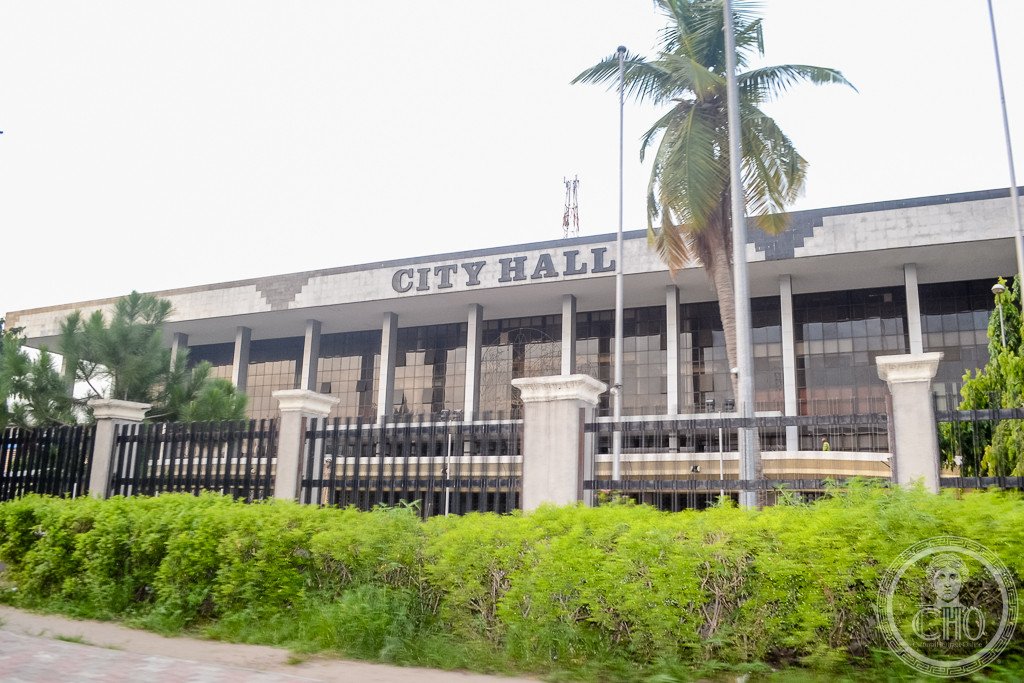
Standing at the heart of Lagos Island’s Brazilian Quarter, the Lagos City Hall is the oldest local government building in Nigeria and one of the most enduring civic monuments of colonial West Africa. Established in 1900 at the height of British colonial administration, the hall was the organisational nerve centre through which colonial Lagos was governed — and later, through which an independent Nigeria began to find its administrative footing. Its Neoclassical form, with colonnaded verandas and rendered masonry typical of British West African public works, sits in vivid contrast to the surrounding commercial density of the Lagos business district. Adjacent to King’s College and St. Nicholas Hospital, the City Hall remains a living landmark, its fabric holding the memory of more than a century of urban governance, political change, and the restless growth of Africa’s most populous city.
At a glance
- Type
- Civic government building
- Period
- Established 1900
- Style
- British Colonial / Neoclassical
- Location
- Brazilian Quarter, Lagos Island, Lagos, Nigeria
- Coordinates
- 6.4541° N, 3.3947° E
- Architect(s)
- British colonial public works department
Overview
The Lagos City Hall is the secretariat of Lagos Island Local Government, the oldest local government authority in Nigeria. Located in the Brazilian Quarter — a district shaped by the return of formerly enslaved Afro-Brazilians in the nineteenth century — the building occupies a historically layered urban neighbourhood. It served as the fountain of local government administration for the entire Lagos colony during the colonial era and continued in that role after independence in 1960, anchoring a tradition of civic governance that predates the Nigerian state itself.
History
Lagos was formally annexed as a British colony in 1861, and for the remainder of the nineteenth century the colonial administration expanded its footprint across Lagos Island. By 1900 the need for a dedicated local government building was established, and the City Hall was constructed to provide institutional premises for the Lagos Town Council — predecessor of today’s local government. Throughout the colonial period the hall served as the focal point for ordinances, civic registration, and public administration. After Nigerian independence in 1960 and the creation of Lagos State in 1967, the building retained its governmental function, surviving episodes of urban pressure that demolished many of its contemporaries.
Architecture & Design
The City Hall exemplifies the British colonial public works tradition in West Africa: a rendered masonry structure organised around shaded verandas and colonnaded bays designed to manage Lagos’s tropical climate. The Neoclassical vocabulary — symmetrical composition, arched openings, and a restrained ornamental programme — reflects the architectural language employed by the British colonial authorities across their West African territories from Sierra Leone to the Gold Coast. The building’s proportions and material palette are consistent with the late-Victorian and Edwardian civic aesthetic that the colonial administration exported throughout the empire.
Cultural significance
As the oldest surviving local government building in Nigeria, the Lagos City Hall carries exceptional historical weight. It is a physical record of colonial governance, of the administrative structures that shaped modern Lagos, and of the continuity of civic life across colonial and post-colonial eras. The Brazilian Quarter in which it sits adds another dimension: the neighbourhood was built by returnees from Brazil who brought their own architectural traditions, creating a palimpsest of Atlantic cultures that makes this corner of Lagos Island unique on the African continent.
Visiting today
The Lagos City Hall remains a functioning government office. The exterior is visible from the street, and the surrounding Brazilian Quarter — with its distinctive Afro-Brazilian townhouses and the nearby Cathedral of the Holy Cross — makes for a rewarding walking itinerary. Heritage Lagos and local tour operators offer walking tours of Lagos Island that include the City Hall and the Brazilian Quarter as key stops.
Getting there
The City Hall is on Lagos Island, accessible via Carter Bridge or Eko Bridge from the mainland. The closest BRT stop is Tafawa Balewa Square on the Lagos BRT network. Water taxis from the Victoria Island ferry terminal offer a scenic alternative crossing. From Murtala Muhammed International Airport allow 45–90 minutes depending on Lagos traffic conditions.
Sources & resources
Find it on the map
See this place and what’s around it →Record researched and written by Luigi De Marchi for Cultural Heritage Online, 2026.
📷 Become a Cultural Heritage Online photographer
Share your photos of places: they stay published under your name as the author. The more they're seen, the more you get noticed — and soon a contest will reward the most appreciated photos.
Log in or sign up free to add a photoIs this page about you?
This page is read by travellers and heritage enthusiasts who find it on Google. Tell us how you are connected to this place and we will take it from there.