
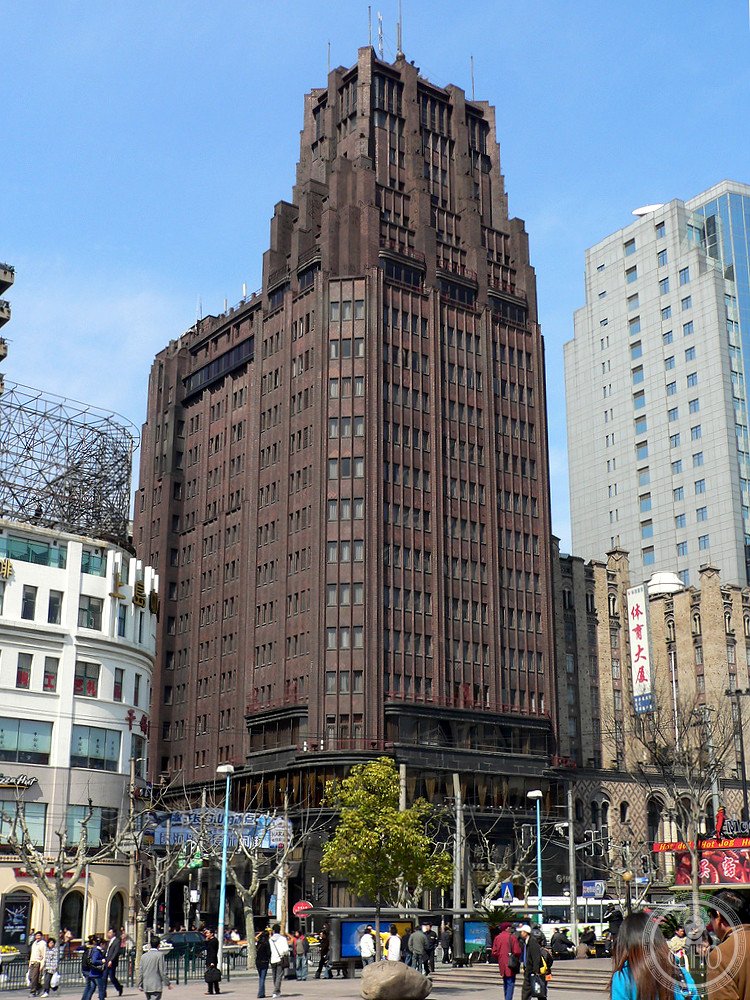
Former Park Hotel Shanghai
For nearly three decades after its completion in December 1934, the Park Hotel — formally the International Hotel (国际饭店) — stood as the tallest building in Asia, a remarkable distinction for a structure that rose only 83.8 metres above Nanjing Road West. Designed by the Hungarian-Slovak architect László Hudec for the Joint Savings Society, the twenty-four-storey tower introduced to Shanghai an authentically American Art Deco vocabulary: a stepped silhouette articulated in polished black Shandong granite at the base, ascending through dark brick and ceramic cladding to a crenellated crown. The hotel commanded panoramic views over the former Shanghai Race Course — now People’s Park — and quickly became the social centre of cosmopolitan Shanghai. Hudec drew freely on the formal language of the American Radiator Building in New York, adapting it to the peculiar ambitions of a city that was reinventing itself at breathtaking speed. The Park Hotel remains open today as a four-star hotel, its Art Deco character carefully maintained through successive renovations.
At a glance
- Type
- Hotel / mixed-use tower
- Period
- 1931–1934
- Style
- Art Deco
- Location
- 170 Nanjing Road West, Huangpu District, Shanghai, China
- Coordinates
- 31.2337° N, 121.4716° E
- Architect(s)
- László Hudec
Overview
The Park Hotel Shanghai anchors the western end of Nanjing Road, one of the world’s most celebrated commercial thoroughfares, overlooking People’s Park. With 22 floors above ground and two below, the structure housed the Joint Savings Society Bank on its lower storeys and hotel accommodation above, a dual-use arrangement common to the era’s prestige towers. Today managed by the Shanghai Jinjiang International Hotels group, it offers approximately 200 guest rooms and retains its historic identity as a landmark of Republican-era Shanghai and a masterwork of László Hudec, the most prolific foreign architect ever to work in the city.
History
The Joint Savings Society commissioned Hudec to design a tower that would rival the recently opened Cathay Hotel on the Bund. Construction proceeded from 1931, and the building opened on 1 December 1934, at which point its 83.8-metre height made it the tallest structure in Asia — a record it held until 1963. It remained the tallest building in China until 1966 and in Shanghai until 1983. During the Republican period the hotel attracted diplomats, businessmen, and celebrities passing through the city. Major renovation campaigns in the 1950s, 1980s, 1997, and 2001 progressively restored the Art Deco interiors and brought the mechanical systems up to contemporary standards while preserving the building’s historic character.
Architecture & Design
Hudec modelled the tower’s massing on the stepped-back American skyscraper type, achieving a dynamic vertical silhouette through successive setbacks as the building rises. The lower four floors are sheathed in polished black granite quarried in Shandong Province, giving the base a sober weight that contrasts with the lighter dark-brown brick and ceramic tile cladding of the upper floors. The crown features decorative brickwork and a series of setback terraces. An outdoor garden on the thirteenth floor was converted to banquet use in 1935, a practical adaptation that became a much-copied model. A later-added marquee partially obscures the original ground-floor composition but leaves the essential silhouette intact.
Cultural significance
The Park Hotel encapsulates the extraordinary ambition of 1930s Shanghai, a city that compressed decades of urban development into a few frenetic years. As the tallest building in Asia for nearly thirty years, it served as a barometer of modernity and a symbol of the city’s cosmopolitan self-image. Hudec’s career in Shanghai — responsible for some sixty buildings — is now recognised as a defining chapter in the architectural history of modern China, and the Park Hotel stands as his most celebrated and historically significant work.
Visiting today
The Park Hotel operates as an active four-star hotel with 200 guest rooms, multiple restaurants, and banquet facilities. Non-staying visitors may enter the lobby and ground-floor public areas. The building is best appreciated from People’s Park directly across Nanjing Road West, which offers unobstructed views of the full Art Deco elevation. The park itself — former site of the Shanghai Race Course — is open daily and free of charge.
Getting there
The hotel stands at 170 Nanjing Road West, at the intersection with Huanghe Road in the Huangpu District. The nearest metro stations are People’s Square (Lines 1, 2, and 8), a two-minute walk to the east. Numerous bus routes serve Nanjing Road West. Ride-hailing via DiDi or taxis are readily available throughout central Shanghai.
Sources & resources
Find it on the map
See this place and what’s around it →📷 Diventa un fotografo di Cultural Heritage Online
Condividi le tue foto dei luoghi: restano pubblicate con la tua firma come autore. Più vengono viste, più ti fai conoscere — e presto un concorso premierà le foto più apprezzate.
Accedi o registrati gratis per aggiungere una fotoDo you manage this place?
This page is read by travellers and heritage enthusiasts who find it on Google. Keep it accurate — and make it work for you. Free for non-profit heritage institutions.