
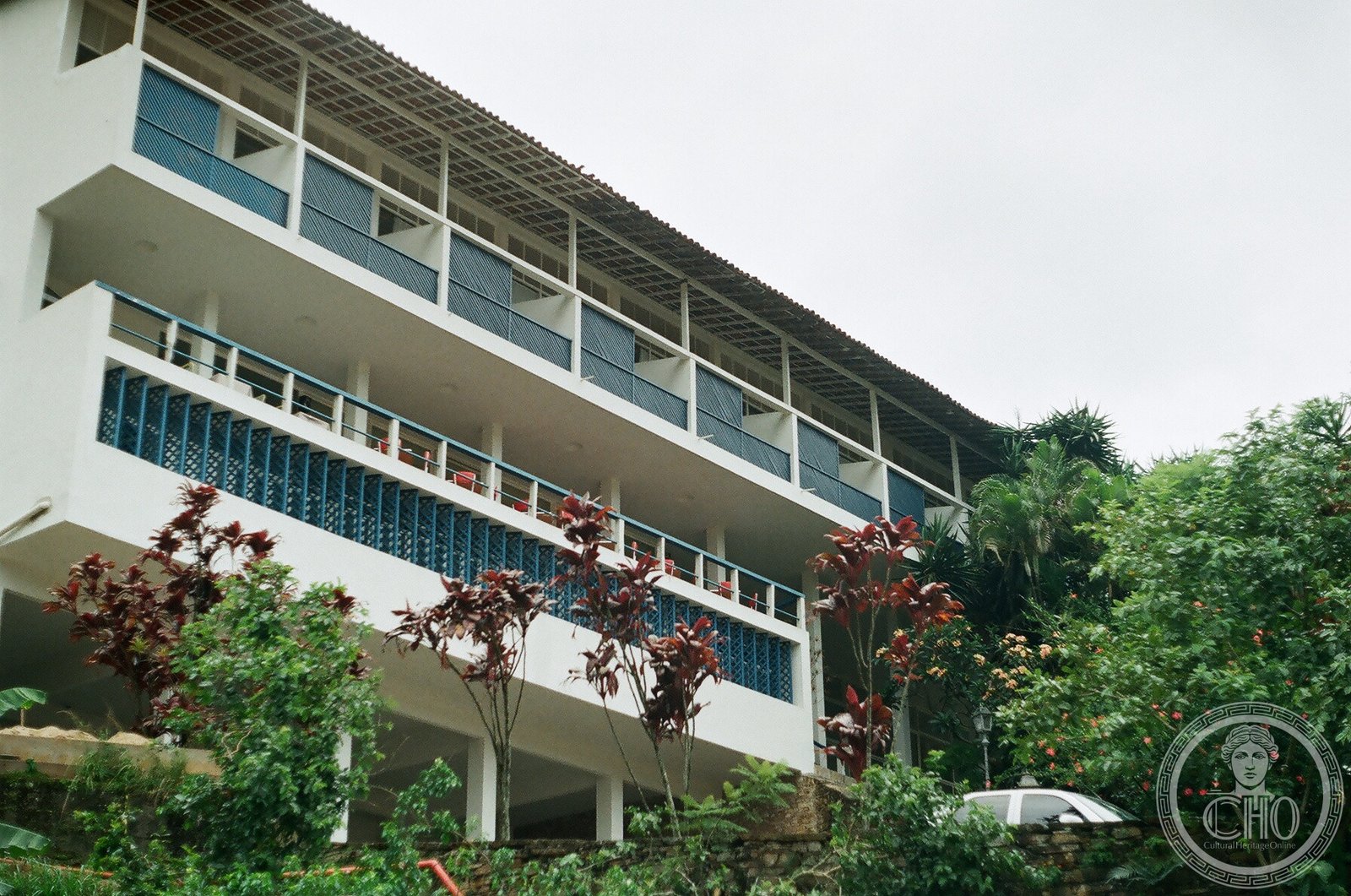
The Grande Hotel Ouro Preto is a landmark of Brazilian Modernism, designed by Oscar Niemeyer and completed in 1940 in the Baroque colonial city of Ouro Preto, Minas Gerais. Commissioned by SPHAN — the forerunner of Brazil’s national heritage institute — in collaboration with architect Lúcio Costa, the project was Niemeyer’s first major built work and remains a defining moment in the history of Brazilian architecture. Set within one of South America’s most intact colonial townscapes, a UNESCO World Heritage Site since 1980, the hotel represents a deliberate act of architectural dialogue: a sleek, horizontal Modernist volume inserted with care into a landscape of seventeenth and eighteenth-century Portuguese Baroque churches and mansions. The building continues to operate as a functioning hotel, offering guests a rare opportunity to stay inside an early Niemeyer original.
At a glance
- Type
- Hotel — heritage modernist building
- Period
- 1938–1940 (construction)
- Style
- Brazilian Modernism
- Location
- Rua Senador Rocha Lagoa, 164, Centro, Ouro Preto, Minas Gerais, Brazil
- Coordinates
- 20.3842° S, 43.5051° W
- Architect(s)
- Oscar Niemeyer; structural engineer Alberto Santos; landscape Roberto Burle Marx
Overview
The Grande Hotel Ouro Preto occupies a hillside plot in the historic centre of Ouro Preto, a city whose Baroque colonial architecture has earned it UNESCO World Heritage status. The hotel was commissioned by SPHAN — the Serviço do Patrimônio Histórico e Artístico Nacional — as an act of enlightened cultural policy: the heritage body wanted a modern hotel that would attract visitors to the colonial city without compromising its historic character. Oscar Niemeyer, then at the very outset of his career, was selected to design it over a competing proposal by architect Carlos Leão. The result is a low-lying Modernist building with brise-soleil screening, pilotis, and clean horizontal lines — a vocabulary that quietly acknowledges, rather than competes with, the Baroque spires visible on the hillsides above.
History
The commission came about through the direct involvement of Lúcio Costa, the leading figure of Brazilian Modernism and director of SPHAN, who engaged Niemeyer for the project. Construction was completed in 1940, making this one of Niemeyer’s earliest built works and a precocious demonstration of his ability to resolve complex contextual problems through architectural means. The hotel was designed in dialogue with the colonial city’s topography and historic fabric, and its completion established the principle — important for SPHAN and for Brazilian heritage practice generally — that contemporary architecture could coexist respectfully with historic environments rather than being excluded from them. The building has been in continuous use as a hotel since its inauguration.
Architecture & Design
Niemeyer’s design employs the formal language developed in Rio de Janeiro by Lúcio Costa and the team responsible for the Ministry of Education and Health building — a language itself influenced by Le Corbusier’s five points of architecture. The hotel rests on pilotis that lift the main body above the sloping ground, freeing the landscape beneath and reducing the building’s visual weight. A brise-soleil system on the principal façade provides solar control while giving the elevation a rhythmic, textured quality. Roberto Burle Marx, who would become Niemeyer’s frequent collaborator, designed the landscaping, integrating tropical planting and paving into the terraced hillside site. Domingos Buzatti served as civil engineer and Anton Dittl as hydraulic designer.
Cultural significance
The Grande Hotel Ouro Preto holds a twofold cultural importance. As an early work by Oscar Niemeyer — who went on to design Brasília and become one of the defining architects of the twentieth century — it is an essential document in the development of Brazilian Modernism and of Niemeyer’s individual trajectory. As an intervention within a UNESCO World Heritage colonial city, it also established a precedent for the thoughtful insertion of contemporary architecture into historic townscapes, a principle that remains relevant to conservation practice worldwide. The coexistence of the hotel’s horizontal rationalism with the Baroque verticality of Ouro Preto’s churches is one of the most photographed and studied architectural juxtapositions in Latin America.
Visiting today
The Grande Hotel Ouro Preto continues to operate as a full-service hotel, making it possible to experience Niemeyer’s early architecture as a guest rather than simply a visitor. Reservations can be made through the hotel’s official website, grandehotelouropreto.com.br. Even for non-guests, the public areas of the building — lobby, terrace, and landscaped grounds — reward a visit. The hotel is centrally located in Ouro Preto’s historic core, within easy walking distance of the city’s major Baroque churches, museums, and the central Praça Tiradentes.
Getting there
Ouro Preto is located approximately 100 kilometres from Belo Horizonte, capital of Minas Gerais state. Regular bus services connect Belo Horizonte’s main bus terminal (Rodoviária) with Ouro Preto, with journey times of around 1.5 to 2 hours. The nearest airport is Belo Horizonte Confins International Airport. Within Ouro Preto, the hotel is in the historic centre on Rua Senador Rocha Lagoa, walkable from the main Praça Tiradentes. The city’s compact colonial core is largely pedestrianised and best explored on foot, though local bus and taxi services are available for the steeper hillside areas.
Sources & resources
Find it on the map
See this place and what’s around it →Record researched and written by Luigi De Marchi for Cultural Heritage Online, 2026.
📷 Become a Cultural Heritage Online photographer
Share your photos of places: they stay published under your name as the author. The more they're seen, the more you get noticed — and soon a contest will reward the most appreciated photos.
Log in or sign up free to add a photoIs this page about you?
This page is read by travellers and heritage enthusiasts who find it on Google. Tell us how you are connected to this place and we will take it from there.