
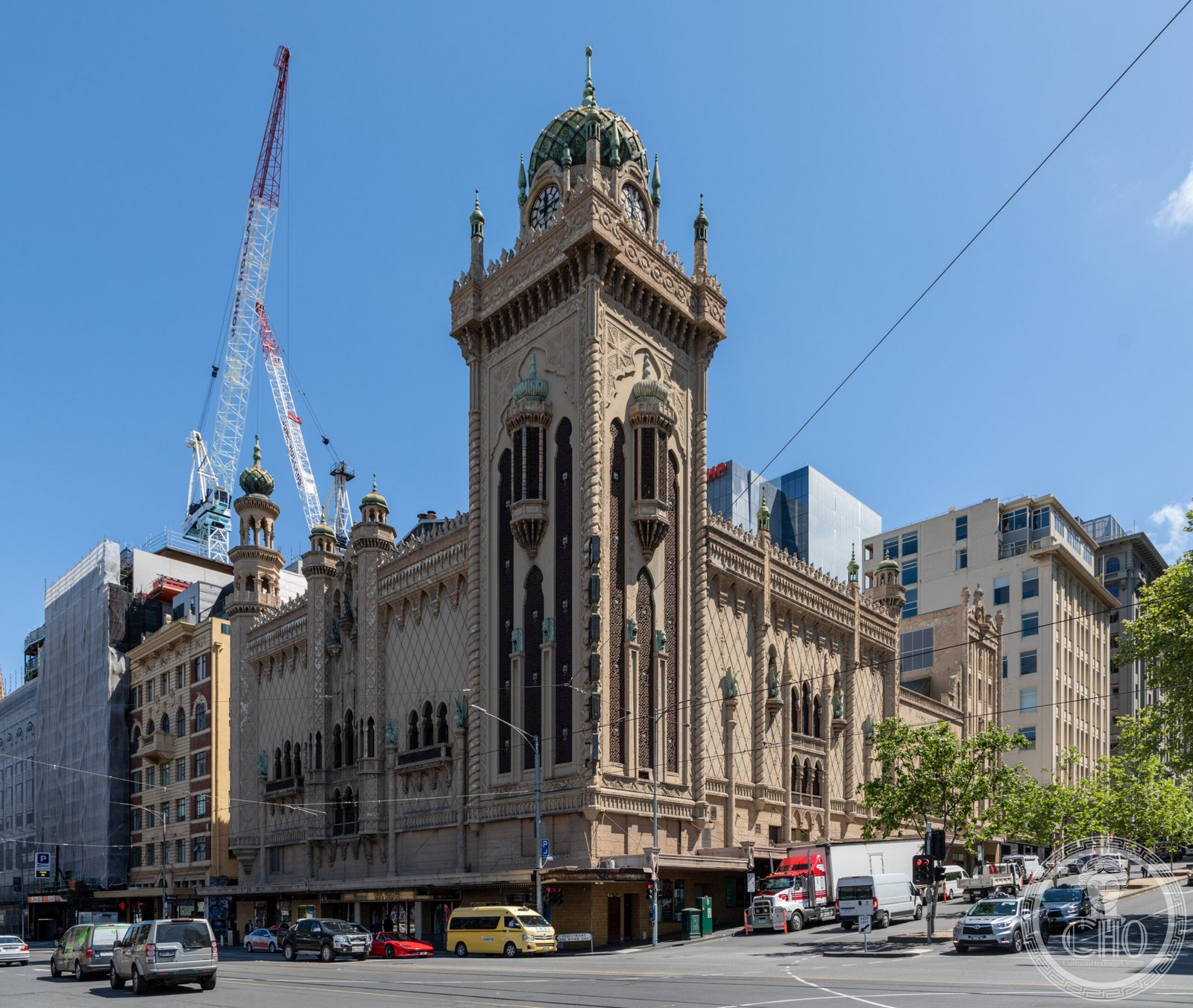
Forum Melbourne, located at 154 Flinders Street in the heart of the Melbourne CBD, is one of Australia’s most theatrically extraordinary heritage venues. Opened in February 1929 as the State Theatre, the building was conceived by American cinema architect John Eberson in association with the local firm Bohringer, Taylor and Johnson. Its Moorish Revival exterior crowned with minarets, a clock tower, and ornamental detail, and its stunning Italian courtyard-style interior made it unlike any other picture palace of its era. Today listed on the Victorian Heritage Register and classified by the National Trust of Australia, Forum Melbourne endures as a living landmark: a concert hall, comedy venue, and cinema that draws hundreds of thousands of visitors each year to one of the finest examples of the atmospheric theatre tradition in the Southern Hemisphere.
At a glance
- Type
- Atmospheric theatre and live music venue
- Period
- 1929 (opened 23 February 1929)
- Style
- Moorish Revival atmospheric theatre
- Location
- 154 Flinders Street, Melbourne, Victoria, Australia
- Coordinates
- 37.8166° S, 144.9694° E
- Architect(s)
- John Eberson (USA); Bohringer, Taylor & Johnson (Melbourne)
Overview
Forum Melbourne occupies a commanding corner site where Flinders Street meets Russell Street, offering an arresting contrast to the surrounding CBD streetscape. What makes the venue exceptional is its dual identity: a robust Moorish exterior complete with minarets and a prominent clock tower, and an interior auditorium designed to evoke a Mediterranean courtyard beneath a starlit sky. Originally seating over 3,300 patrons, the building was designed by John Eberson, the American pioneer of the atmospheric cinema style, working with Melbourne-based architects Bohringer, Taylor and Johnson. The result is an immersive architectural fantasy that remains the finest example of the atmospheric tradition in Australia, earning both statutory heritage protection and enduring affection from Melbourne audiences.
History
The venue opened on 23 February 1929 as the State Theatre, one of the most lavish picture palaces in Australia at the time. It operated continuously as a cinema until 1985, when it passed to the Revival Centres International for religious use. In 1995 the Marriner Group acquired the building and undertook a careful restoration to return it to cultural use as a live events venue, formally renaming it Forum Melbourne. A major restoration programme ran from 2016 to 2017, reinforcing original decorative plasterwork and modernising technical infrastructure while preserving heritage fabric. The venue was listed on the Victorian Heritage Register in 1978 and classified by the National Trust of Australia in 1994, cementing its status as an irreplaceable piece of Melbourne’s architectural legacy.
Architecture & Design
John Eberson perfected the atmospheric cinema by replacing the conventional theatre box with an open-air fantasy: patrons sat under a vaulted ceiling painted cerulean blue and scattered with electric stars simulating the night sky, surrounded by painted Italianate garden walls, trellises, and sculpted architectural fragments. At Forum Melbourne, the interior conjures a walled Florentine courtyard, complete with castellated upper tiers and ornamental niches. The Moorish exterior features white rendered facades, horseshoe arch motifs, tapering minarets, and a distinctive clock tower. The building originally housed a dual-console Wurlitzer organ, removed in 1963. Today Forum 1 (downstairs) holds 2,000 standing patrons; Forum 2 (upstairs) seats 520.
Cultural significance
Forum Melbourne stands as Australia’s pre-eminent surviving example of the atmospheric cinema genre, a global architectural phenomenon of the 1920s that sought to transport cinema-goers into fantastical imagined worlds. Its dual heritage listing on the Victorian Heritage Register since 1978 and National Trust classification since 1994 reflects this exceptional status. Beyond architecture, the venue has been central to Melbourne’s live music culture for three decades, hosting internationally significant acts and winning the Music Victoria Award for Best Venue in 2019, 2020, and 2022. Its continued operation as an active cultural venue means each performance generation encounters the heritage interior as a living, sensory experience.
Visiting today
Forum Melbourne operates as an active events venue with concerts, comedy performances, and film screenings staged throughout the year. Tickets are available via the venue website (forummelbourne.com.au) and major ticketing platforms. The building is not generally open for casual visits outside event times, though the exterior and foyer can often be viewed on event nights. Heritage tours are occasionally offered; check the venue and Heritage Victoria websites for current programmes. The interior is best appreciated during a live event when the atmospheric lighting system is fully active.
Getting there
Forum Melbourne sits on Flinders Street at the corner of Russell Street in the Melbourne CBD, steps from Flinders Street Station, one of the city’s principal rail interchanges. Tram routes along Flinders Street, including the free City Circle, stop directly in front of the venue. Numerous bus services cover the surrounding streets. For those arriving by car, the nearest car parks are on Russell Street and in the Flinders Lane precinct. Federation Square is two minutes on foot, making the venue highly accessible from anywhere in the central city.
Sources & resources
Find it on the map
See this place and what’s around it →Record researched and written by Luigi De Marchi for Cultural Heritage Online, 2026.
📷 Become a Cultural Heritage Online photographer
Share your photos of places: they stay published under your name as the author. The more they're seen, the more you get noticed — and soon a contest will reward the most appreciated photos.
Log in or sign up free to add a photoIs this page about you?
This page is read by travellers and heritage enthusiasts who find it on Google. Tell us how you are connected to this place and we will take it from there.