
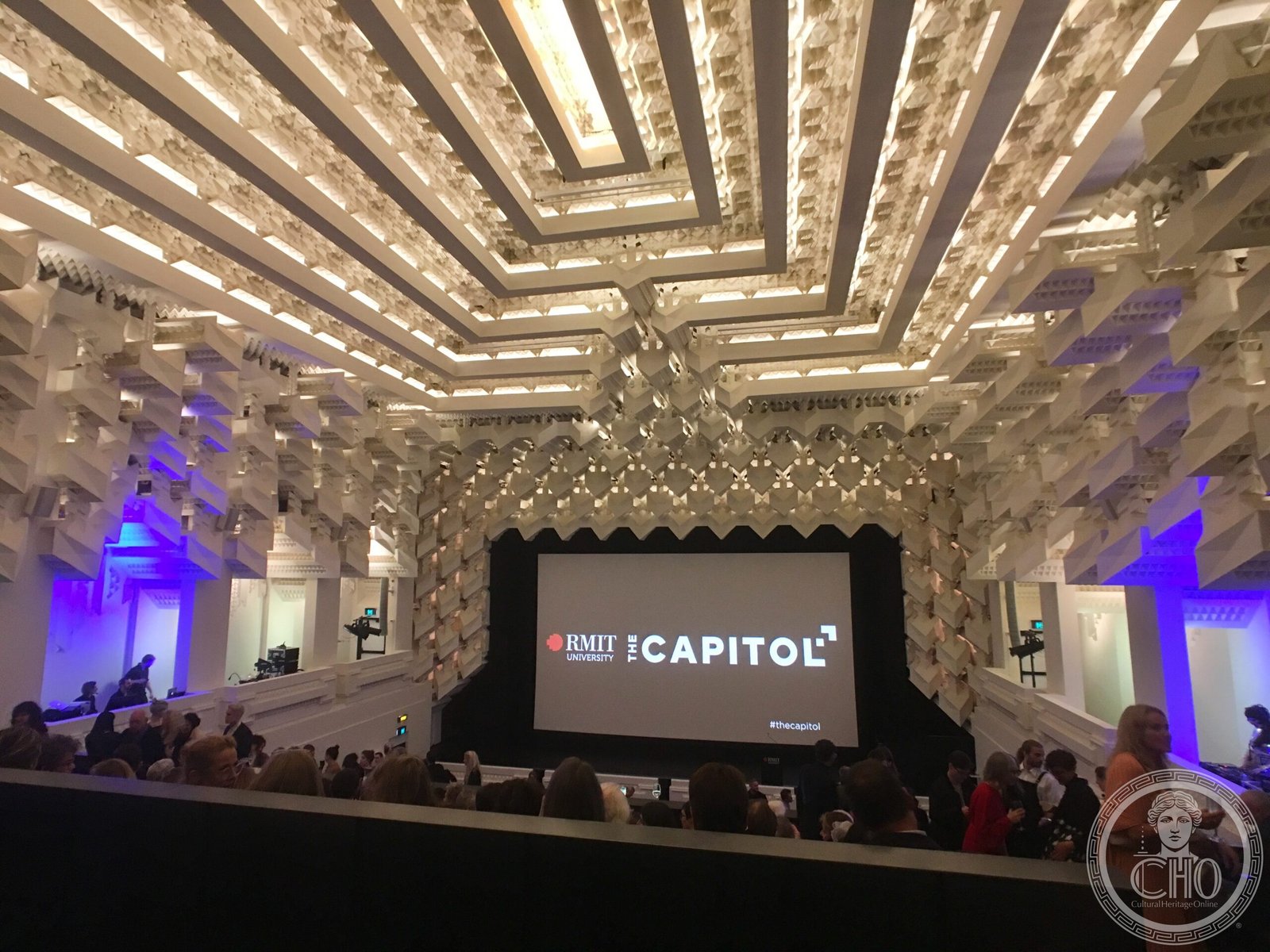
The Capitol Theatre, located at 113 Swanston Street in Melbourne’s central business district, is a singular achievement of Art Déco design and one of the most architecturally important cinemas built in Australia during the interwar period. Opened on 7 November 1924, it was designed by the American husband-and-wife team of Walter Burley Griffin and Marion Mahony Griffin — the same partnership responsible for the planning of Australia’s capital, Canberra. The Griffins brought to the Capitol their characteristic synthesis of organic geometry and spatial drama, most spectacularly expressed in the auditorium’s crystalline plaster ceiling, a three-dimensional latticework of angular forms originally illuminated by some 4,000 coloured lights. Nearly demolished in the early 1960s, the theatre survived thanks to a vigorous heritage campaign and was purchased by RMIT University in 1999. Following an extensive restoration completed in 2019, it operates today as a cultural venue hosting film festivals, live performances, and university events.
At a glance
- Type
- Heritage cinema and cultural performance venue
- Period
- Opened 7 November 1924; restored and reopened June 2019
- Style
- Art Déco atmospheric (organic geometric design)
- Location
- 113 Swanston Street, Melbourne, Victoria, Australia
- Coordinates
- 37.8154° S, 144.9664° E
- Architect(s)
- Walter Burley Griffin and Marion Mahony Griffin
Overview
The Capitol sits within the Capitol House complex on Swanston Street, its street presence relatively restrained in comparison to the extraordinary spatial experience that unfolds inside. Commissioned by Melbourne businessmen including the Greek Consul-General Antony J. Lucas, it originally seated 2,137 patrons and offered a level of architectural invention unprecedented in Australian cinema design. The Griffins conceived the building not as a vessel for illusion in the usual picture-palace sense, but as an immersive architectural environment in its own right — a space where the geometry of the ceiling itself would be the spectacle. That ambition, partly realised and partly constrained by budget, produced a room unlike anything else built in the country at the time.
History
Walter Burley Griffin and Marion Mahony Griffin received the Capitol commission in the early 1920s, during the period when Griffin was simultaneously working on the Canberra city plan. The theatre opened in November 1924 as part of a mixed-use block combining cinema, retail, and office space. By the early 1960s declining attendances and the economics of Melbourne’s property boom placed the building under serious threat of demolition. A heritage advocacy campaign, led in part by architect Robin Boyd, secured its survival. Significant modifications were made in 1965. RMIT University acquired the property in 1999 and invested substantially in a restoration programme that ran from 2014 to 2019, returning the auditorium closely to the Griffins’ original conception and reopening the building in June 2019. The original Wurlitzer organ, removed from the building, was returned in 2021.
Architecture & Design
The Capitol’s defining feature is its auditorium ceiling, a three-dimensional composition of angular crystalline forms that Griffin described as evoking a geological cave — an inverted landscape of plaster facets that recede upward in interlocking geometries. Originally equipped with approximately 4,000 coloured incandescent lamps set into the plasterwork, the ceiling created a shifting chromatic atmosphere that could be tuned to complement the mood of the screen programme. The 2019 restoration replaced the incandescent array with LED technology capable of replicating the original colour sequences. Griffin’s approach drew on his broader design philosophy of organic architecture, which sought to derive form from natural geometric principles rather than historical precedent — a position that set the Capitol apart from the prevailing Moorish and Baroque picture palace conventions of the era. The current seating capacity is 554 plus 8 accessible spaces.
Cultural significance
The Capitol Theatre is listed on the Australian Heritage Council’s register, the National Trust of Australia, and Heritage Victoria, reflecting its exceptional significance at every level of heritage classification. As a work by Walter Burley Griffin and Marion Mahony Griffin — whose contribution to Australian architecture and urbanism is unparalleled among foreign-born practitioners — it holds a unique place in the national cultural canon. The building’s survival is itself a milestone in Melbourne’s heritage movement, representing one of the first major victories for organised architectural preservation in the city. Today it stands as living proof that a radical design vision from 1924 can remain genuinely affecting a century later, attracting scholars, film enthusiasts, and architecture visitors from around the world.
Visiting today
The Capitol Theatre is owned and operated by RMIT University and is used for film screenings, film festival events, live music, theatrical performances, and university programming. The venue is generally accessible during scheduled events rather than as a stand-alone attraction, though guided heritage tours have been organised. The Melbourne International Film Festival has used the Capitol as a signature venue. Programme and ticketing information is available through RMIT’s Capitol website. The original Wurlitzer organ, returned to the theatre in 2021, is occasionally featured in special organ performance events.
Getting there
The Capitol Theatre is situated at 113 Swanston Street, one of Melbourne CBD’s principal pedestrian and tram corridors. Multiple tram routes run along Swanston Street, making it directly accessible by tram from Flinders Street Station and the northern end of the city. Melbourne Central Station on the Pakenham and Cranbourne lines is approximately 300 metres to the north, providing underground rail access. Flinders Street Station is roughly 600 metres to the south. The building is within easy walking distance of the main city retail and cultural precinct. Commercial car parking is available on nearby streets and in multi-storey facilities off Swanston and Russell Streets.
Sources & resources
Find it on the map
See this place and what’s around it →📷 Diventa un fotografo di Cultural Heritage Online
Condividi le tue foto dei luoghi: restano pubblicate con la tua firma come autore. Più vengono viste, più ti fai conoscere — e presto un concorso premierà le foto più apprezzate.
Accedi o registrati gratis per aggiungere una fotoDo you manage this place?
This page is read by travellers and heritage enthusiasts who find it on Google. Keep it accurate — and make it work for you. Free for non-profit heritage institutions.