
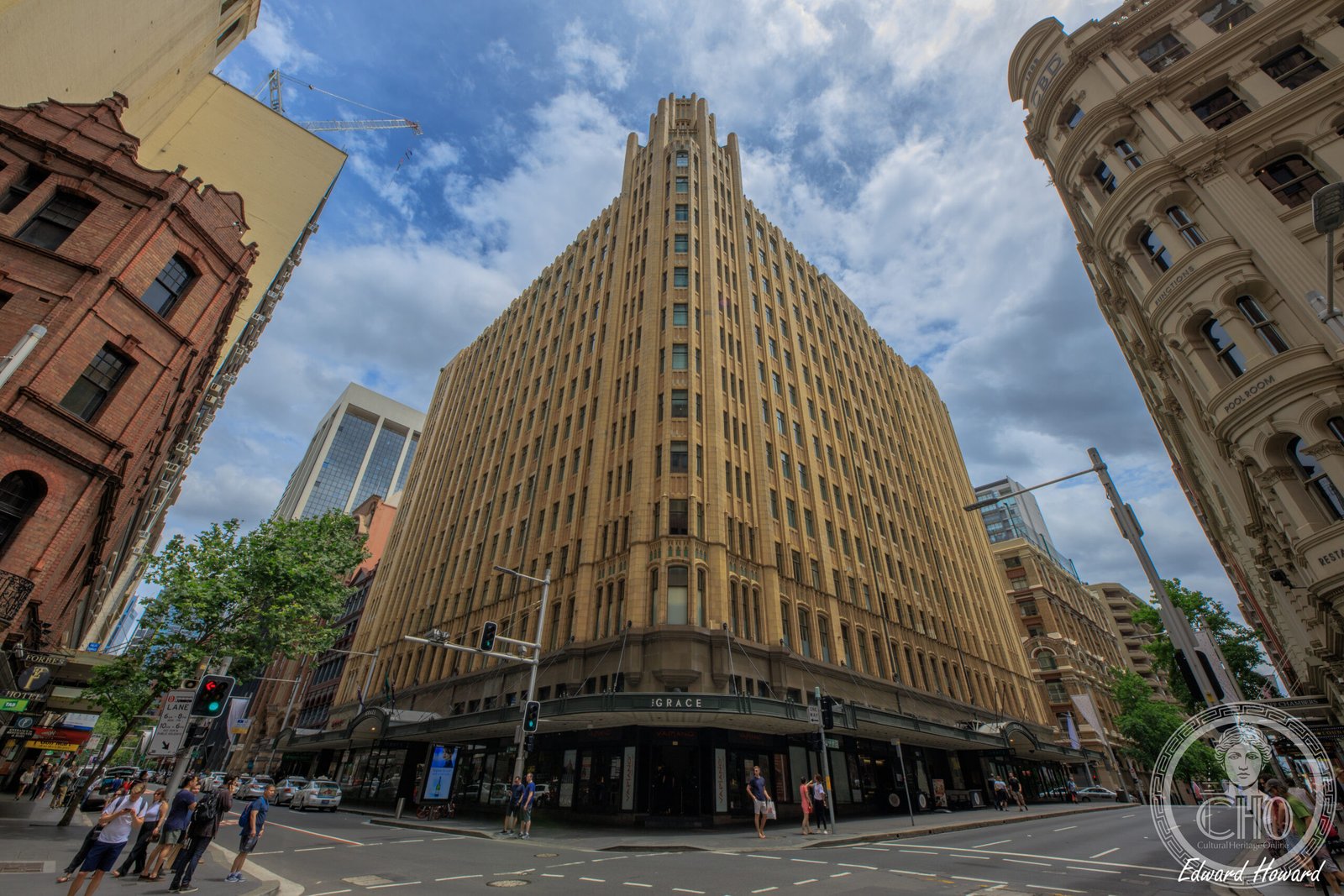
The Grace, rising eleven storeys at 77–79 York Street in the heart of Sydney’s central business district, is one of Australia’s finest examples of Gothic Art Déco commercial architecture and a building of remarkable historical depth. Completed in 1930 as the headquarters and flagship store of Grace Bros, the city’s prominent department store dynasty, it was designed by the firm of Morrow and Gordon with a cladding of glazed cream terra cotta, soaring pointed windows, flying buttresses, and quatrefoil ornament that place it firmly in the tradition of American Gothic skyscraper design. During the Second World War the building served as the Pacific headquarters of General Douglas MacArthur, lending it a significance far beyond commerce. Extensively restored in the 1990s, it reopened in 1997 as The Grace Hotel, a luxury property that preserves much of the original decorative fabric including marble floors, original light fittings, and decorative ironwork.
At a glance
- Type
- Heritage commercial building, now luxury hotel
- Period
- Completed 1930; hotel conversion 1997
- Style
- Gothic Art Déco (Federation Skyscraper Gothic)
- Location
- 77–79 York Street, Sydney CBD, New South Wales, Australia
- Coordinates
- 33.8689° S, 151.2059° E
- Architect(s)
- Morrow and Gordon
Overview
The Grace Building anchors a prominent York Street block with a façade that skillfully grafts Gothic ecclesiastical motifs onto a thoroughly modern reinforced concrete frame. Its glazed cream terra cotta skin, detailed with green ceramic accents, flying buttresses at the upper floors, and lancet windows running the full height of the building, made it one of Sydney’s most visually distinctive commercial addresses at the time of its completion. The building’s eleven floors originally housed the Grace Bros department store across the lower levels, with offices above. That layered programme — retail, commercial, then wartime command centre, then hotel — makes the building a compressed index of twentieth-century Sydney history.
History
Grace Bros opened the building in 1930 as the corporate and retail centrepiece of their growing department store empire, then one of the most powerful retail operations in New South Wales. Within little more than a decade, the trajectory of global conflict redirected the building entirely: the Commonwealth government compulsorily acquired it in 1945 after it had served as the Pacific theatre headquarters for General Douglas MacArthur and the Allied forces from 1942. After the war the building returned to commercial use, cycling through various occupants over subsequent decades. A thorough restoration project in the 1990s stripped back later accretions and reinstated key original features, leading to the reopening as The Grace Hotel in 1997 — a conversion widely regarded as a model of adaptive heritage reuse in New South Wales.
Architecture & Design
Morrow and Gordon drew on the Gothic skyscraper idiom pioneered in North America — most visibly in Cass Gilbert’s Woolworth Building in New York — to produce a design that married vertical ambition with decorative richness. The cream terra cotta cladding is articulated with green ceramic trim at the spandrels and cornices, creating a chromatic contrast that animates the façade in changing light. Flying buttresses project from the upper storeys, a purely ornamental gesture that reinforces the Gothic register. Pointed windows with tracery-like mullions run in vertical bands, emphasising height. Inside, the original construction employed reinforced concrete slab-and-beam framing — structurally modern beneath the Gothic dress — while the lobby preserves marble floors, decorative ironwork, and period light fittings that survive from the 1930 fit-out.
Cultural significance
The Grace Building holds heritage listings at both state and local level, recognised for its architectural merit and its exceptional historical associations. Its role as MacArthur’s Pacific headquarters between 1942 and 1945 gives it a place in the military and diplomatic history of the Second World War that extends well beyond Australian borders. As a work of architecture it documents the moment when Sydney’s commercial builders looked to American Gothic skyscraper models rather than the prevailing British precedents, making it an important marker of the city’s evolving cultural orientation in the interwar period. The successful hotel conversion is frequently cited in heritage conservation literature as evidence that adaptive reuse can sustain both economic vitality and historical integrity.
Visiting today
The Grace operates today as a full-service luxury hotel with guest rooms, a bar, café, and restaurant open to non-residents. The lobby and ground-floor spaces, which retain significant original fabric, are accessible to visitors during normal hotel hours. Those with an interest in the building’s wartime history will find interpretive material within the hotel. Room bookings and dining reservations can be made directly through the hotel’s website. The heritage-listed exterior is freely visible from York Street at any time.
Getting there
The Grace is located at 77–79 York Street in Sydney’s central business district, within easy reach of the city’s main public transport hubs. Wynyard Station (T1 North Shore and Western lines; T9 Northern line) is approximately 250 metres to the north on George Street, making it the most convenient rail access point. Town Hall Station is roughly 500 metres to the south. Multiple bus routes serve York Street and surrounding streets. The CBD light rail network runs along George Street nearby. Metered street parking and commercial car parks are available in the surrounding blocks.
Sources & resources
Find it on the map
See this place and what’s around it →Record researched and written by Luigi De Marchi for Cultural Heritage Online, 2026.
📷 Become a Cultural Heritage Online photographer
Share your photos of places: they stay published under your name as the author. The more they're seen, the more you get noticed — and soon a contest will reward the most appreciated photos.
Log in or sign up free to add a photoIs this page about you?
This page is read by travellers and heritage enthusiasts who find it on Google. Tell us how you are connected to this place and we will take it from there.