
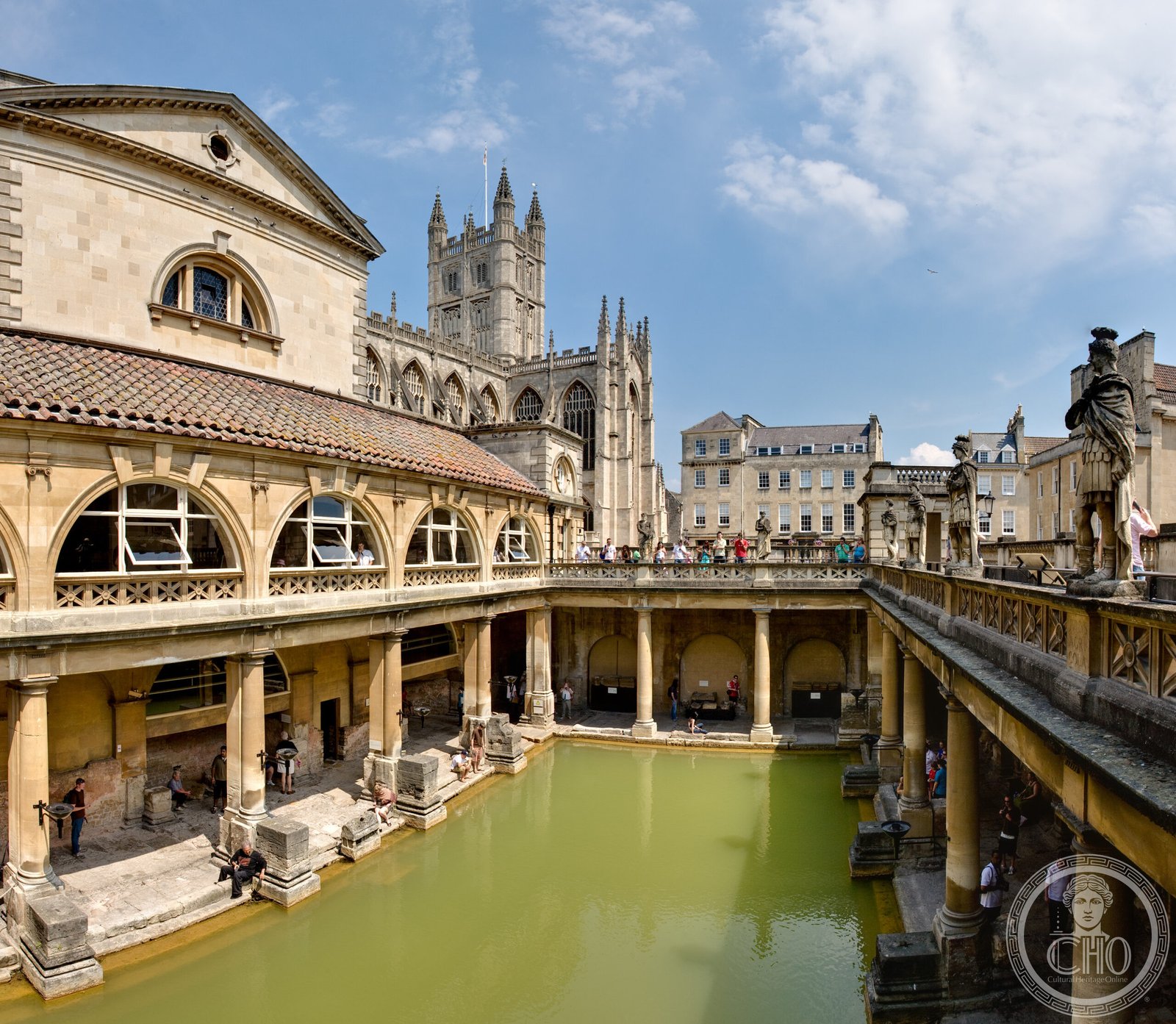
Eleven historic spa towns across seven European countries where aristocracy and intellectuals gathered for centuries to take the waters — and where Europe’s distinctive spa culture, architecture, and social ritual were born. UNESCO World Heritage Site since 2021.
At a glance
The Great Spa Towns of Europe is a transnational UNESCO World Heritage Site (2021) comprising eleven historic towns recognized for their shared spa culture that flourished from the late 17th to the early 20th century. The inscribed towns span seven countries: Bad Ischl (Austria), Spa (Belgium — the word spa originates here), Františkovy Lázně, Karlovy Vary/Karlsbad, and Mariánské Lázně/Marienbad (Czech Republic), Vichy (France), Baden-Baden and Bad Ems (Germany), Montecatini Terme (Italy), Bath (United Kingdom, already UNESCO since 1987), and Baden bei Zürich (Switzerland). Together, they represent an exceptional period in European cultural history when mineral spring towns became the preeminent leisure, health, and social destinations for the continent’s elite.
The inscription anchors at Baden-Baden, Germany’s most celebrated spa town, whose Trinkhalle (pump room, 1839–1842) and Kurhaus remain among the finest surviving examples of spa architecture anywhere in Europe.
Key facts
- UNESCO inscription: 2021, transnational serial property
- Countries: Austria, Belgium, Czech Republic, France, Germany, Italy, Switzerland, United Kingdom
- Number of towns: 11 (across 7 countries)
- Origin of the word spa: Spa, Belgium — giving its name to the global wellness industry
- Heyday: Late 17th century to the early 20th century
- Notable guests across the towns: Goethe, Beethoven, Chopin, Turgenev, Karl Marx, Napoleon III, Franz Joseph I, Kaiser Wilhelm I, Edward VII, Johannes Brahms
- Architectural typology: Pump room (Kurhaus/Trinkhalle), grand hotels, casino, concert hall, curative bathing establishments, landscaped promenades
- Baden-Baden Trinkhalle: Built 1839–1842; 90-metre colonnade with twelve frescoes depicting Black Forest legends
History
The therapeutic use of mineral springs is ancient — the Romans built elaborate bath complexes at Aquae Sulis (Bath) and Aquae Aureliae (Baden-Baden) as early as the 1st–2nd centuries CE. But the distinctive spa culture that defines these eleven towns emerged in the late 17th century, when Enlightenment medicine endorsed mineral water cures, and European aristocracy began treating spa visits as an essential social ritual.
By the 18th century, spa towns had evolved a characteristic dual identity: they were simultaneously medical establishments (where physicians prescribed drinking schedules and bathing regimes) and centres of aristocratic sociability (where the same patients promenaded, gambled, attended concerts, and transacted politics and marriage alliances). The town of Spa in Belgium was so fashionable by the 1680s that it gave its name to the entire phenomenon — the word spa entered European languages from the Belgian town’s reputation.
Karlovy Vary/Karlsbad (Czech Republic) exemplifies the cultural intensity of the spa circuit: Goethe visited thirteen times, Beethoven composed there, Chopin performed there, and Marx wrote large sections of Das Kapital during his stays. The town’s colonnaded pump rooms (the Mlýnská kolonáda and Tržní kolonáda) remain architectural masterpieces of 19th-century European design.
Baden-Baden became the summer capital of Europe in the 1830s–1860s, attracting virtually every major European monarch, writer, and composer. Dostoevsky set his novella The Gambler here after losing his fortune at the Kurhaus casino. The French bombardment of the town in 1870 (Franco-Prussian War) permanently diminished its international character, but the architectural ensemble survived intact.
The golden age ended with World War I. The democratization of health travel after 1918, the economic disruptions, and the transformation of medical practice gradually stripped spa towns of their social exclusivity. Several reinvented themselves as health tourism destinations; others entered long periods of decline. The UNESCO inscription recognizes what survives: an extraordinary concentration of purpose-built spa architecture and landscape design without parallel in the world.
What you see
Each of the eleven towns preserves a recognizable spa ensemble — a set of building types developed over two centuries specifically to serve spa culture:
- The pump room (Trinkhalle/Kurhaus): The social heart of every spa town, where guests gathered to drink the mineral waters under a colonnade or in an ornate hall. Baden-Baden’s Trinkhalle (1839–1842) has a 90-metre arcade with painted lunettes; Karlovy Vary’s Mlýnská kolonáda (1871–1881) is a cast-iron Italianate masterpiece spanning the Teplá riverbank.
- Grand hotels: Purpose-built luxury accommodation — Brenner’s Park-Hotel (Baden-Baden), the Grandhotel Pupp (Karlovy Vary), the Imperial (Vienna/Bad Ischl) — defined the social geography of each town.
- Casino and concert hall: The Spielbank Baden-Baden (casino, 1824) is among the most opulent in Europe; the Kurhaus concert hall hosted Brahms premieres.
- Curative bathing establishments: From the Roman baths of Bath (1st–4th century CE, preserved at remarkable depth) to the Friedrichsbad in Baden-Baden (1877, neo-Renaissance, with 17-stage Roman-Irish bath ritual still in use).
- Landscaped parks and promenades: Every spa town planned its green spaces as a therapeutic environment — the Lichtentaler Allee in Baden-Baden (3 km riverside promenade, planted 1655), the Colonnade Park in Mariánské Lázně, the Parc des Sources in Vichy.
Practical information
The eleven spa towns function independently as tourist destinations — there is no single entry point to the UNESCO property. Most visitors choose one or two towns to explore in depth:
- Baden-Baden (Germany): Best-preserved spa ensemble; Trinkhalle free entry; Friedrichsbad bathing from €27; Caracalla Therme (modern spa) from €18; casino visit from €5
- Karlovy Vary (Czech Republic): 13 hot springs to drink free of charge along the colonnaded walkways; spa week packages widely available; International Film Festival in July draws large crowds
- Bath (UK): Roman Baths museum adult £22.50; Thermae Bath Spa (modern spa in Georgian building) from £45; city compact and walkable
- Mariánské Lázně (Czech Republic): The most intact 19th-century spa townscape; singing fountain performs hourly; quieter than Karlovy Vary
- Vichy (France): The most historically ambiguous — capital of the collaborationist Vichy regime 1940–1944; 19th-century spa architecture is exceptional; Opéra de Vichy worth seeing
Getting there
Baden-Baden (anchor entry): Baden-Baden Airpark (FKB) has Ryanair connections to several European cities. By train from Frankfurt: ~1h 20min on ICE/IC to Baden-Baden Bahnhof (3 km from centre, bus 201/205). From Paris Gare de l’Est: ~3h by TGV to Strasbourg, then regional train (40 min) or bus. Stuttgart–Baden-Baden: ~45 min by IC train.
Karlovy Vary (Czech Republic): Prague–Karlovy Vary: ~2h by bus (Flixbus, Student Agency); no direct train. Karlovy Vary Airport has seasonal charter flights from Moscow/Tel Aviv; Prague Airport is more practical for international arrivals.
Bath (UK): London Paddington–Bath Spa: ~1h 25min by Great Western Railway. No airport in Bath; Bristol Airport 20 km away.
A Grand Spa Route driving itinerary (Baden-Baden → Vichy → Bath → Spa → Aachen → Bad Ems → Karlovy Vary → Mariánské Lázně → Františkovy Lázně → Montecatini Terme → Bad Ischl) covers all eleven towns in approximately 3,500 km and makes for a remarkable two-week cultural journey across Europe.
Nearby
Around Baden-Baden: the Black Forest (Schwarzwald) begins immediately east of the city — Baden-Baden is the gateway for hikes to the Merkur summit (cable car), the Mummelsee lake, and the high-altitude Schwarzwaldhochstrasse scenic road. Strasbourg (France) is 45 km west: Alsatian Gothic cathedral and old town. Heidelberg (Schloss + old university town) is 80 km north.
Around Karlovy Vary: Loket Castle (Hrad Loket) — a 13th-century castle on a meander of the Ohře river, 15 km east; featured in the James Bond film Casino Royale (2006). Cheb (Eger), a medieval Bohemian-German town with a distinctive market square and royal castle ruins, 40 km west. The Ore Mountains (Erzgebirge) UNESCO WHS begins 30 km north.
Sources
- UNESCO World Heritage Committee: Great Spa Towns of Europe — Inscription Decision 44 COM 8B.19 (2021), whc.unesco.org/en/list/1613
- Hembry, Phyllis: The English Spa 1560–1815: A Social History. Athlone Press, 1990.
- Cossic, Annick & Patrick Galliou (eds.): Spas in Britain and in France in the Eighteenth and Nineteenth Centuries. Cambridge Scholars Publishing, 2006.
- Baden-Baden Kur & Tourismus GmbH: www.baden-baden.com/en
- Wikipedia: Great Spa Towns of Europe
Find it on the map
See this place and what’s around it →📷 Become a Cultural Heritage Online photographer
Share your photos of places: they stay published under your name as the author. The more they're seen, the more you get noticed — and soon a contest will reward the most appreciated photos.
Log in or sign up free to add a photo