
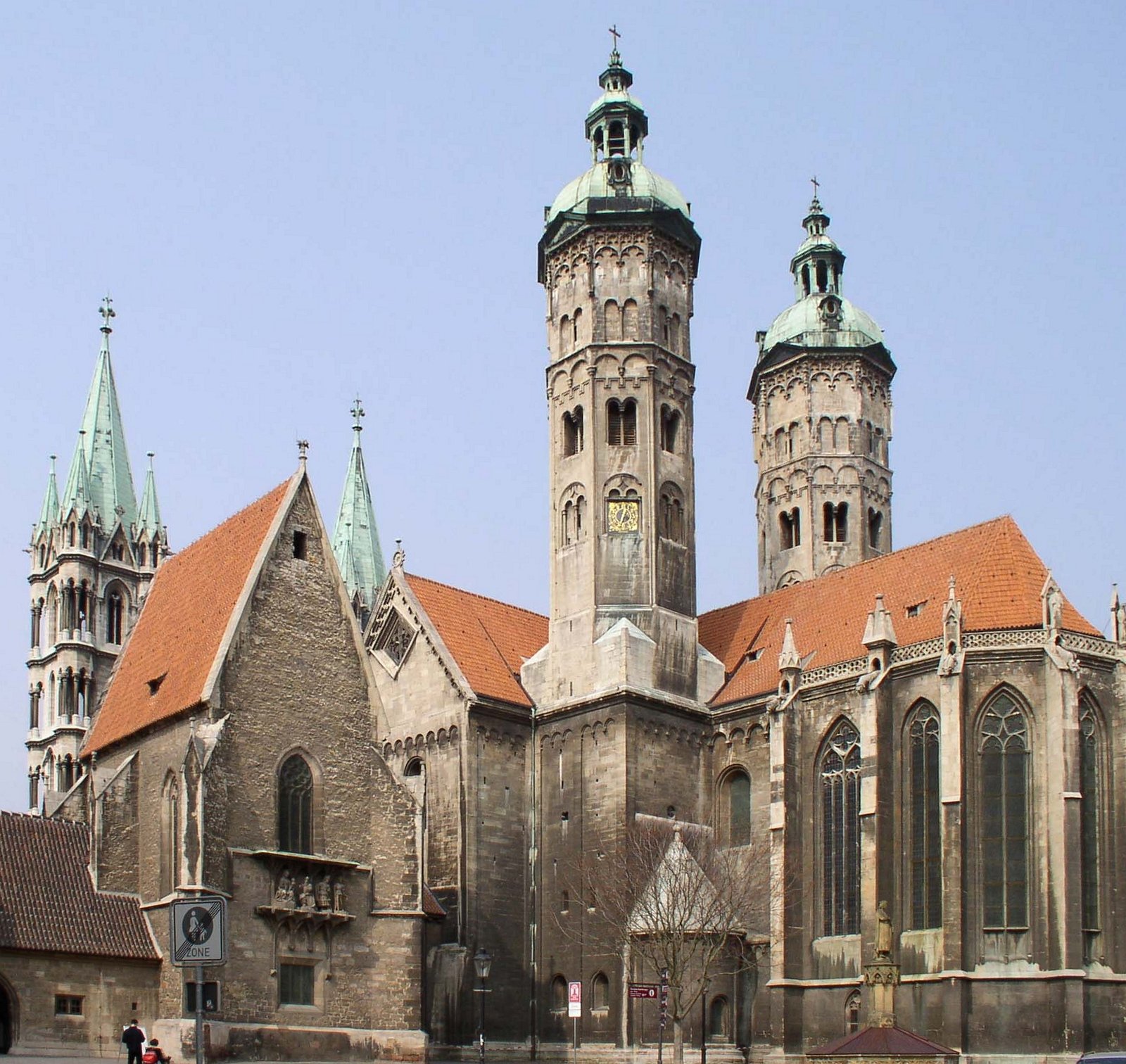
A masterpiece of High Gothic architecture in the Germanic lands and home to the most celebrated ensemble of medieval sculpture in Germany — the twelve lifelike founders’ statues carved by the anonymous Naumburg Master around 1250 CE, including the iconic Margravine Uta whose face has haunted viewers for eight centuries.
At a glance
Naumburg Cathedral (Cathedral of Saints Peter and Paul) rises above the old town of Naumburg an der Saale in Saxony-Anhalt, eastern Germany. Its construction spanned nearly three centuries, producing a building that layers Romanesque solidity with High Gothic audacity. UNESCO inscribed it in 2018 as an exceptional example of Gothic architecture in the Germanic region and, above all, as the site where medieval sculpture achieved a psychological realism centuries ahead of its time. The twelve polychrome stone figures of the cathedral’s founders — carved around 1250 CE by an unknown master of almost supernatural skill — remain among the most astonishing works of art produced anywhere in medieval Europe.
Key facts
- UNESCO inscription: 2018 (criterion i, ii, iv)
- Dedication: Saints Peter and Paul
- Construction phases: c. 1028 CE (Romanesque east choir) through early 14th century (High Gothic west choir)
- Most famous artwork: Twelve Stifterfiguren (founders’ statues) in the West Choir, c. 1250 CE
- Sculptor: The Naumburg Master (anonymous; also worked at Mainz, Metz, Amiens, and Noyon)
- Location: Naumburg an der Saale, Saxony-Anhalt, Germany
- Coordinates: 51.1508 N, 11.8124 E
History
The bishopric of Naumburg-Zeitz was established in 968 CE; the first cathedral on this site was consecrated in 1042. The current building evolved in stages. A Romanesque nave and east choir were raised in the early 12th century, then rebuilt in the late Romanesque style around the 1170s. The decisive creative moment came in the mid-13th century, when the cathedral chapter decided to construct a second, western choir as a memorial to the twelve nobles who had donated land to found the original cathedral — men and women who had been dead for over 200 years.
To decorate this memorial choir, the chapter hired a sculptor of exceptional gifts, today known only as the Naumburg Master. He had trained in the workshops of the great French Gothic cathedrals — Chartres, Reims, Amiens — absorbing their formal innovations, but pushed portraiture and psychological expression far beyond anything those schools had attempted. His twelve founders are not symbolic archetypes but individualized portraits of recognizable human beings: aged and youthful, martial and serene, proud and introspective. The Master also carved the Passion cycle on the rood screen, where Christ, Judas, Peter, Pilate, and bystanders are depicted with an almost documentary vividness.
The cathedral passed through the Reformation relatively intact; it became Protestant in 1564 but the medieval furnishings, including the priceless sculpture cycle, survived. Today Naumburg remains a working cathedral and a destination for art historians, who regard the West Choir as one of the high-water marks of medieval European art.
What you see
The West Choir: Enter to find six founders’ statues in the choir gallery. Uta von Ballenstedt — depicted pulling her collar up against the cold, head slightly tilted, gaze inward — is the most reproduced medieval sculpture in Germany. Her husband Ekkehard II stands opposite in armour, imperial in bearing. Reglindis is shown with a slight smile so natural it seems photographed rather than carved. The stone retains its original 13th-century polychrome pigments.
The Rood Screen: The carved stone Lettner separating nave from west choir contains the Naumburg Master’s Passion cycle at its expressive peak: the Last Supper, the Betrayal in Gethsemane (Judas’s face twisted with guilt), Christ before Pilate. These faces are so alive that viewers describe a sudden sense of recognition, as though meeting people known from somewhere else.
The East Choir: A serene Romanesque contrast — rounded arches, simple mouldings, calm light — where the remaining six founders’ statues are displayed.
The Towers: The exterior presents four towers, two Romanesque in the east and two Gothic in the west, rising above the Saale valley. The interplay between the two architectural idioms is visible from across the town.
Practical information
- Opening hours: Generally Mon–Sat 09:00–18:00, Sun 12:00–18:00 (seasonal; check naumburger-dom.de)
- Admission: Adults approx. EUR 8–10; concessions available; children under 6 free
- Audio guide: Available in German, English, and French at the entrance
- Photography: Permitted inside without flash; tripods require prior permission
- Guided tours: Daily tours from the main portal; group bookings available
Getting there
Naumburg an der Saale is in Saxony-Anhalt, approximately 50 km south-west of Halle and 60 km south-west of Leipzig. By rail, direct trains run from Leipzig Hbf (approx. 45 min) and Halle (approx. 40 min); the cathedral is a 12-minute walk from Naumburg (Saale) Hbf. By car, take the A9 autobahn (exit Naumburg-Ost) or the A38. The nearest international airports are Leipzig/Halle (LEJ, approx. 75 km) and Erfurt-Weimar (ERF, approx. 80 km).
Nearby
Naumburg is set in the Saale-Unstrut wine region — Germany’s most northerly wine district — with Romanesque churches dotting the landscape along the Straße der Romanik. Nearby Merseburg Cathedral (35 km north) preserves a superb Romanesque interior. The Goseck Circle — a Neolithic solar observatory, one of the oldest in Europe — lies 15 km north-east.
Sources
- UNESCO World Heritage List: Naumburg Cathedral (2018)
- Wikipedia: Naumburg Cathedral
- Official site: naumburger-dom.de
Find it on the map
See this place and what’s around it →📷 Become a Cultural Heritage Online photographer
Share your photos of places: they stay published under your name as the author. The more they're seen, the more you get noticed — and soon a contest will reward the most appreciated photos.
Log in or sign up free to add a photoIs this page about you?
This page is read by travellers and heritage enthusiasts who find it on Google. Tell us how you are connected to this place and we will take it from there.