
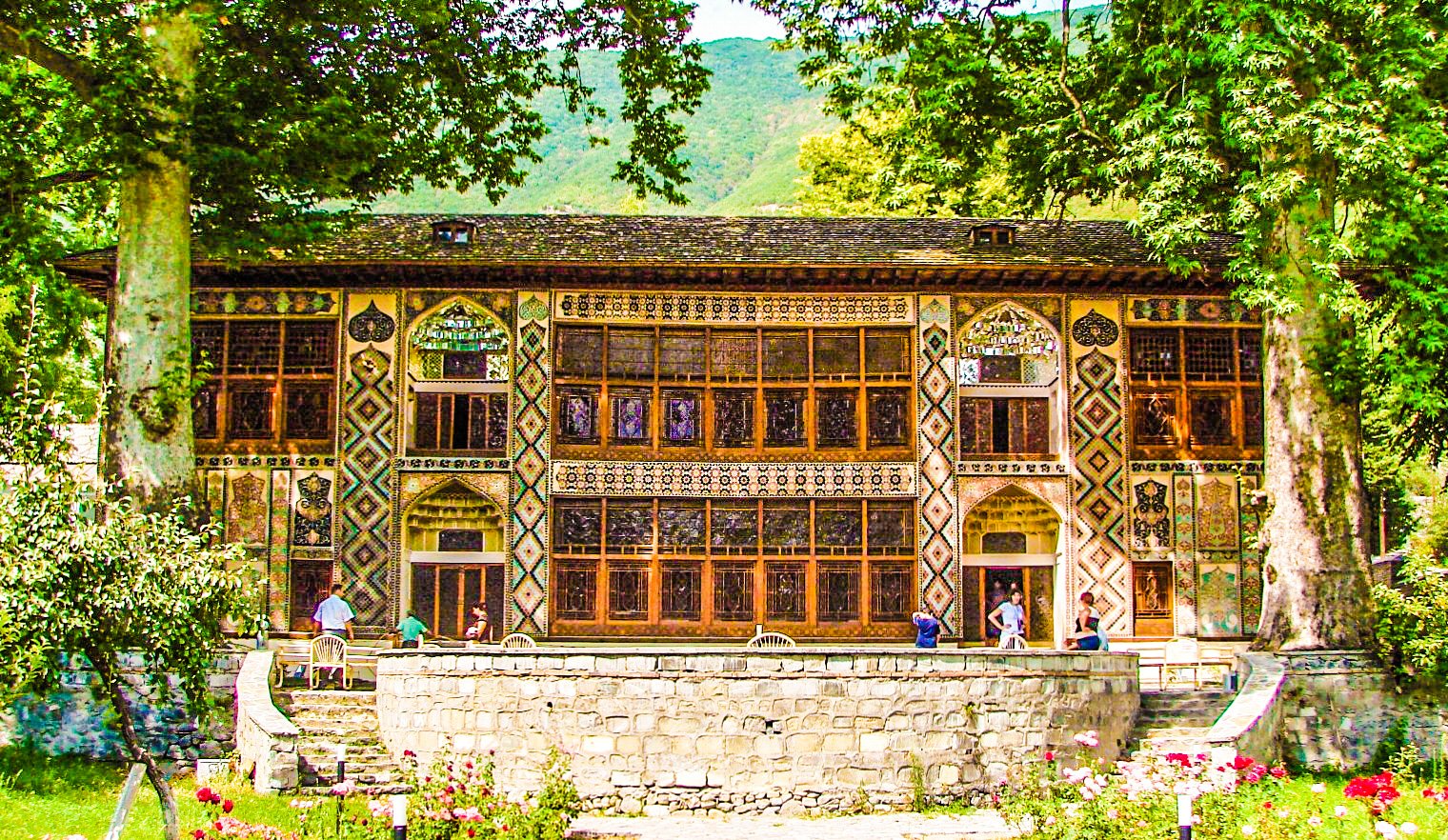
In the foothills of the Greater Caucasus, the 18th-century Khan’s Palace stands as one of the most breathtaking works of Islamic decorative art in the South Caucasus — its facade and interiors entirely clad in thousands of hand-cut coloured glass pieces and vivid hunting frescoes, all built without a single nail.
At a glance
Built in 1762 CE by Huseyn Khan of the Sheki Khanate, the palace anchors a UNESCO-inscribed historic centre that preserves the merchant quarter of a once-flourishing Silk Road city in northwestern Azerbaijan. The two-storey palace is celebrated above all for its extraordinary shebeke — a unique Azerbaijani craft of hand-cut coloured glass assembled into geometric patterns within wooden frames, using no nails or adhesive. Sheki was inscribed on the UNESCO World Heritage List in 2019.
Key facts
- UNESCO inscription: 2019 (World Heritage Site)
- Built: 1762 CE by Huseyn Khan of the Sheki Khanate
- Shebeke windows: 10,000–14,000 hand-cut glass pieces per window, no nails or adhesive
- Frescoes: Entire interior walls covered — unusual figurative scenes (horsemen, battles, animals) for Islamic art
- Caravanserai: 17th-century, one of the best-preserved in the Caucasus
- Silk heritage: Kelagayi silk scarves — UNESCO Intangible Cultural Heritage
- Location: Sheki, Sheki-Zagatala Economic Region, northwestern Azerbaijan
- Coordinates: 41.1917° N, 47.1700° E
From Silk Road caravanserai to UNESCO site
Sheki’s position at a mountain pass in the foothills of the Greater Caucasus made it a natural waypoint on routes connecting the Caspian lowlands with Transcaucasia. By the 17th and 18th centuries, the city had grown into a major silk-producing and silk-trading centre, attracting merchants from Persia, the Ottoman Empire, Russia, and beyond. The 17th-century Sheki Caravanserai — with its 24 rooms and two courtyards — survives today as one of the finest examples of Caucasian caravanserai architecture.
The Sheki Khanate, established in the mid-18th century, ruled this fertile mountain territory as a semi-independent principality under nominal Persian suzerainty. Its greatest patron was Huseyn Khan, who commissioned the palace in 1762 CE. The structure was conceived as a summer residence and reception hall, and the investment in its decoration reflects the enormous wealth flowing through Sheki’s silk trade. The khanate passed to Russian Imperial control in 1806 CE; the palace subsequently served administrative functions, which paradoxically contributed to its physical preservation.
The traditional silk-weaving industry gave rise to the distinctive kelagayi — a hand-printed silk head-scarf unique to Sheki, using natural dyes and block-printing techniques passed down through generations of artisans. UNESCO recognized the kelagayi tradition as Intangible Cultural Heritage in 2014, making Sheki doubly significant on the international heritage register.
What you see: shebeke, frescoes, and the caravanserai
The Khan’s Palace is modest in scale — a two-storey rectangular building about 27 metres long — but overwhelming in ornamental density. Every surface carries meaning. The lower and upper facades are dominated by towering shebeke windows: geometric compositions of walnut and mulberry wood interlocking into patterns of stars, hexagons, and lozenges, with each cell filled by a hand-cut piece of coloured glass (red, blue, green, yellow). No adhesive binds the glass; only the precision of the wooden frames and a lead-solder technique hold the 10,000–14,000 pieces of each window in place. The effect on a sunny afternoon — shards of coloured light sweeping across the interior — is unlike anything else in the Caucasus.
The interior walls are entirely covered with frescoes, a visual language that cuts against the standard conventions of Islamic decoration, which typically avoids human figures. Sheki’s painters depicted mounted hunters in pursuit of deer and lions, warriors in combat, and elaborately costumed courtiers. The fresco programme reads as a narrative of power and pleasure — the ideal world of the Khan projected in pigment onto every wall and ceiling.
A short walk through the old bazaar quarter brings you to the Sheki Caravanserai (17th century), its stone facade punctuated by arched gateways and the upper-storey rooms that once housed merchants and their wares. The surviving workshop tradition of kelagayi silk printing can still be observed in the old craft quarter, where artisans use wooden blocks carved with traditional motifs to print patterns on stretched silk.
Practical information
- Opening hours: Palace open daily approx. 09:00–18:00 (closed some Mondays); verify locally as hours vary seasonally
- Admission: Entrance fee applies to the palace museum; caravanserai is freely accessible
- Best time to visit: April–June and September–October for mild temperatures; summer can be hot, winter cold in the foothills
- Photography: Permitted inside the palace for personal use; check for restrictions on flash
- Language: Azerbaijani is the local language; some guides speak Russian and English
- Currency: Azerbaijani Manat (AZN); cards accepted at hotels, cash preferred at local shops
Getting there
Sheki is approximately 350 kilometres northwest of Baku. Regular bus services run from Baku’s bus terminals (journey approx. 5–6 hours). There is also a train service, though slower; buses are the more popular option. Marshrutka (shared minibus) services connect Sheki with other towns in the Sheki-Zagatala region. Within the city, the old town and palace are easily walkable from the central bazaar. Taxis are available for the short transfer from the bus station to the palace.
Nearby
- Sheki Caravanserai — 17th-century Silk Road caravanserai, 300m from the palace
- Gelersen-Görersen fortress — 18th-century hilltop fortification with panoramic views over the valley, approx. 2 km
- Kish Albanian Church — 1st-century Albanian Christian church in the village of Kish, 5 km from Sheki; one of the oldest Christian buildings in the South Caucasus
- Lahij — traditional coppersmiths’ village in the mountains, approx. 60 km southwest; UNESCO Intangible Heritage craft tradition
- Gobustan National Park — UNESCO WHS with prehistoric rock art, approx. 400 km southeast near Baku
Sources
- UNESCO World Heritage Centre — Historic Centre of Sheki with the Khan’s Palace (2019)
- UNESCO Intangible Cultural Heritage — Azerbaijani Shebeke and Kelagayi
- Wikipedia — Khan’s Palace, Sheki
- Wikipedia — Sheki, Azerbaijan
Find it on the map
See this place and what’s around it →📷 Become a Cultural Heritage Online photographer
Share your photos of places: they stay published under your name as the author. The more they're seen, the more you get noticed — and soon a contest will reward the most appreciated photos.
Log in or sign up free to add a photoIs this page about you?
This page is read by travellers and heritage enthusiasts who find it on Google. Tell us how you are connected to this place and we will take it from there.