
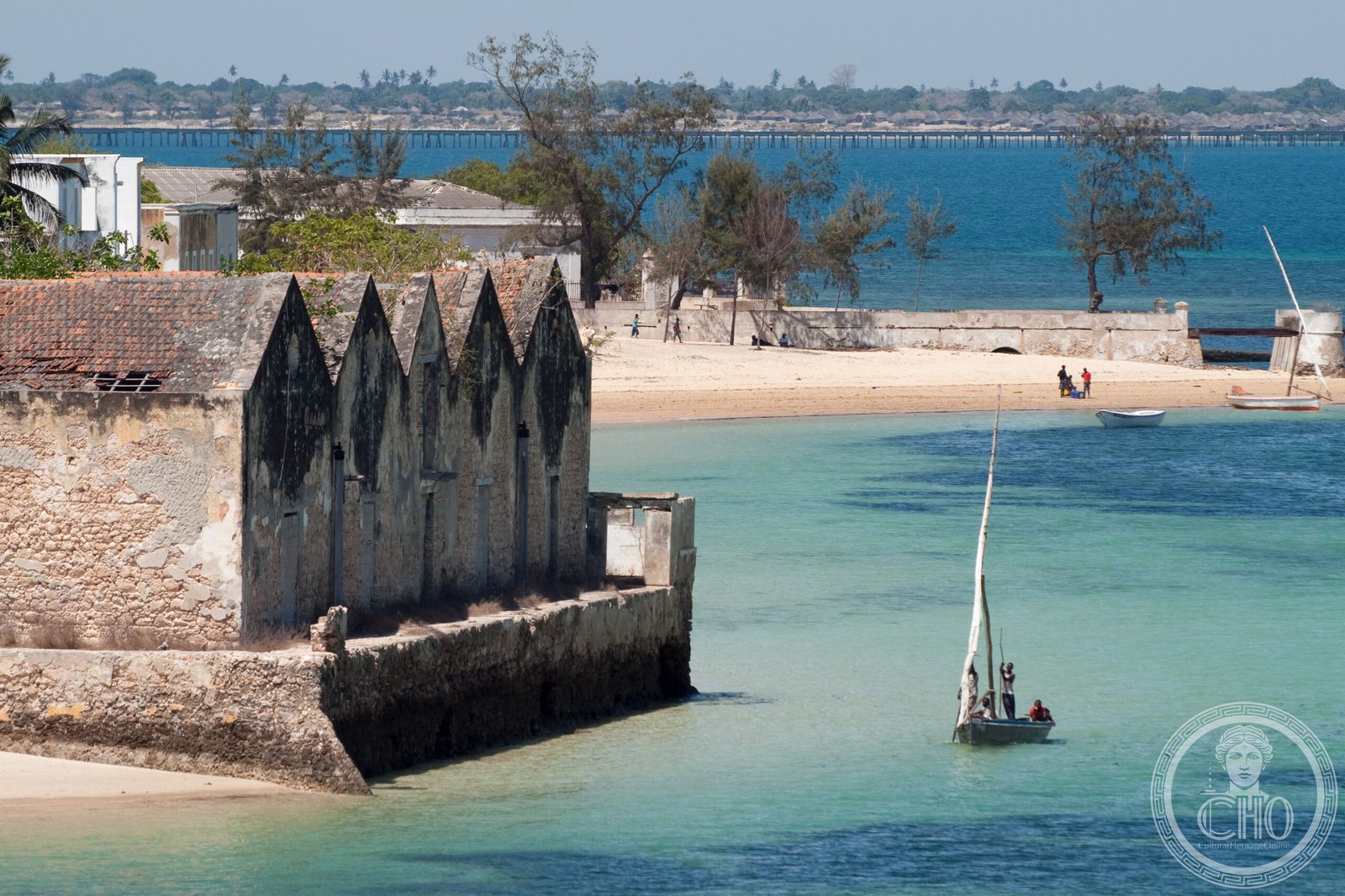
A tiny coral island off the Mozambique coast where Swahili dhow-traders, Portuguese colonial architects, Indian merchants, and Makua builders layered four centuries of civilisation into 3 kilometres of extraordinary history.
At a glance
The Island of Mozambique (Ilha de Mocambique in Portuguese) is a tiny coral island measuring just 3 km long by 500 metres wide, lying 3 km off the coast of Nampula Province in northern Mozambique. Despite its small size, it carries one of the most layered and significant architectural and historical records anywhere in Africa. Inhabited since at least the 10th century CE as a major Indian Ocean dhow-trading station, it was reached by Vasco da Gama in 1498 CE and became the capital of Portuguese East Africa from 1507 CE to 1898 CE, a span of nearly 400 years. Inscribed as a UNESCO World Heritage Site in 1991, the island is recognised for its extraordinary concentration of Swahili, Portuguese, Indian, and African architectural traditions, its largely intact historic urban layout, and its outstanding universal value as a document of the Indian Ocean trading world at the intersection of Africa, Arabia, and Asia.
Key facts
- UNESCO inscription: 1991 (Cultural)
- Size: 3 km x 500 m
- Capital of Portuguese East Africa: 1507-1898 CE (391 years)
- Vasco da Gama anchored here: 1498 CE, outbound voyage to India
- Key monuments: Fort of Sao Sebastiao (c. 1558 CE, never conquered); Palace and Chapel of Sao Paulo; Misericordia Church; colonial merchant houses (Stone Town); traditional Makua architecture (Reed Town)
- Architectural traditions: Swahili, Portuguese, Indian (Gujarati), and African Makua
- Two urban zones: Stone Town (north, coral stone, 16th-19th c.); Reed Town (south, reed and mortar, traditional Makua)
- Connection to mainland: 3 km bridge (built 1960s) is the only fixed link
History
The Island of Mozambique has been a significant node in the Indian Ocean trade system since at least the 10th century CE. Arab and Swahili dhow-traders used the island as a provisioning and commercial stop on the monsoon-driven trade routes connecting the Persian Gulf, the Red Sea, the East African coast, and India. Chinese porcelain and Persian beads found in archaeological excavations attest to the island deep involvement in this world economy long before European contact.
In March 1498 CE, Vasco da Gama anchored at Mozambique Island on his first voyage to India, seeking provisions and a pilot. The Portuguese quickly recognised its strategic value: a safe harbour on the East African coast with access to fresh water, food, and the monsoon winds needed to cross the Indian Ocean. By 1507 CE the Portuguese had established a fortified settlement and declared Mozambique Island the capital of their Estado da India operations in East Africa. The Fort of Sao Sebastiao, constructed from local coral stone from c. 1558 CE onwards, became the most powerful Portuguese military installation in sub-Saharan Africa; it was never taken by force.
For nearly four centuries, the island was the administrative, military, and commercial heart of Portuguese East Africa. Indian merchants, particularly Gujarati traders, established themselves in the Stone Town and became indispensable intermediaries in the trade between the African interior, the Portuguese colonial administration, and the wider Indian Ocean economy. The island changed character gradually as the slave trade expanded, the ivory trade shifted, and Portuguese power on the East African coast was challenged by the Oman Sultanate in the north. In 1898 CE, the colonial capital was transferred to Lourenco Marques (present-day Maputo), reducing Mozambique Island to a secondary port. This relative neglect preserved its historic fabric largely intact through the 20th century.
What you see
The island divides into two architecturally distinct zones. The Stone Town occupies the northern third of the island and is built almost entirely in coral stone, cut from the surrounding reef and laid with mortar, in a tradition that links the island to the coral-stone architecture of Zanzibar, Lamu, and Mombasa. The Fort of Sao Sebastiao at the northern tip is the most dramatic structure: its massive bastioned walls, in places 3 metres thick, enclose a chapel, cisterns, and barracks. The fort is considered one of the finest examples of 16th-century Portuguese military architecture anywhere in the world.
Within the Stone Town, the Palace of Sao Paulo (formerly the Governor Palace, 17th-18th century) now functions as a museum with an extraordinary collection of Portuguese Indo-Pacific furniture, Chinese porcelain, and Indian textiles. The Misericordia church, the oldest functioning church in sub-Saharan Africa, dates to the late 15th century CE. Colonial merchant houses line the main street with carved coral facades and Indian-influenced wooden balconies. The Reed Town in the south is densely packed with traditional Makua architecture: structures built with local cane and mortar, with decorated facades that represent a living vernacular tradition distinct from the Stone Town across the same small island.
Practical information
- Access from Nampula: Approximately 165 km northeast by road (3-4 hours by bush taxi or hired car); the road is unpaved for sections and quality varies seasonally
- Access by bus: Regular chapas (minibuses) from Nampula to Mossuril on the mainland, then a short ferry crossing or crossing via the bridge to the island
- Accommodation: Several guesthouses and small hotels on the island; advance booking recommended in high season (July-September)
- Best time: May to October (dry season). April to November is drier; December to March brings heavy rains and high humidity.
- Fort opening hours: Generally 08:00-17:00 daily; small entry fee
- Museum Sao Paulo: Morning visits; small entry fee
- Currency: Mozambican Metical (MZN); USD and EUR accepted in tourist businesses
- Language: Portuguese (official); Makua and Emakhuwa (local); English limited
Getting there
The nearest airport is Nampula Airport (APL), served by flights from Maputo (LAM Mozambique Airlines) and occasionally from Dar es Salaam and Johannesburg. From Nampula city, the island is reached by road northeast to Mossuril and across the 3-km causeway-bridge to the island. Shared bush taxis (chapas) run from Nampula central market to Mossuril; the journey takes 3-4 hours. Alternatively, organised tours from Nampula or from Pemba (to the north) can be arranged through local tour operators.
Nearby
- Chocas Mar: a quiet beach village on the mainland coast opposite the island, known for good snorkelling and diving on the Mozambique Channel reefs
- Nacala Bay: approximately 80 km northeast, one of the largest natural deep-water harbours in Africa, with Portuguese-era fortifications
- Nampula: the main northern city, 165 km southwest, with Mozambique Natural History Museum and vibrant local market
- Pemba: the capital of Cabo Delgado Province, approximately 500 km northeast, gateway to the Quirimbas Archipelago
Sources
- UNESCO World Heritage List, Island of Mozambique (1991): whc.unesco.org/en/list/599
- Pearson, M.N. (1998). Port Cities and Intruders: The Swahili Coast, India, and Portugal in the Early Modern Era. Johns Hopkins University Press.
- Newitt, M. (1995). A History of Mozambique. Hurst and Company.
- Sheriff, A. (2010). Dhow Cultures of the Indian Ocean: Cosmopolitanism, Commerce, and Islam. Columbia University Press.
Find it on the map
See this place and what’s around it →📷 Become a Cultural Heritage Online photographer
Share your photos of places: they stay published under your name as the author. The more they're seen, the more you get noticed — and soon a contest will reward the most appreciated photos.
Log in or sign up free to add a photo