

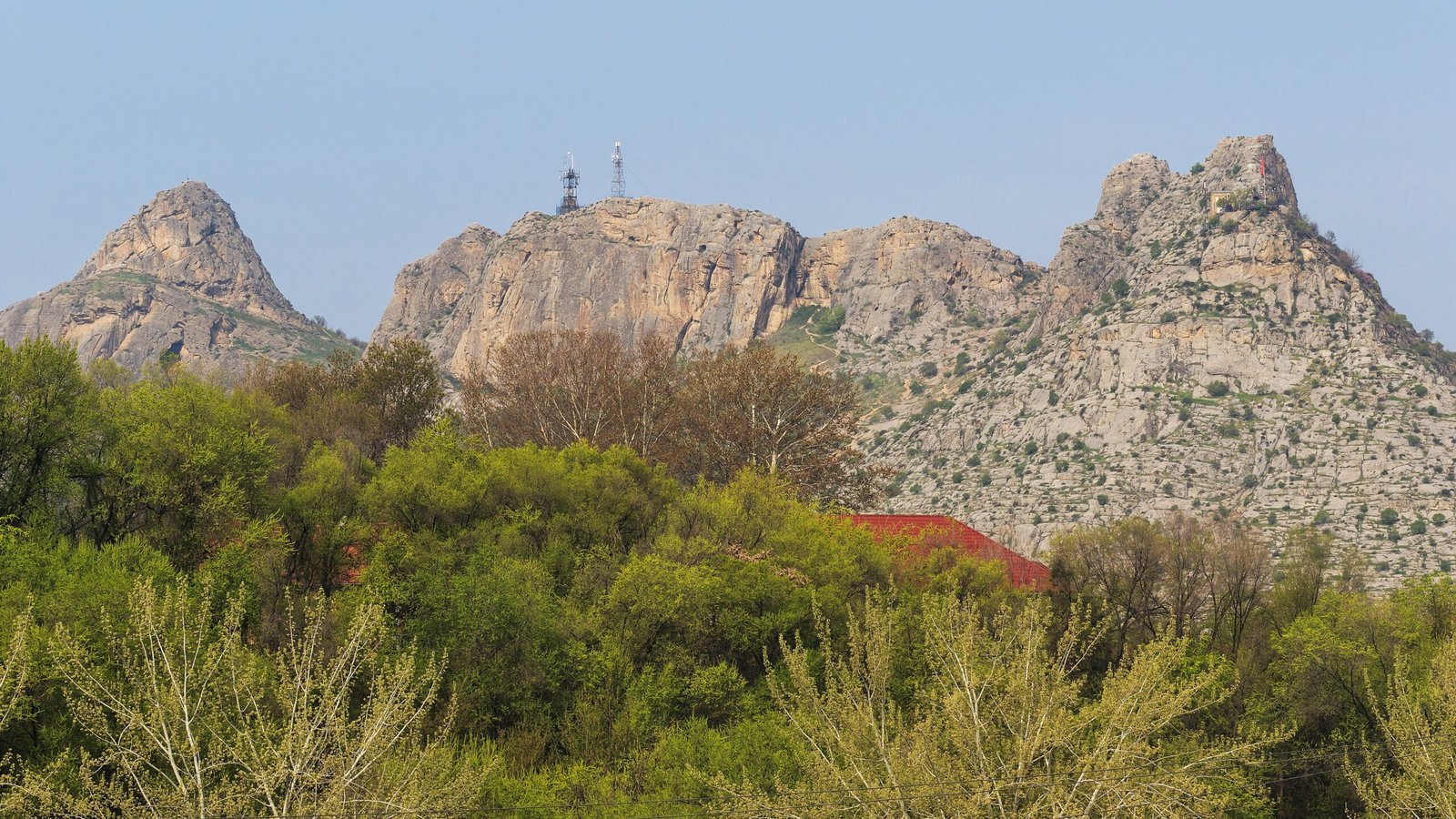
A single limestone ridge above the Fergana Valley has been venerated by shamanic, Buddhist, Zoroastrian and Islamic traditions in turn, its rock faces carrying Bronze Age petroglyphs, a cave mosque cut by the young Babur, and a summit revered as Solomon’s tomb.
At a glance
Sulaiman-Too rises above Osh, Kyrgyzstan’s second city and a longstanding crossing point of the Fergana Valley Silk Road. For some fifteen centuries the mountain has drawn worship from more than one tradition at once, a convergence of pre-Islamic Central Asian beliefs, Buddhist pilgrimage and Islamic sacred geography on the same outcrop of rock.
Key facts
- Status: Inscribed on the UNESCO World Heritage List in 2009, Property #1230
- Height: 175 metres above the surrounding plain
- Location: Osh city, Osh Province, southern Kyrgyzstan, in the Fergana Valley
- Petroglyphs: Over 100 Bronze Age and Iron Age rock carvings
- Cave mosque: Rawat Mosque, also called the House of Babur, carved into the rock around 1497–1498
- Museum: State Historical and Cultural Museum-Reserve, established 1978
History
The earliest traces on Sulaiman-Too belong to the Bronze Age and Iron Age, when more than a hundred petroglyphs were cut into the rock faces showing animals, hunting scenes and geometric symbols typical of Eurasian steppe cultures of the period. As the Silk Road took shape from the second century BCE, Osh and its mountain became fixed points on the caravan routes linking China, India, Persia and the Mediterranean.
The best-documented moment in the mountain’s history came in 1497–1498, when Zahir ud-Din Muhammad Babur, then the young Timurid ruler of Fergana and later founder of the Mughal Empire, carved a prayer niche into the rock and recorded the act in his memoir, the Baburnama. The cave mosque built around this niche, known as the Rawat Mosque or House of Babur, went on to become a stop on Central Asian Islamic pilgrimage routes. Islamic tradition identifies the summit as the tomb of the Prophet Sulaiman, Solomon, which gave the mountain its present name and continues to draw pilgrims from across Central Asia and the Middle East.
What you see
Five connected limestone peaks bear traces of human presence across several millennia. The lower slopes carry Bronze Age and Iron Age petroglyphs of horses, deer, ibex, hunting scenes and abstract geometric forms. The Rawat Mosque preserves Babur’s original prayer niche, framed by later additions built in traditional Central Asian style. The State Museum-Reserve, founded in 1978 and partly set into the mountainside, holds artefacts from the Fergana Valley spanning prehistoric to medieval times. From the summit the view takes in the city of Osh, the long-established Jayma Bazaar, and, on clear days, the distant lines of the Pamir and Tian Shan ranges.
Practical information
- Access: The mountain itself is open to visitors at all times; the museum keeps its own opening hours, best checked with the site’s official channels before visiting
- Dress: Modest dress is expected around the mosque and tomb areas
- Time to allow: A visit to the mountain circuit and museum takes a couple of hours at an easy pace
Getting there
Sulaiman-Too stands in central Osh, within easy walking distance of Jayma Bazaar. Osh is reached by domestic flights from Bishkek and by international flights into Osh Airport (OSS); the overland route from Bishkek covers roughly 680 kilometres. Current schedules and journey times are best confirmed directly with airlines or transport operators.
Nearby
- Jayma Bazaar, Osh — a short walk away; one of Central Asia’s oldest continuously operating markets, trading along the Ak-Buura River for some 3,000 years
- Uzgen Complex — about 130 km east; Karakhanid minarets and mausolea from the 11th and 12th centuries, among the finest early Islamic architecture in Kyrgyzstan
- Arslanbob — to the north; one of the world’s largest natural walnut forests, set in the Babash-Ata mountains
Sources
- UNESCO World Heritage List: Sulaiman-Too Sacred Mountain, Property #1230
- Babur, Baburnama, trans. A.S. Beveridge
- Wikipedia: “Sulayman Mountain”
Find it on the map
See this place and what’s around it →📷 Become a Cultural Heritage Online photographer
Share your photos of places: they stay published under your name as the author. The more they're seen, the more you get noticed — and soon a contest will reward the most appreciated photos.
Log in or sign up free to add a photoIs this page about you?
This page is read by travellers and heritage enthusiasts who find it on Google. Tell us how you are connected to this place and we will take it from there.