
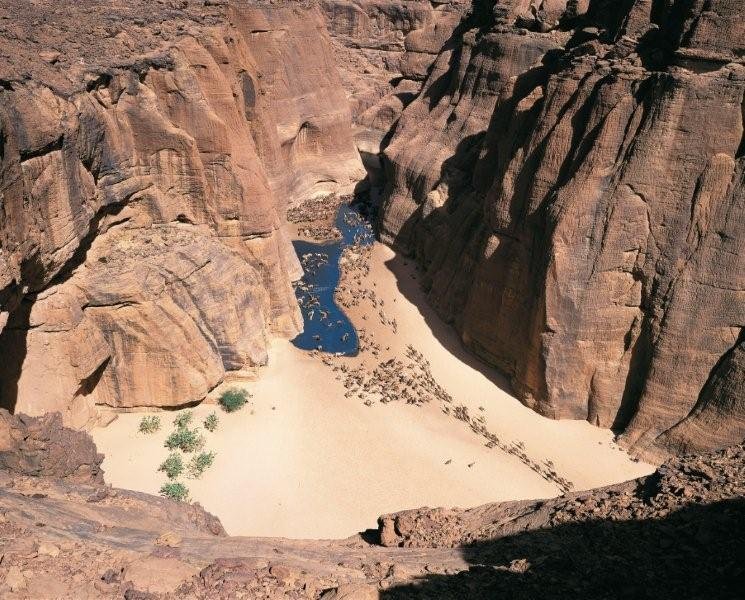
In the far northeastern corner of Chad, the Sahara is interrupted by a dramatic sandstone plateau of eroded towers, natural arches, and hidden canyons — sheltering one of Africa’s greatest concentrations of rock art, remnant Saharan wildlife, and the living pastoral culture of the Toubou people.
At a glance
The Ennedi Massif was inscribed as a UNESCO World Heritage Site in 2016 as a mixed natural and cultural property. A sandstone plateau rising sharply from the Sahara Desert in northeastern Chad, it combines three outstanding values: one of the most important concentrations of prehistoric rock art in the Sahara (spanning approximately 7,000 BCE to the present); a critical biodiversity refuge for Saharan megafauna that have disappeared from surrounding landscapes; and a living cultural landscape still inhabited by the Toubou pastoral people. It is among the most remote and least-visited UNESCO sites in the world.
Key facts
- UNESCO inscription: 2016 (mixed natural and cultural)
- Period: c. 7,000 BCE–present (prehistoric through modern Toubou pastoral)
- Location: Ennedi-Est and Ennedi-Ouest Regions, northeastern Chad
- Geology: Sandstone plateau (Nubian Sandstone formation), heavily eroded into towers, arches, and canyons
- Rock art: Thousands of paintings and engravings, among the most important in the Sahara
- Wildlife: Last populations of West African crocodile, addax, Barbary sheep (aoudad), painted hunting dog in isolated refugia
- Access: 4WD expedition only; one of Africa’s most remote sites
History
The Ennedi Massif sits at one of the most important archives of human environmental and cultural history in Africa. The rock art record begins approximately 7,000 BCE, during the “Green Sahara” period (c. 7000–3500 BCE) — a prolonged humid phase when the current Saharan desert was a moist savannah with permanent water bodies, forests, and abundant wildlife. The paintings from this era depict animals now absent from the region: hippopotamuses, crocodiles, elephants, giraffes, hunting dogs, and domestic cattle. They were painted by communities who lived in a radically different Sahara, one so unlike the present landscape that their images seem fantastical to modern eyes.
As the Sahara dried over millennia, the rock art record documents the progressive shift in human adaptation and animal life: the cattle herders of the Neolithic give way to horse-using pastoralists (c. 1500–500 BCE), then to camel-riding peoples as the desert deepened. Images of the same motifs — animals, human figures, hunting and herding scenes — span thousands of years, making the Ennedi one of the world’s longest continuous artistic traditions in a single landscape.
The Toubou, the indigenous people of the Ennedi, have inhabited the massif for centuries. Their pastoral culture — centred on camels, goats, and seasonal movement between water sources — is adapted to the extreme aridity of the Sahara. They remain the primary human presence in the massif today, and their rock art tradition continues into the contemporary period.
What you see
The Ennedi’s geological character is its first spectacle: sandstone towers, natural rock arches (some among the largest in Africa), slot canyons, and isolated water-filled guelta (pools) that support remarkably dense life in an otherwise waterless desert. The Archei guelta, perhaps the most famous, shelters a small relict population of the West African crocodile — a population isolated for thousands of years as the Sahara dried, now constituting one of the northernmost crocodile populations on earth.
The rock art sites are distributed across hundreds of canyon walls, overhang shelters, and rock faces throughout the massif. No single “site” captures the tradition; it is landscape-scale. The paintings and engravings are executed in various techniques — painted outlines, filled silhouettes, incised engravings — and range from palm-sized individual animal figures to wall-filling composite scenes. Specialist guided tours can reach particularly rich concentrations in the Bachikélé, Gora, and Niola Doa areas.
The landscape itself, explored by 4WD caravans over multi-day expeditions, is the defining experience: sleeping under stars, following ancient caravan tracks between water sources, and encountering Toubou nomadic camps.
Practical information
- Access: 4WD expedition only; no paved roads within the massif
- Entry point: Faya-Largeau (nearest significant town, ~300 km west) or from N’Djamena by air then overland
- Organised tours: Several specialist operators run expeditions from N’Djamena or via Sudan; independent travel is possible but complex — permits and a local guide are required
- Duration: Typical expeditions range from 10 to 21 days to adequately explore the massif
- Best time: November to February (cooler, dry season); summer temperatures exceed 45°C and are life-threatening without proper preparation
- Permits: Tourism permit required; obtain through the Chad Ministry of Tourism in N’Djamena
Getting there
The Ennedi Massif is one of the most logistically demanding destinations in this guide. The nearest airport with commercial connections is N’Djamena International Airport in Chad’s capital. From N’Djamena, charter or military flights sometimes reach Fada (in the Ennedi-Est region) or Faya-Largeau; otherwise, the overland journey from N’Djamena takes 3–5 days by 4WD across difficult desert terrain. The vast majority of visitors travel as part of organised specialist expeditions, which handle all logistics including permits, fuel, water, food, and local Toubou guides. The Chad security situation varies; check current foreign ministry advisories before planning travel.
Nearby
- Ounianga Lakes — UNESCO WHS for its extraordinary series of desert lakes in northern Chad, approximately 300 km north-west of the Ennedi
- Tibesti Mountains — volcanic massif and prehistoric rock art site in northwestern Chad, even more remote
- Wadi Howar — archaeological corridor through Sudan marking the Green Sahara migration routes
- Aïr and Ténéré Natural Reserves — UNESCO WHS in neighbouring Niger, a comparable Saharan rock art and landscape site
Sources
- UNESCO World Heritage — Ennedi Massif: Natural and Cultural Landscape
- Wikipedia — Ennedi Massif
Find it on the map
See this place and what’s around it →📷 Become a Cultural Heritage Online photographer
Share your photos of places: they stay published under your name as the author. The more they're seen, the more you get noticed — and soon a contest will reward the most appreciated photos.
Log in or sign up free to add a photo