
Eight archaeological sites across South Korea’s Chungcheong and Jeolla Provinces that document the final two centuries of the Baekje Kingdom — one of the Three Kingdoms of Korea — when it became a cultural conduit transmitting Buddhism, writing, architecture, and decorative arts to Japan. Inscribed as a UNESCO World Heritage Site in 2015, the sites include walled hilltop fortresses, royal tombs, and the largest known wooden pagoda site in East Asia.
At a glance
Baekje (18 BCE–660 CE) occupied the southwestern Korean peninsula and at its height rivalled the Silla and Goguryeo kingdoms to its east and north. The UNESCO inscription focuses on the period after 475 CE, when Baekje relocated its capital first to Woongjin (modern Gongju) and then to Sabi (modern Buyeo), following military pressure from Goguryeo. During this period Baekje’s influence on Japanese culture was profound: craftsmen, monks, scribes, and architects travelled across the Korea Strait carrying Buddhism (officially transmitted to Japan in 552 CE), the Chinese writing system, roof tile technology, and a distinctive sculptural style visible in Japan’s earliest Buddhist icons.
The eight component sites are grouped around three areas: Gongju (the Gongsanseong Fortress and Songsan-ri Tomb Complex), Buyeo (Busosanseong Fortress, Gwanbuk-ri Archaeological Site, Jeongnimsa Temple Site, and Neungsan-ri Ancient Tombs), and Iksan (Wanggung-ri Archaeological Site and Mireuksa Temple Site). Together they present a comprehensive picture of Baekje royal, religious, and administrative life.
Key facts
- UNESCO inscription: 2015 (Cultural, Criteria ii, iii)
- Number of component sites: 8
- Period covered: c. 475–660 CE (later Baekje, Two Capitals period)
- Kingdom: Baekje, one of the Three Kingdoms of Korea
- Key event: King Muryeong’s tomb (Gongju) found intact in 1971 — one of the few undisturbed Korean royal tombs
- Mireuksa Temple: Contained the largest wooden pagoda ever built in East Asia (c. 600 CE)
- Sarira discovery: 2009 excavation at Mireuksa west stone pagoda revealed intact golden sarira container in the foundation stone
- Cultural transmission: Baekje directly transmitted Buddhism, writing, and architecture to Japan in the 6th century
History
The Baekje Kingdom traced its legendary origins to Onjo, son of the founder of Goguryeo, who established a capital near modern Seoul around 18 BCE. For its first four centuries Baekje was centred on the Han River basin; under pressure from Goguryeo it relocated south to Woongjin (Gongju) in 475 CE, and then further south to Sabi (Buyeo) in 538 CE. These two capitals — and the secondary ritual centre at Iksan — are the focus of the UNESCO inscription.
The reign of King Muryeong (501–523 CE) marked a high point: Baekje conducted an active diplomacy with the Southern Chinese dynasties and with Japan, and Muryeong’s tomb at Gongju, discovered intact in 1971, revealed an extraordinary array of gold jewellery, Chinese coins, and Japanese bronze mirrors attesting to this international network. A brick chamber tomb in a style derived from Chinese Southern Qi models, it was the first Korean royal tomb to be conclusively identified by an inscription naming the deceased.
Baekje’s cultural contribution to Japan is one of the most significant in East Asian history. In 538 CE (or 552 CE, according to some sources), the Baekje court officially transmitted a gilded bronze Buddha image and sutras to the Yamato court in Japan, marking the formal introduction of Buddhism to Japan. Baekje craftsmen built the first Buddhist temples in Japan, including Horyuji (c. 607 CE), and introduced the Chinese writing system (hanja/kanji) and a system of Confucian scholarship.
The kingdom ended in 660 CE when a combined Tang Chinese and Silla alliance overwhelmed the Sabi capital. A brief restoration movement (the Baekje Restoration War, 660–663 CE) failed despite Japanese military support at the Battle of Baekgang. The remnant Baekje aristocracy was absorbed into the Tang administration or fled to Japan, carrying their crafts and scholarship with them.
What you see
At Gongju, the Gongsanseong Fortress is a well-preserved hilltop earthwork and stone fortress (originally earthwork, reinforced in stone during the Joseon period) commanding the Geum River; its walls and gatehouses are walk-able. The Songsan-ri Tomb Complex nearby presents a series of burial mounds; the replica of King Muryeong’s brick chamber tomb can be entered (the original is closed to prevent deterioration), and the adjacent museum displays the original gold crown ornaments, bronze mirrors, and jade pendants found inside.
At Buyeo, the Busosanseong Fortress preserves the Nakwha Rock (Falling Flowers Rock) above the Baengma River, where legend holds that court ladies jumped to their deaths rather than submit to the Tang invaders in 660 CE. The Neungsan-ri Ancient Tombs are a grouping of seven large earthen tumuli; one is accessible and reveals a painted chamber with lotus and cloud motifs.
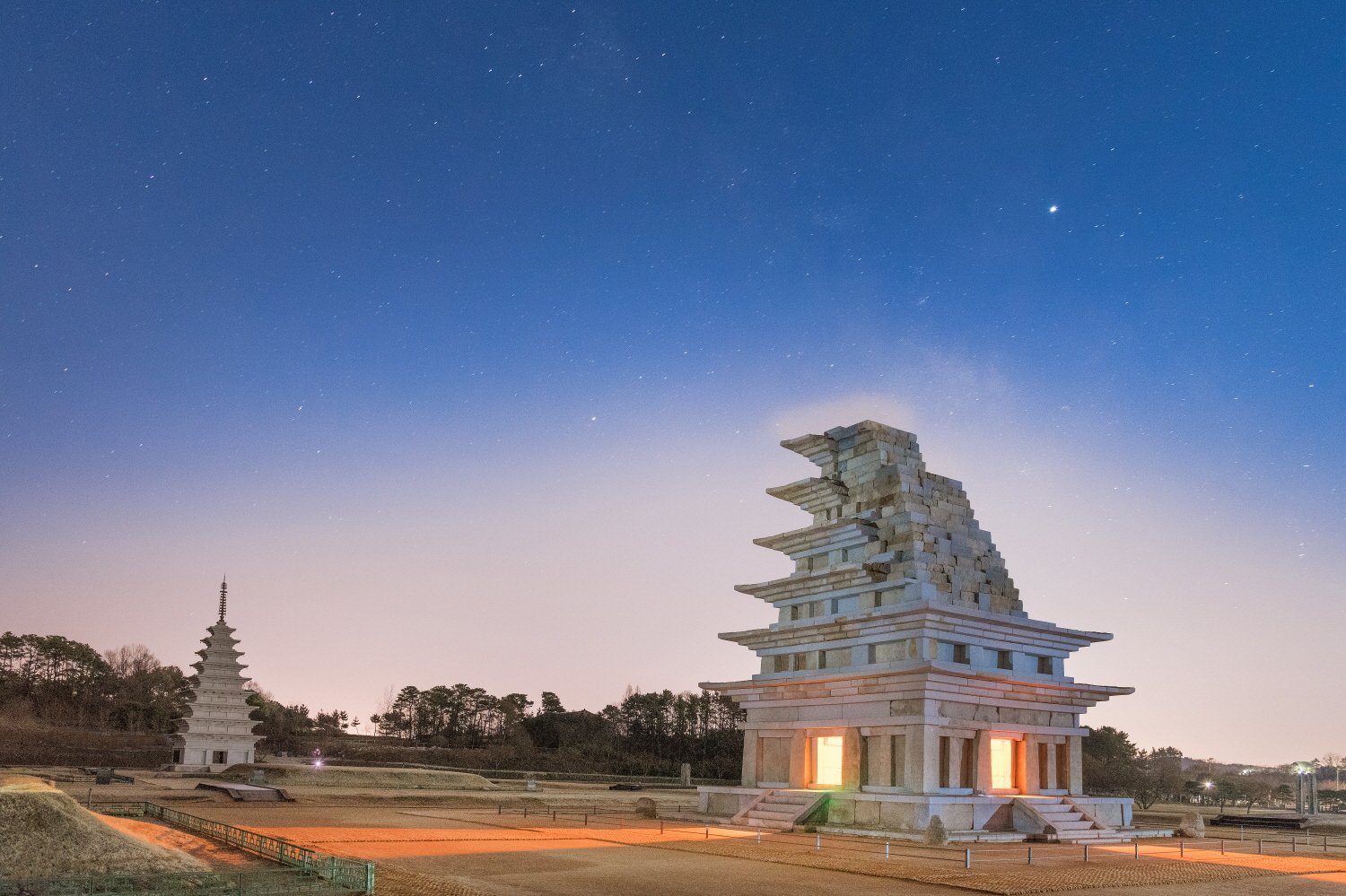
At Iksan, the Mireuksa Temple Site is the most extraordinary archaeological site in the group. The west stone pagoda — the oldest and largest surviving stone pagoda in Korea, modelled on the wooden original — was painstakingly dismantled and reconstructed between 1999 and 2019; during dismantling in 2009 workers discovered an intact sarira reliquary in the foundation stone, containing a golden container with an inscription dating it to 639 CE and naming the royal donor.
Practical information
- Main hubs: Gongju and Buyeo, both in South Chungcheong Province
- Gongju National Museum: Houses the King Muryeong tomb burial goods; essential visit before the tomb complex
- Buyeo National Museum: Covers the Sabi period; includes the Baekje Incense Burner (National Treasure no. 287), a masterpiece of gilt-bronze metalwork
- Iksan: Accessible by KTX from Seoul (approx. 1 hour) or bus from Jeonju
- Recommended time: 2–3 days to cover all three areas
- Entrance fees: Modest fees apply at most sites; national museums free on certain days
Getting there
Gongju is approximately 1.5 hours by bus from Seoul’s Gangnam Bus Terminal. Buyeo is 30 minutes from Gongju by intercity bus. The two towns are also accessible from Daejeon (approximately 1 hour bus) which is on the KTX Seoul–Busan main line. The Iksan sites are most easily reached from Iksan Station, served by KTX from Seoul (approximately 1 hour) and from Jeonju (20 minutes by local train).
Nearby
- Jeonju Hanok Village: 40 minutes south of Iksan; a preserved Joseon-era townscape with Korea’s largest concentration of traditional hanok houses
- Gyeongju Historic Areas (Korea): The Silla kingdom capital; UNESCO WHS; allows comparison of Baekje and Silla material culture
- Horyuji Temple, Japan: Built by Baekje craftsmen; the world’s oldest surviving wooden structures; shows the direct architectural legacy of Baekje
Sources
- UNESCO World Heritage List: Baekje Historic Areas (2015) — whc.unesco.org/en/list/1477
- Wikipedia: Baekje Historic Areas
- Gongju National Museum: gongju.museum.go.kr
Find it on the map
See this place and what’s around it →📷 Become a Cultural Heritage Online photographer
Share your photos of places: they stay published under your name as the author. The more they're seen, the more you get noticed — and soon a contest will reward the most appreciated photos.
Log in or sign up free to add a photo