

Twelve sites across the Nagasaki region and Amakusa Islands that bear witness to an extraordinary episode of cultural survival: a Japanese Catholic community that maintained its faith clandestinely for over 250 years under threat of execution, blending Marian devotion with Buddhist and Shinto outward forms, before emerging into the open when Western missionaries returned in 1865. Inscribed as a UNESCO World Heritage Site in 2018.
At a glance
The Hidden Christian Sites are not a single monument but a scattered archipelago of memory: castle ruins, remote island villages, and churches spread across the Nagasaki Peninsula, the Goto Islands, and the Amakusa Islands of Kyushu. Together they document the complete arc of Japanese Christianity — its introduction by Jesuit missionaries in 1549, its brutal suppression between 1597 and 1650, the 250-year era of clandestine practice by the Kakure Kirishitan (Hidden Christians), and the astonishing moment of re-emergence when thousands of practising Catholics revealed themselves to a French missionary at Urakami in 1865.
The 12 sites include the ruins of Hara Castle, where the Shimabara Rebellion ended in the massacre of some 37,000 Christian peasants in 1638; remote island communities on Nozaki, Kashiragashima, and Hisaka islands whose churches preserve the spatial logic of hidden worship; and the Urakami Cathedral, rebuilt after the 1945 atomic bomb partially destroyed it.
Key facts
- UNESCO inscription: 2018 (Cultural, Criteria iii)
- Number of component sites: 12
- Period of prohibition: 1614–1873 (effective total ban; executions until 1650s)
- Years of clandestine practice: approx. 250 years
- Shimabara Rebellion: 1637–38; approximately 37,000 killed at Hara Castle
- Re-emergence at Urakami: 1865 (Hidden Christians identify themselves to Fr. Petitjean)
- Atomic bombing of Urakami Cathedral: 9 August 1945 (rebuilt 1925 original partially destroyed)
- Region: Nagasaki Prefecture and Kumamoto Prefecture (Amakusa), Kyushu
History
Christianity arrived in Japan with the Jesuit missionary Francis Xavier in 1549, and spread rapidly through the western domains of Kyushu, where local lords found it a useful counterweight to Buddhist temple authority. By 1600, there were an estimated 300,000 Japanese Christians. The first great persecution came in 1597, when Toyotomi Hideyoshi ordered the crucifixion of 26 Christians — Japanese converts and foreign missionaries — on a hill above Nagasaki. This event, known as the Martyrdom of the 26 Saints of Japan, is commemorated at the Martyrs’ Monument in Nishizaka, Nagasaki, one of the 12 UNESCO sites.
The Tokugawa shogunate intensified suppression from 1614, requiring all Japanese subjects to register with a Buddhist temple (the terauke system), publicly trample on religious images (fumie), and denounce Christians. Missionaries were expelled or executed; Japanese Christians who refused to apostatise faced death by crucifixion, burning, or the notorious practice of suspended torture in a pit. By the mid-17th century, open Christianity had been effectively eliminated — or so the authorities believed.
In the coastal villages and remote islands of the Nagasaki region, however, communities of Kakure Kirishitan had gone underground. They preserved their faith across generations through oral transmission, prayers that had gradually transformed into Japanese rhythms barely recognisable as Latin, and devotional practices hidden within Buddhist and Shinto ritual forms. The figure of Maria Kannon — the Virgin Mary disguised as the Buddhist bodhisattva Kannon — became an iconic expression of this syncretistic survival.
When France obtained a clause guaranteeing freedom of worship for foreigners in the 1858 treaties, a French mission was allowed to build Oura Cathedral in Nagasaki. In 1865, a group of villagers from Urakami approached Fr. Bernard Petitjean and disclosed that they had been secretly Christian for generations — the Discovery of Hidden Christians that astonished the world. Subsequent persecution by the Meiji government (1867–1873) saw thousands exiled; final emancipation came with the Meiji constitution of 1873.
What you see
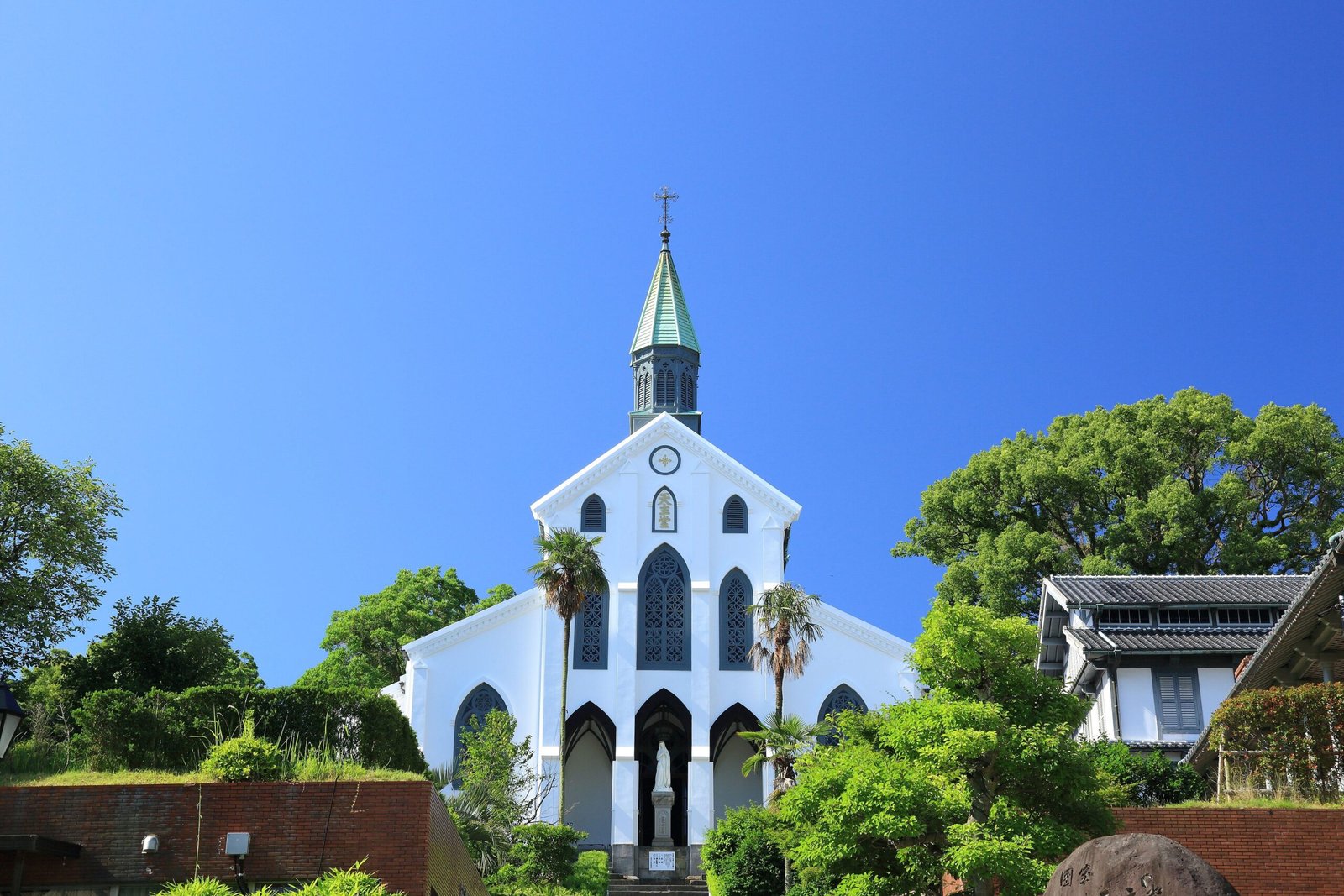
The 12 component sites vary widely in character. Oura Cathedral (Nagasaki city, 1864–65) is a Gothic Revival structure built by French missionaries — the only building in Japan designated a National Treasure on the day of its construction — and remains an active church. The ruins of Hara Castle on the Shimabara Peninsula are a low earthwork site with a dramatic clifftop setting above the Ariake Sea.
The island sites — Nozaki Island, Kashiragashima Island, Hisaka Island, Kuroshima Island — are the most evocative. Remote, sparsely populated, and often visited by boat, their stone churches and cluster-village layouts reflect centuries of isolation. The Kuroshima Catholic Church (1897) is particularly distinguished, with its red-brick Romanesque exterior rising incongruously above the fishing community that built it.
The rebuilt Urakami Cathedral (1925, reconstructed 1959 after 1945 damage) stands in a residential neighbourhood; outside it preserves a blackened stone head of Mary, partly melted by the heat of the atomic bomb, which has become one of Nagasaki’s most powerful memorials.
Practical information
- Central hub: Nagasaki city is the practical base for most sites
- Oura Cathedral: 10-minute walk from Nagasaki Station; entry fee applies
- Island sites: Require ferry travel; Goto Islands accessible from Nagasaki Port; Amakusa from Misumi (Kumamoto)
- Shimabara Peninsula: Accessible by JR Nagasaki Line to Shimabara; hara Castle ruins approachable on foot
- Urakami Cathedral: Free admission; open daily
- Recommended time: 2–4 days to cover the Nagasaki city sites and one island group
Getting there
Nagasaki city is served by the JR Nagasaki Line from Hakata (Fukuoka), approximately 2 hours by limited express. The Nishikyushu Shinkansen now connects Nagasaki to Hakata in under 1.5 hours (change at Takeo-Onsen). From Nagasaki, trams and buses serve the city sites; island sites require ferry connections from Nagasaki Port or the Goto Ferry Terminal.
Nearby
- Nagasaki Peace Park and Atomic Bomb Museum: The 1945 bombing epicentre, 3 km north of Nagasaki Station
- Dejima, Nagasaki: The reconstructed Dutch trading post — the only permitted Western presence in Japan during the period of isolation (1641–1853)
- Amakusa Islands: The Amakusa component sites of the WHS; known also for dolphin-watching and a distinctive culinary tradition
Sources
- UNESCO World Heritage List: Hidden Christian Sites in the Nagasaki Region (2018) — whc.unesco.org/en/list/1535
- Wikipedia: Hidden Christian Sites in the Nagasaki Region
- The Japan Catholic Council: cbcj.catholic.jp
Find it on the map
See this place and what’s around it →
📷 Become a Cultural Heritage Online photographer
Share your photos of places: they stay published under your name as the author. The more they're seen, the more you get noticed — and soon a contest will reward the most appreciated photos.
Log in or sign up free to add a photo