
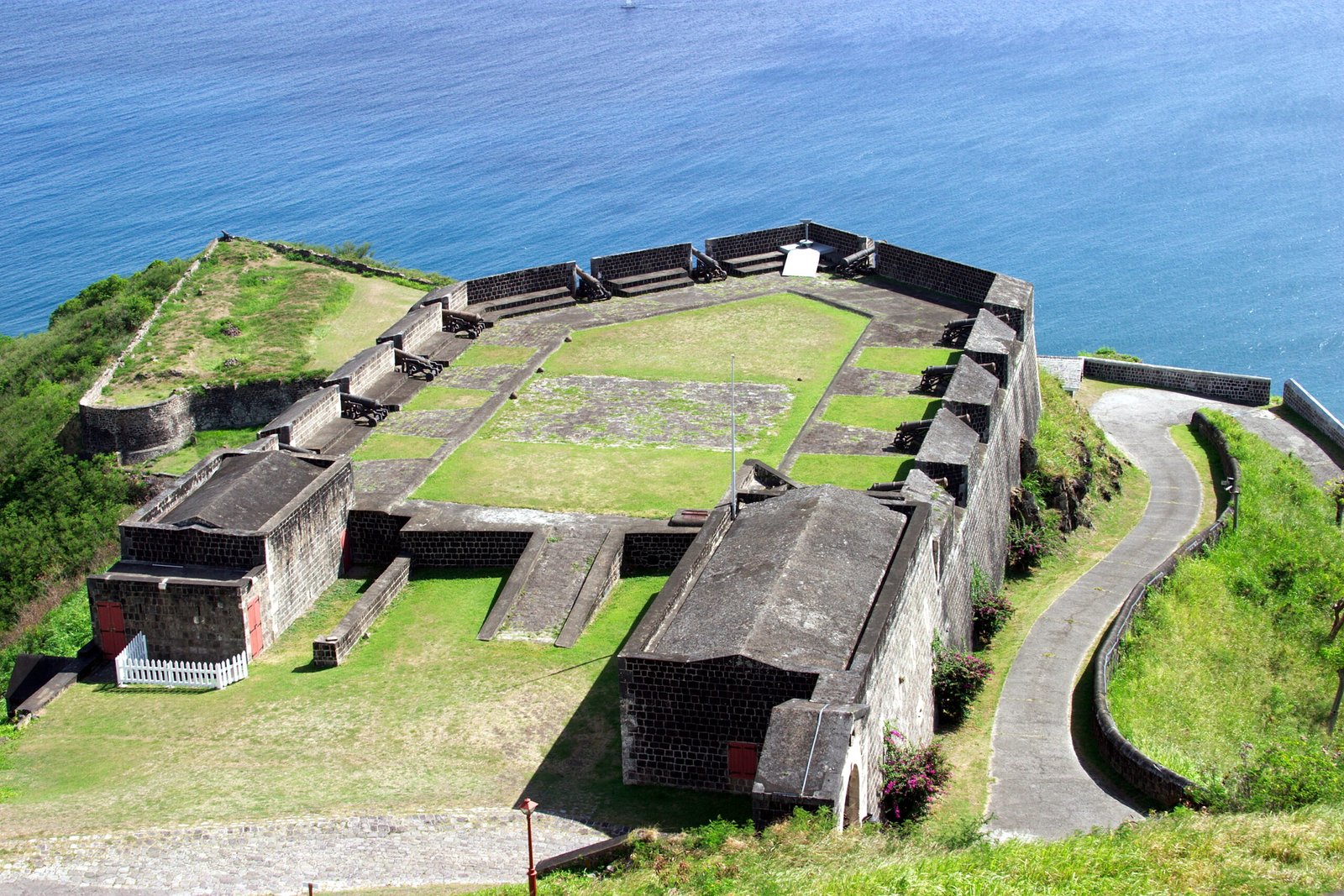
Perched 240 metres above the Caribbean on the summit of an extinct volcanic hill, Brimstone Hill is the best-preserved colonial military fortification in the Americas — a century of British engineering condensed into walls up to 12 metres thick, earning it the sobriquet the Gibraltar of the West Indies.
At a glance
Inscribed as a UNESCO World Heritage Site in 1999, Brimstone Hill Fortress National Park protects a sprawling complex of bastions, gun batteries, magazines, and barracks built by the British between 1690 and 1790 on the northwestern coast of St. Kitts. The volcanic hill rises so steeply from the surrounding lowlands that it was considered virtually impregnable — a reputation tested only once, in 1782, when 8,000 French troops needed 26 days of sustained bombardment to force the surrender of a garrison of 1,000 defenders.
Key facts
- UNESCO inscription: 1999
- Elevation: 240 m above sea level
- Construction period: c. 1690–1790 CE (British colonial)
- Active military use: 1690–1853 CE
- Main structure: Fort George Citadel — walls up to 12 m thick
- Only successful siege: French, 1782 (26 days, 8,000 troops vs. 1,000 defenders)
- Decommissioned: 1853, British Army
- Nickname: The Gibraltar of the West Indies
- Coordinates: 17°21′N, 62°50′W
History
The British began fortifying Brimstone Hill in 1690, after a French assault temporarily expelled them from St. Kitts. The volcanic outcrop — its flanks nearly vertical — offered a commanding position over the western sea lanes and the straits between St. Kitts and Sint Eustatius. Over the following century successive British governors and engineers transformed the summit into one of the most elaborate fortifications in the colonial Caribbean, with much of the construction carried out by enslaved African labourers — a history now acknowledged in the park interpretation.
The fortress’s defining episode came in January 1782 during the American Revolutionary War. Admiral de Grasse landed 8,000 French troops on St. Kitts and began a sustained bombardment of the hill. After 26 days the British garrison of approximately 1,000 men under General Fraser surrendered on 13 February. The island was returned to Britain under the Treaty of Paris (1783), and the fortress was never seriously threatened again. The British Army abandoned Brimstone Hill in 1853; it became a national park in 1985 and achieved UNESCO inscription in 1999.
What you see
Fort George Citadel at the summit is the centrepiece: a compact but massive fortress with a central parade ground, barracks, officers’ quarters, magazine rooms cut into the volcanic rock, and cannon embrasures opening across 360 degrees. The Prince of Wales Bastion on the southern slope is the largest of the outlying defensive works; covered walkways and stone staircases — many intact after 200 years of abandonment — connect the various levels.
From the highest gun platforms on a clear day six neighbouring islands are visible: Statia, Saba, St. Barts, St. Martin, Nevis, and Montserrat — the same panorama that made the hill strategically invaluable in the age of sail. The on-site museum inside the restored Fort George barracks covers the construction, the 1782 siege, the role of enslaved labour, and the natural history of the volcanic hill.
Practical information
- Opening hours: Daily 09:30–17:30; last admission 17:00
- Admission: USD 12 adults; discounts for children and St. Kitts and Nevis nationals
- Museum: Included in admission; inside Fort George barracks
- Facilities: Car park, gift shop, café, toilets
- Accessibility: Road to summit is driveable; citadel involves stone stairs and uneven surfaces
- Time needed: 2–3 hours for the full site
Getting there
Brimstone Hill is 14 km northwest of Basseterre on the main western coastal road through Sandy Point — well signposted. By taxi from Basseterre: approximately 20–25 minutes, around USD 25–30 one way. Most island tour operators include the fortress in their half-day circuits, often combined with Romney Manor. There is no scheduled public bus to the entrance.
Nearby
- Romney Manor and Caribelle Batik — historic plantation estate 2 km south, now a batik studio with century-old gardens
- Black Rocks — ancient lava formations on St. Kitts’s northeastern coast where a volcanic flow met the sea
- Sandy Point Town — small fishing village 4 km north with a local beach
- St. Kitts Scenic Railway — narrow-gauge railway circling the island, originally built for the sugar cane industry
Sources
- UNESCO World Heritage Centre — whc.unesco.org/en/list/910
- Brimstone Hill Fortress National Park Society — brimstonehillfortress.org
- Wikipedia — Brimstone Hill Fortress National Park
Find it on the map
See this place and what’s around it →📷 Become a Cultural Heritage Online photographer
Share your photos of places: they stay published under your name as the author. The more they're seen, the more you get noticed — and soon a contest will reward the most appreciated photos.
Log in or sign up free to add a photo