
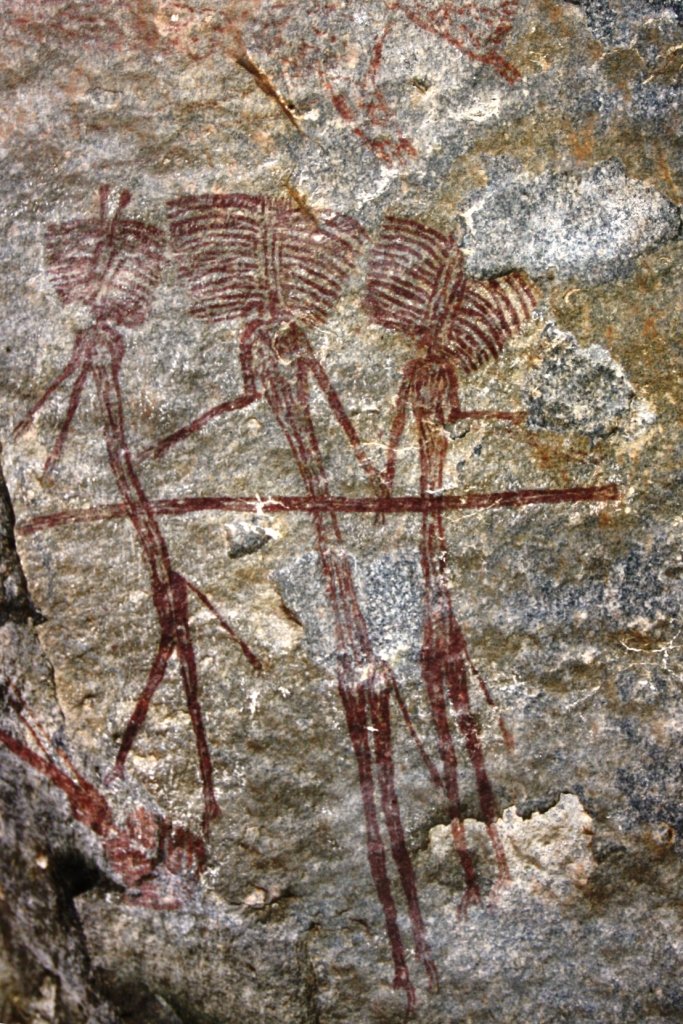
More than 1,500 vivid rock paintings on granite inselbergs in central Tanzania, spanning two millennia of human occupation — UNESCO World Heritage since 2006 and one of the finest concentrations of prehistoric and early historic art in East Africa.
At a glance
Scattered across the dry savanna hills of the Kondoa District in central Tanzania — granite inselbergs rising from flat plains between the Masai steppe and the central plateau, roughly 200 kilometres south of Arusha — more than 1,500 individual rock paintings at over 150 recorded sites cover the overhangs and shallow cave walls of the local granite hills. First documented by European archaeologists in the 1930s and studied systematically by Mary Leakey in the 1950s, the paintings represent at least three stylistic phases corresponding to successive peoples who occupied the region over approximately two thousand years. The site was inscribed as a UNESCO World Heritage Site in 2006 for its testimony to human creative genius and to the cultural evolution of the peoples of East Africa.
Key facts
- Location: Kondoa District, Dodoma Region, central Tanzania; approx. 200 km south of Arusha.
- Period: c. 2000 BCE – 19th century CE (Late Stone Age through early historic).
- Scale: Over 1,500 paintings at 150+ sites across multiple granite hills.
- UNESCO status: World Heritage Site since 2006 (criteria I, III, V).
- Earliest research: Hans Reck and Ludwig Kohl-Larsen (1930s); Mary Leakey catalogue (1950s).
- Principal artists: Sandawe hunter-gatherer ancestors, Cushitic pastoralists, and Bantu-speaking farmers — three distinct phases.
- Pigments: Red and yellow ochre, white kaolin, charcoal — applied by hand, sticks, and bone tools.
History and archaeology
The rock paintings of the Kondoa hills were first brought to archaeological attention in the 1930s by the German researchers Hans Reck and Ludwig Kohl-Larsen, who recorded some of the principal sites during Tanganyika interior surveys. The most influential early study was conducted in the 1950s by Mary Leakey — better known for her Olduvai Gorge hominin discoveries — whose systematic catalogue established the typological framework still in use today. Leakey identified at least three successive stylistic traditions: an early naturalistic phase of large, confident red-ochre animals linked by linguistic and genetic evidence to ancestors of the Sandawe people (a Tanzanian group retaining click consonants related to the southern African Khoisan, and the most likely descendants of the original Late Stone Age artists); a later, more schematic phase of smaller human figures and domestic animals attributed to Cushitic-speaking pastoralists; and a final simpler phase attributed to Bantu-speaking agricultural communities.
The Sandawe interpretation is supported by living oral traditions: Sandawe elders retain specific names and ceremonial associations for painted sites, describing them as sacred places where ancestor spirits may be contacted — a cosmological framework strikingly similar to the San interpretation of rock art in southern Africa, suggesting a shared deep structure of belief among the hunter-gatherer peoples of eastern and southern Africa. UNESCO inscription in 2006 formalised international recognition of the site outstanding universal value under criteria I (creative genius), III (exceptional civilisation testimony), and V (cultural landscape).
What you see
The paintings appear on the near-vertical and overhanging faces of the Kondoa granite inselbergs, protected from direct rainfall by natural rock shelters. The most celebrated images — from the early naturalistic phase — are large-format depictions of animals rendered in vivid red-ochre with mastery of anatomy and movement: elephant, rhinoceros, giraffe, eland, buffalo, and numerous smaller mammals, often in energetic poses suggesting direct observation of living animals. Human figures appear in many panels, some in postures associated with dance or trance — crouching, arms raised, bent at the waist in positions also found in San rock art of the Drakensberg — alongside abstract geometric forms (concentric circles, spirals, zigzag lines) interpreted as entoptic visual phenomena from altered states of consciousness.
Later phases overlay or neighbour earlier images: cattle with distinctive Nilotic breed characteristics, donkeys, and stylised human figures in the schematic mode of Cushitic pastoralist traditions appear at many accessible sites. The overall impression is of a living archive — a rock face where the entire cultural history of the Kondoa hills has been layered over centuries, each generation of artists adding to a palimpsest of images that collectively narrate the human occupation of this landscape across two millennia. The most visited cluster, the Kolo paintings near the western escarpment, is accessible by road with a site museum and guided path.
Practical information
- Access: Principal Kolo sites accessible by road from Kondoa town; outlying sites require 4WD and local guides.
- Entry: Fees payable at the Antiquities Division site office at Kolo village; Sandawe-guided tours available and strongly recommended.
- Best time: Dry season (June–October) for road access; rains may close tracks to outlying sites.
- Condition: Several sites show humidity deterioration and historic graffiti damage; most accessible panels remain vivid.
- Photography: Permitted; tripod useful for overhang interiors.
- Nearest base: Kondoa town (basic accommodation); Arusha (~200 km north) for full logistics.
Getting there
Kondoa is approximately 200 kilometres south of Arusha on the tarmac road to Dodoma. The drive takes roughly 3–4 hours. From Kondoa town, the Kolo site cluster is a further 25 kilometres by gravel road. Shared minibus transport runs from Arusha and Dodoma to Kondoa; the Kolo branch requires local vehicle hire or a tour operator four-wheel drive. Several Arusha-based safari operators offer day trips or multi-day itineraries combining Kondoa with Tarangire National Park or the Rift Valley escarpment.
Nearby
- Tarangire National Park — savanna wildlife park approximately 150 km north-west, famous for large elephant herds and ancient baobab trees.
- Lake Manyara — Rift Valley lake with flamingos and tree-climbing lions, roughly 170 km north-west via Arusha.
- Olduvai Gorge — the cradle-of-mankind archaeological site where Mary Leakey (who also catalogued Kondoa) made her hominin discoveries; approximately 280 km north-west.
- Dodoma — Tanzania capital, approximately 160 km south, with national administrative services.
Sources
- UNESCO World Heritage List — Kondoa Rock-Art Sites (2006): whc.unesco.org/en/list/1183.
- Mary Leakey, Africa’s Vanishing Art: The Rock Paintings of Tanzania, Doubleday, 1983.
- Tanzania Antiquities Division, Kolo site documentation and visitor guides.
- David Lewis-Williams & David Pearce, San Spirituality: Roots, Expression, and Social Consequences, AltaMira Press, 2004.
- Wikipedia — Kondoa Rock Art Sites: en.wikipedia.org/wiki/Kondoa_Rock_Art_Sites.
Find it on the map
See this place and what’s around it →📷 Become a Cultural Heritage Online photographer
Share your photos of places: they stay published under your name as the author. The more they're seen, the more you get noticed — and soon a contest will reward the most appreciated photos.
Log in or sign up free to add a photo