
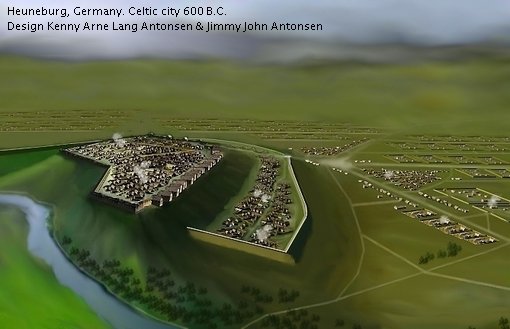
An Iron Age Celtic aristocratic centre in the upper Danube valley: the Heuneburg was the largest settlement north of the Alps around 600 BCE, its Mediterranean-style mudbrick walls evidence of trade and cultural exchange reaching from Bronze Age Germany to early Athens and Etruria.
At a glance
The Heuneburg sits on a plateau above the upper Danube River in the Swabian Alb of Baden-Wurttemberg, roughly 100 kilometres southwest of Stuttgart. Occupied from approximately 700 to 480 BCE during the Late Hallstatt Iron Age, it was the largest and most sophisticated settlement north of the Alps — a Celtic aristocratic centre covering some 10 hectares within its walls, with extensive lower settlements raising the estimated population to 5,000–10,000 people. Its most remarkable feature is a section of fortification wall built not in the traditional timber-and-earth style of central European hillforts, but in sun-dried mudbrick on a stone foundation — a purely Mediterranean construction technique interpreted as evidence of direct contact with Greek colonial cities of southern France. Hundreds of fragments of Attic black-figure pottery and Greek bronze vessels found at the site confirm the trade connections that made this Mediterranean borrowing possible.
Key facts
- Location: Plateau above the upper Danube, near Herbertingen, Baden-Wurttemberg, Germany
- Period: c. 700–480 BCE (Late Hallstatt / Early Iron Age); peak occupation c. 600–550 BCE
- Size: approximately 10 hectares within the walls; lower settlement extends the total site considerably
- Population at peak: estimated 5,000–10,000 — the densest concentration of population in central Europe at that time
- Unique feature: a section of mudbrick fortification wall on a stone foundation — the only such Mediterranean-style construction known from any Iron Age site north of the Alps
- Key finds: Attic black-figure pottery, Greek and Etruscan bronze vessels, amber, coral, and Massalian wine amphorae confirming long-distance Mediterranean trade
- Associated burial: the nearby Hochdorf Chieftain tumulus (discovered 1977), one of the richest Iron Age burials in central Europe
History
The Heuneburg was occupied from around 700 BCE as one of a cluster of Hallstatt-period aristocratic centres in southwestern Germany — the so-called Hohenasperg horizon — that controlled trade routes connecting the Alpine passes and the Danube corridor with the Mediterranean world. During the 6th century BCE the settlement grew to become the administrative, commercial, and probably ritual capital of a Celtic aristocratic territory stretching across the Swabian Alb, with the local ruling elite accumulating wealth through control of long-distance trade in bronze, tin, and amber from the Baltic in exchange for Mediterranean luxury goods.
The construction of the mudbrick wall — dated to approximately 600–550 BCE — is the most striking episode in the site’s history. Unlike any other comparable hillfort in central Europe, a substantial stretch of the Heuneburg’s perimeter was built in sun-dried clay brick on a stone socle, with rectangular projecting bastions at regular intervals: a design matching Greek and Etruscan defensive architecture precisely, and completely alien to local Celtic building tradition. The most plausible interpretation is that a Greek architect from Massalia (the Greek colonial city founded at Marseille around 600 BCE) was brought to the Heuneburg by the local chieftain — direct evidence that the Celtic aristocracy was not merely trading with the Mediterranean world but actively importing its technology and expertise. The settlement was destroyed by fire and abandoned around 480 BCE, probably in connection with the broad cultural disruption of the late Hallstatt period that saw the rise of La Tene Celtic culture further north and west.
The most famous find associated with the Heuneburg is the Hochdorf Chieftain, discovered in a tumulus approximately 60 kilometres north near Stuttgart in 1977: a 6th-century BCE male burial in a wooden chamber with a bronze couch decorated with dancer figures, a gold-plated neck torc, gold shoes, a bronze cauldron originally containing approximately 400 litres of mead decorated with gold-wire lions, and nine bronze drinking horns hanging from the chamber wall — one of the most spectacular Iron Age burials ever excavated in Europe.
What you see
The Heuneburg archaeological site preserves the outline of the hillfort plateau and traces of the mudbrick wall, partially reconstructed at the site to illustrate its original form. The reconstruction shows the characteristic Mediterranean profile — a mass of clay brick rising from a stone footing, with square projecting bastions — a dramatic visual statement on the Danube plateau unlike anything else in the Celtic world at the time. The lower settlement area, excavated since the 1950s, has revealed workshops, storage buildings, and residential structures extending well beyond the main wall. Finds from excavations — Attic pottery fragments, Greek bronzes, amber and coral jewellery, and site models — are displayed in the Keltenmuseum Heuneburg on site and at the Wurttemberg State Museum in Stuttgart.
The wider landscape includes numerous burial tumuli (Grabhugel) scattered across the surrounding hills; several large mounds are visible from the plateau, and the most accessible are along marked walking paths in the surrounding forest. The Hochdorf burial mound, though approximately 60 kilometres north, is separately reconstructed and visitable as a dedicated museum near Eberdingen.
Practical information
- Address: Heuneburg, 88518 Herbertingen, Baden-Wurttemberg, Germany
- Opening hours: The open-air site is accessible year-round; the Keltenmuseum Heuneburg has seasonal hours (check the official site before visiting)
- Admission: Small fee for the museum; the hillfort plateau is freely walkable
- Best time to visit: April–October for comfortable walking; the terrain can be muddy in winter
- Accessibility: The plateau is reachable by footpath from the car park; ground is uneven archaeological terrain
- Photography: Freely permitted throughout the outdoor site
Getting there
The Heuneburg lies approximately 100 kilometres southwest of Stuttgart and 40 kilometres northeast of Lake Constance, near Herbertingen in the upper Danube valley. By car, take the A81 motorway towards Singen, exit at Mengen/Herbertingen, and follow local signs; the drive from Stuttgart takes approximately one hour. There is a car park at the base of the hill. The nearest train station is Herbertingen on the Stuttgart–Singen regional line, approximately 4 kilometres from the site; a taxi or bicycle from the station is the practical option without a car.
Nearby
- Keltenmuseum Heuneburg (on site) — dedicated museum with excavation finds including Attic pottery and reconstructed objects
- Hochdorf Chieftain burial (near Eberdingen, approx. 60 km north) — the intact 6th-century BCE tumulus with its extraordinary bronze couch and gold artefacts
- Sigmaringen Castle (approx. 20 km east) — dramatic Hohenzollern castle perched above the Danube gorge
- Lake Constance (Bodensee) (approx. 40 km southwest) — the largest lake in Germany, with Roman and early medieval heritage sites along its shores
Sources
- Kimmig, W., “Die Heuneburg an der oberen Donau,” Fuhrer zu vor- und fruhgeschichtlichen Denkmalern, Mainz, 1983
- Wells, P.S., The Barbarians Speak: How the Conquered Peoples Shaped Roman Europe, Princeton University Press, 1999
- Biel, J., “The Late Hallstatt Chieftain’s Grave at Hochdorf,” Antiquity 55(214), 1981, pp. 16–18
- Fernandez-Gotz, M., “Rethinking La Tene Oppida,” Archaeological Journal 175(1), 2018
- Wikipedia, “Heuneburg,” accessed 2026 — GPS coordinates and basic chronology
Find it on the map
See this place and what’s around it →📷 Become a Cultural Heritage Online photographer
Share your photos of places: they stay published under your name as the author. The more they're seen, the more you get noticed — and soon a contest will reward the most appreciated photos.
Log in or sign up free to add a photo