
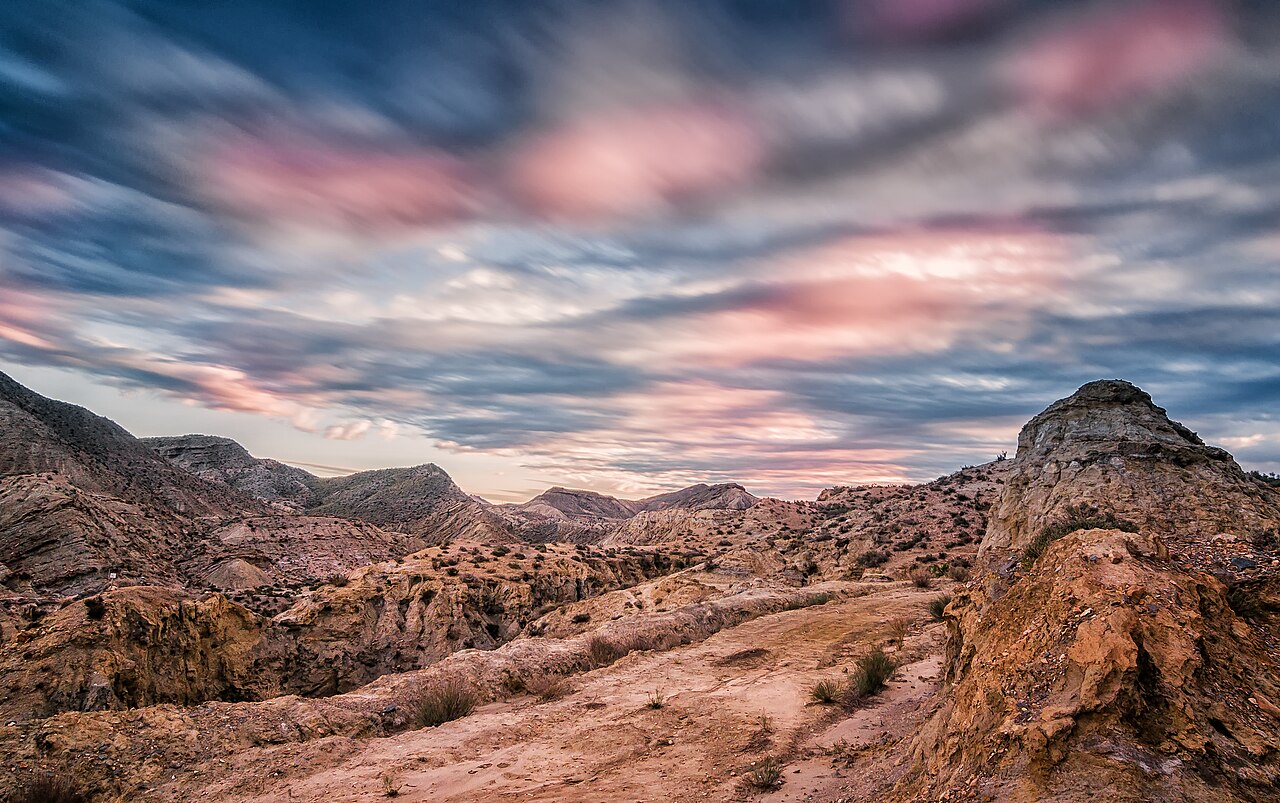
The only semi-desert in Europe — dry badlands in Almeria, Andalusia, formed by the rain shadow of the Sierra Nevada — chosen by Sergio Leone in 1964 as the location for his Dollars Trilogy and the visual grammar of the Spaghetti Western; the original western-town sets still stand and operate as tourist attractions, and the desert continues to attract film productions seeking landscapes indistinguishable from the American Southwest at a fraction of the cost.
At a glance
In the interior of the province of Almeria in Andalusia, between the Sierra Nevada to the west and the Sierra de los Filabres to the north, the Tabernas Desert — approximately 280 square kilometres of eroded clay badlands, dry riverbeds, and sparse scrub — is geologically unique in Europe: the only landscape on the continent classified as a true semi-desert (annual rainfall under 200 mm, summer temperatures regularly exceeding 40 C, erosion patterns nearly identical to those of Nevada or Arizona). Italian director Sergio Leone recognised this resemblance in 1964 and used the Tabernas landscape for A Fistful of Dollars, beginning a film era that would produce The Good, the Bad and the Ugly (1966) and Once Upon a Time in the West (1968) and launch the “Spaghetti Western” as a cinematic genre. The western town sets built for those productions — Mini Hollywood (Oasys), Fort Bravo (Texas Hollywood), and Western Leone — still stand, welcoming visitors with daily gunfight shows and permanent displays of film history. The Tabernas Desert is also protected as a Natural Park of Andalusia.
Key facts
- Location: Tabernas municipality, Almeria province, Andalusia, Spain; GPS: 37.0533 N, 2.3611 W
- Area: approximately 280 km2 (Tabernas Natural Park / Desierto de Tabernas)
- Climate: semi-arid; annual rainfall under 200 mm; temperatures 40+ C in summer; frost possible in winter
- Film era: 1964-1980 (peak); continues sporadically into 21st century
- Key films: A Fistful of Dollars (1964), The Good, the Bad and the Ugly (1966), Once Upon a Time in the West (1968), Lawrence of Arabia (partly, 1962), Indiana Jones and the Last Crusade (1989)
- Film sets open to public: Oasys/Mini Hollywood (full theme park with daily shows); Fort Bravo/Texas Hollywood; Western Leone (near Tabernas town)
- Protection: Natural Park of Andalusia (Paraje Natural Desierto de Tabernas)
How the Almeria badlands became the Wild West
When Sergio Leone arrived in Almeria province in 1964 to film A Fistful of Dollars — a low-budget Italian reimagining of the Japanese samurai film Yojimbo (1961) as a Western, starring an American actor named Clint Eastwood who had been appearing in the television series Rawhide — he was not the first filmmaker to use the Almeria landscape. Samuel Bronston’s epic productions (King of Kings, 1961; El Cid, 1961; The Fall of the Roman Empire, 1964) had already established Almeria as a cost-effective alternative to Hollywood location filming in Spain; the Franco-era Spanish government offered generous film subsidies, cheap labour, and the cooperation of the Spanish army as extras. But Leone’s use of the Tabernas Desert specifically — its dry riverbeds, eroded clay hills, and golden light quality — as a substitute for the American Southwest was more fundamental: not a backdrop, but a visual argument. The Almerian badlands, Leone believed, were in many ways more authentically “Western” than the actual American West had been by the early 1960s.
The three films of Leone’s “Dollars Trilogy” — A Fistful of Dollars (1964), For a Few Dollars More (1965), and The Good, the Bad and the Ugly (1966) — transformed the Western genre internationally and created Clint Eastwood’s film career. The climactic three-way pistol duel (the “triello”) in The Good, the Bad and the Ugly, filmed partly in the Tabernas area and partly at the Plaza de Toros de Almeria, became one of the most imitated scenes in film history. Leone returned to Almeria for Once Upon a Time in the West (1968), his elegy for the Western genre, with Henry Fonda cast against type as a brutal villain. The western town set constructed for Leone’s productions — the “Poblado del Oeste,” known commercially as “Mini Hollywood” — accommodated subsequent productions including A Man Called Horse (1970), and dozens of European Westerns throughout the 1970s. After the Spaghetti Western era ended in approximately 1980, the desert continued to attract productions: Indiana Jones and the Last Crusade (1989, the desert chase sequence) and many others filmed in the unique landscape.
The town of Tabernas and the Almeria province have embraced their film heritage. The three original western sets have been converted into commercial attractions: Oasys/Mini Hollywood (the largest, with a zoo and water park addition), Fort Bravo/Texas Hollywood (specialising in film-era atmosphere), and Western Leone (the most historically authentic, located closest to the original Leone filming locations). The Almeria Film Office continues to attract productions; the desert has appeared in Doctor Who, Game of Thrones, and numerous commercials and music videos.
What you see in the Tabernas Desert
The Tabernas Desert landscape is strikingly alien in the European context: bare badland hills of grey and ochre clay, deeply eroded by the seasonal ramblas (dry watercourses) that flash-flood after rare rainstorms, with sparse vegetation of esparto grass, dwarf palms, and drought-adapted shrubs. The colour palette — pale clay, ochre rock, deep blue sky, harsh white light — is what made it cinematically convincing as the American Southwest. The three film sets are located on the road between Almeria city and Tabernas: Oasys/Mini Hollywood (at km 464 on the A-92 motorway) is the most accessible and the most developed as a theme park; Fort Bravo/Texas Hollywood is approximately 3 km further inland; Western Leone is the most intact in terms of original film-era construction.
Beyond the film sets, the Tabernas Natural Park offers hiking and 4WD trails through the badlands; the Rambla de Tabernas is a particularly striking dry canyon. The Almeria city (40 km south) is the practical base, offering full services, the Alcazaba fortress, and the Almeria Cathedral; the CIESOL solar energy research centre (Centro de Investigaciones de Energia Solar) is also located in the Tabernas area, taking advantage of the exceptional solar radiation levels.
Practical information
- Oasys / Mini Hollywood: km 464 on the A-92; theme park with western shows daily (noon and 17:00); zoo and water park (summer); approx. EUR 25 adults (2026); open year-round, hours vary seasonally
- Fort Bravo / Texas Hollywood: approx. 3 km from A-92 via Tabernas road; daily western shows; approx. EUR 15 adults; film set atmosphere more intact
- Western Leone: near Tabernas town; the most historically significant set; combined ticket with Fort Bravo available
- Natural Park hiking: no entrance fee; trails marked from Tabernas town; 4WD recommended for interior tracks
- Best season: October-April (moderate temperatures); July-August is very hot (40+ C); winter occasionally cold but usually sunny
Getting there
Tabernas is approximately 35 km north of Almeria city on the A-92 motorway. From Almeria: approximately 30 minutes by car. From Almeria airport (AGP, actually Malaga — Almeria has its own airport, IATA: LEI): fly to Almeria Airport (LEI), approximately 15 km east of the city; the Tabernas area is then approximately 45 minutes by car. By public transport: buses from Almeria city toward Guadix stop at Tabernas (approx. 45 minutes); the film sets are 2-4 km from the bus stop and require a taxi or rental car for the final stretch. The nearest major city is Almeria; Malaga (AGP) is approximately 2 hours west by road and is the usual gateway for international travellers visiting the Costa del Sol and interior Andalusia.
Nearby
- Almeria Alcazaba — the best-preserved Arab fortress in Spain, overlooking Almeria city; 10th-century Moorish construction; approximately 35 km south
- Cabo de Gata-Nijar Natural Park — Spain’s driest and most arid coastal natural park; volcanic cliffs, isolated beaches, salt lagoons; approximately 50 km southeast of Tabernas
- Almeria Cathedral (Cathedral-Fortress) — unique fortified cathedral built in the 16th century as protection against Barbary pirates; city centre, approximately 35 km south
Frequently asked questions
What films were shot in the Tabernas Desert?
It became the home of the spaghetti western. Sergio Leone filmed A Fistful of Dollars here in 1964, launching a run of Westerns shot in the Almeria badlands through the 1960s and 1970s.
Can you visit the Tabernas Desert film sets?
Yes. Surviving western sets are open as theme parks, Oasys / Mini Hollywood and Fort Bravo / Texas Hollywood, with daily western shows.
Where is the Tabernas Desert?
It lies in Almeria province, Andalusia, Spain, about 35 km north of Almeria city on the A-92 motorway. It is the only semi-desert in continental Europe.
Why did filmmakers use Tabernas for Westerns?
Its bare ochre badlands and dry riverbeds read on camera as the American West, with reliable sun and low costs. Sergio Leone chose it in 1964 and other directors followed.
Is the Tabernas Desert worth visiting?
Yes. Beyond the film sets, it is a protected natural area of eroded clay hills and dry watercourses, geologically unique in Europe.
See this location in context: Set-Jetting: Six Famous Film & TV Locations You Can Actually Visit.
Sources
- Frayling, C. (1981). Spaghetti Westerns: Cowboys and Europeans from Karl May to Sergio Leone. Routledge.
- Hughes, H. (2004). Once Upon a Time in the Italian West: The Filmgoers’ Guide to Spaghetti Westerns. I.B. Tauris.
- Junta de Andalucia: Paraje Natural Desierto de Tabernas. juntadeandalucia.es/medioambiente
- Oasys Mini Hollywood official site: oasysparquetematicoalmeria.es
- Fort Bravo / Texas Hollywood official site: fortbravo.es
Find it on the map
See this place and what’s around it →
Historical events at this place (2)
📷 Become a Cultural Heritage Online photographer
Share your photos of places: they stay published under your name as the author. The more they're seen, the more you get noticed — and soon a contest will reward the most appreciated photos.
Log in or sign up free to add a photo