
The largest ancient tomb ever found in Greece — a 500-metre circumference funerary mound with marble sphinxes, caryatid sculptures, a pebble mosaic of Persephone’s abduction, and an occupant whose identity remains the most debated question in Greek archaeology.
At a glance
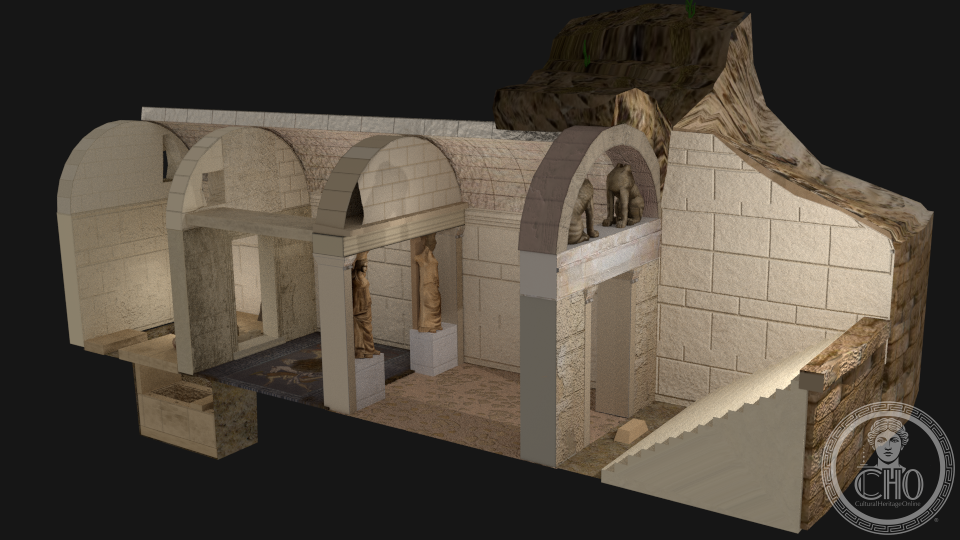
Near the ancient city of Amphipolis in Central Macedonia — a strategically vital city on the Strymon River that was among the most bitterly contested prizes in 5th-century BC Greek warfare — the Kasta Tumulus is the largest circular funerary monument ever found in Greece: a mound approximately 500 metres in circumference, its perimeter wall faced with marble. Excavated with national excitement between 2012 and 2014 by archaeologist Katerina Peristeri, the tomb interior contains marble sphinxes, carved caryatid figures, a marble door, and a remarkable pebble mosaic floor depicting the abduction of Persephone by Hades. The identity of the occupant — someone of the highest importance in the Macedonian world, contemporary with Alexander the Great — has not been conclusively established.
Key facts
- Location: Near Amphipolis town, Serres Regional Unit, Central Macedonia, Greece
- Dimensions: Approximately 500 metres in circumference; originally ~30 metres high; perimeter wall faced with marble
- Period: c. 325–300 BC (late Classical / early Hellenistic)
- Excavation: Katerina Peristeri, Greek Archaeological Service, 2012–2014
- Key architectural features: Marble sphinxes at entrance; caryatids between chambers; mosaic floor (Persephone abduction); marble relief door
- Occupant identity (candidates): Hephaestion, Roxane and Alexander IV, Olympias — no conclusive identification
- Significance: Largest tomb ever found in Greece by circumference; scale paralleled only by Macedonian royal tombs at Vergina
History
Amphipolis was founded by Athens in 437 BC as a strategic colony on the Strymon River, controlling access to the timber forests and gold mines of Thrace. The city changed hands repeatedly in the Peloponnesian War — Athens went to war with Sparta partly over control of Amphipolis — and was later absorbed into the Macedonian kingdom under Philip II. At the time of Alexander the Great’s death (323 BC), Amphipolis was a major administrative centre of the Macedonian empire, and it remained important throughout the period of the Wars of the Successors.
The tumulus mound at Kasta had been visible on the landscape for centuries but was not systematically excavated until 2012, when Katerina Peristeri of the Greek Archaeological Service began work. The excavation proceeded in conditions of extraordinary public attention: each discovery — the sphinxes in 2012, the caryatids in 2014, the mosaic floor in 2014 — was broadcast live in Greece and covered internationally. The scale and quality of the construction, financed at enormous cost, indicated an occupant of the highest social status in the Macedonian world; the dating to approximately 325–300 BC placed the construction firmly in the period immediately after Alexander’s death.
Despite the extensive excavation and analysis, the identity of the occupant has not been definitively established. Multiple burials were found in the tomb from different periods, complicating the identification. The leading scholarly candidates remain Hephaestion (Alexander’s closest companion, who died in 324 BC and for whom Alexander ordered a massive state funeral), Roxane and Alexander IV (Alexander’s wife and posthumous son, murdered around 310 BC), and Olympias (Alexander’s mother, killed 316 BC).
What you see
The approach to the tomb begins at the impressive perimeter wall of the tumulus, faced with white marble in the Doric style — a wall nearly a kilometre in length that originally enclosed the mound completely. The entrance is flanked by two large marble sphinxes with wings outstretched, partially preserved; beyond them, a long vaulted dromos (entrance corridor) leads to the first chamber, whose portal is flanked by two marble caryatid figures — female figures carved in the round serving as architectural supports — of exceptional quality and scale. A second barrier, a marble door decorated with relief carvings, leads to the third and innermost chamber.
The innermost chamber floor is covered with a pebble mosaic approximately 4.5 metres across depicting Hermes Psychopomp (guide of souls) leading the abduction of Persephone by Hades in a chariot — an extraordinarily accomplished composition executed in coloured pebbles and tesserae, one of the finest surviving ancient Greek mosaic floors. The mosaic’s iconography of the passage to the underworld is fitting for a funerary monument of this scale.
Practical information
- Address: Near Amphipolis town, Serres Regional Unit, Central Macedonia, Greece
- Access: The tumulus is visible from the road; access to the interior may be restricted depending on ongoing work — check with local archaeological service before visiting
- The Lion of Amphipolis: A large ancient marble lion monument stands at the bridge over the Strymon in Amphipolis town — a worthwhile companion stop
- Archaeological Museum of Amphipolis: Houses finds from the Kasta Tomb and the broader Amphipolis region; essential context for the site
Getting there
Amphipolis is approximately 100 km east of Thessaloniki on the E90/Via Egnatia highway. By car from Thessaloniki: take the E90 east toward Kavala, exit at Amphipolis; the Kasta Tumulus is signposted from the town. By public transport: KTEL buses from Thessaloniki to Serres or Kavala pass through Amphipolis; the tomb site is a short taxi ride from the town. The nearest airport is Kavala International Airport (KVL), approximately 55 km east, with connections to Athens and limited international routes.
Nearby
- Amphipolis Archaeological Museum (in town) — Kasta Tomb finds and broader regional collection; essential companion visit
- Lion of Amphipolis (in town) — large ancient marble funerary lion, one of the best-preserved such monuments in Greece
- Lake Kerkini (~50 km northwest) — wetland nature reserve and bird sanctuary of international importance
- Philippi Archaeological Site (~50 km east) — UNESCO WHS; the city where St Paul delivered his first European sermon; Roman theatre and early Christian basilicas
Sources
- Peristeri, K. & Lebih, J.-P. (2016). The Amphipolis Tomb. Archaeological Reports 62, 44–68
- Cargill, J. (1995). Athenian Settlements of the Fourth Century BC. Brill
- Thucydides, History of the Peloponnesian War IV.102–108 (the fall of Amphipolis)
- Greek Ministry of Culture. “Kasta Tomb, Amphipolis.” Official excavation updates 2012–2014. Accessed June 2026
- Wikipedia contributors. “Kasta Tomb.” Wikipedia. Accessed June 2026
Find it on the map
See this place and what’s around it →📷 Become a Cultural Heritage Online photographer
Share your photos of places: they stay published under your name as the author. The more they're seen, the more you get noticed — and soon a contest will reward the most appreciated photos.
Log in or sign up free to add a photoIs this page about you?
This page is read by travellers and heritage enthusiasts who find it on Google. Tell us how you are connected to this place and we will take it from there.