

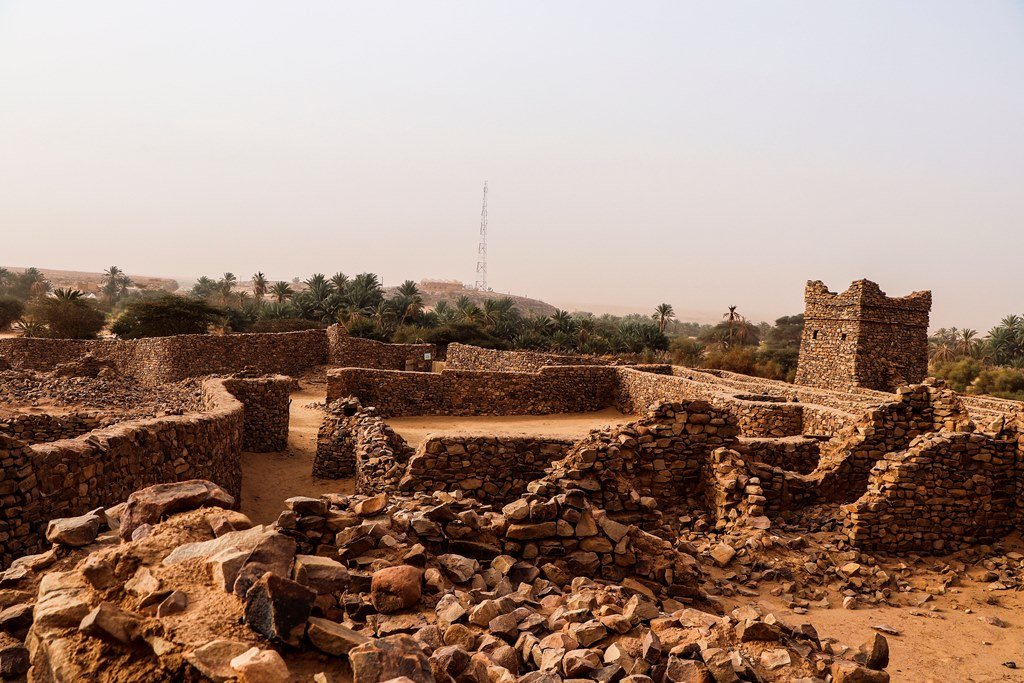
A 12th-century Saharan caravan city perched on a clifftop ridge in the Adrar Plateau — one of the most perfectly preserved medieval trading towns in the Sahara, its warm red sandstone walls rising above two wadi valleys as the surrounding desert reaches toward the empty horizon.
At a glance
Ouadane occupies a narrow rocky ridge approximately 90 km northeast of Atar in the Adrar region of central Mauritania. Founded around 1147 AD during the Almoravid period as a waystation on the trans-Saharan gold and salt caravan routes, it reached its commercial peak in the 14th and 15th centuries before declining into a largely uninhabited ruin. It is one of the four “Ancient Ksour” inscribed as UNESCO World Heritage Site in 1996 alongside Chinguetti, Tichitt, and Oualata. The old city — built entirely from local red sandstone — preserves an almost intact fabric of houses, mosques, and alleyways; a population of approximately 2,000 lives in a new settlement at the base of the cliff below.
Key facts
- Founded: c. 1147 AD, Almoravid period
- Peak: 14th–15th centuries; major waystation on trans-Saharan gold and salt trade routes
- UNESCO: World Heritage Site 1996 — Ancient Ksour of Ouadane, Chinguetti, Tichitt and Oualata
- Architecture: local red sandstone; no mud-brick (distinguishes the four ksour from Sahel towns)
- First European contact: Portuguese diplomatic missions 1487, attempting to divert gold trade to the coast
- Location: Adrar Region, Mauritania; approx. 90 km northeast of Atar at 600 m altitude
- Old city dimensions: narrow ridge approx. 600 m long × 80–100 m wide
History
Ouadane was founded around 1147 AD during the Almoravid period as a waystation on the trans-Saharan caravan routes that connected the gold and salt economies of West Africa with Morocco and the Mediterranean world. Its position on a rocky clifftop ridge above two wadi valleys gave it both defensibility and proximity to the seasonal water sources essential for sustaining large caravans crossing the Adrar Plateau. The city grew through the 13th and 14th centuries as the trans-Saharan trade reached its medieval peak: gold arriving north from the Bambuk and Bure goldfields of what is now Guinea and Senegal, salt travelling south from the Ijil mines of the Mauritanian Sahara, passed through Ouadane’s markets and warehouses in both directions. At its commercial height in the 14th and 15th centuries, Ouadane was also a centre of Islamic scholarship with a working library tradition, smaller than Chinguetti’s but part of the same intellectual network of Saharan learning.
The first European contact with Ouadane came in 1487 when the Portuguese crown sent diplomatic missions to the city, attempting to persuade the local rulers to divert their gold exports from the overland trans-Saharan route to the Portuguese-controlled Atlantic coastal trade. The missions failed to achieve their commercial objective, but they mark the moment when Atlantic European expansion first reached the interior Saharan trading system. Ouadane declined progressively from the 16th century as the Portuguese and later Dutch and English coastal trade routes drew the gold economy away from the Sahara. By the 19th century most of the old city had been abandoned; the modern settlement at the base of the cliff began as a seasonal camp and gradually grew into the permanent community that exists today.
What you see
The old city of Ouadane occupies a ridge so narrow that the houses are built wall-to-wall along its spine, with alleyways cutting between them to the cliff edges overlooking the wadi valleys on either side. The material throughout is the local red-orange sandstone, cut and laid in the dry-stone and mortar tradition of the four ksour; there is no mud-brick here, and no plaster on most surfaces, so the walls retain the raw warm colour of the plateau itself. The absence of electricity, paved roads, and modern construction in the old city creates one of the most complete experiences of medieval urban space available anywhere in the Sahara: the human scale of the alleyways, the thickness of the walls, the small carved doorways leading into ruined or occasionally still-inhabited courtyards, all remain substantially as they were built.
The mosque at the centre of the old city — still in occasional use for Friday prayers — is the best-preserved major structure on the ridge. Several private houses retain their original internal arrangements of reception rooms and domestic spaces, some accessible through local guides. The views from the cliff edges are among the most striking in the Adrar: the two wadi valleys below the ridge green briefly after rain, the new settlement visible at the base of the escarpment, and the open desert plateau stretching to the horizon in every other direction, broken only by the circular form of the Richat Structure to the northwest.
Practical information
- Access: 4WD and local guide essential; approx. 90 km northeast of Atar on a desert track
- Best season: November to February; summer temperatures exceed 45°C
- Accommodation: very limited; a small guesthouse operates in or near the new settlement; most visitors base in Atar
- Guides: a local guide is strongly recommended for navigating the old city and accessing private buildings
- Security: verify current travel advisories for Mauritania before travel
- Photography: permitted in public spaces; ask permission before entering inhabited areas
Getting there
Ouadane is reached by a desert track approximately 90 km northeast of Atar (2–3 hours by 4WD). Atar itself is accessible by air from Nouakchott (Atar Airport, ATR) or by road (approximately 7 hours from Nouakchott). No public transport serves the Ouadane track; a 4WD with a driver-guide experienced in desert navigation is essential. Ouadane and Chinguetti are sometimes combined into a multi-day loop from Atar; the journey between them is approximately 100 km through the plateau.
Nearby
- Chinguetti — the other principal ksour of the Adrar, approx. 100 km southwest; the seventh holy city of Islam and centre of manuscript culture
- Richat Structure (Eye of the Sahara) — a vast circular geological formation visible from space, approx. 50 km to the northwest; accessible by 4WD
- Atar — regional capital and main base for the Adrar, approx. 90 km southwest
- Amogjar Pass — a dramatic basalt gorge between Atar and the plateau, notable for prehistoric rock paintings
Sources
- UNESCO World Heritage Centre — “Ancient Ksour of Ouadane, Chinguetti, Tichitt and Oualata” (whc.unesco.org)
- Pazzanita, Anthony G. — Historical Dictionary of Mauritania (2008)
- Lydon, Ghislaine — On Trans-Saharan Trails: Islamic Law, Trade Networks, and Cross-Cultural Exchange in Nineteenth-Century Western Africa (2009)
- Wikipedia — “Ouadane” (en.wikipedia.org/wiki/Ouadane)
- UNESCO Advisory Bodies evaluation, Mauritanian submission 1996
Find it on the map
See this place and what’s around it →📷 Become a Cultural Heritage Online photographer
Share your photos of places: they stay published under your name as the author. The more they're seen, the more you get noticed — and soon a contest will reward the most appreciated photos.
Log in or sign up free to add a photoIs this page about you?
This page is read by travellers and heritage enthusiasts who find it on Google. Tell us how you are connected to this place and we will take it from there.