
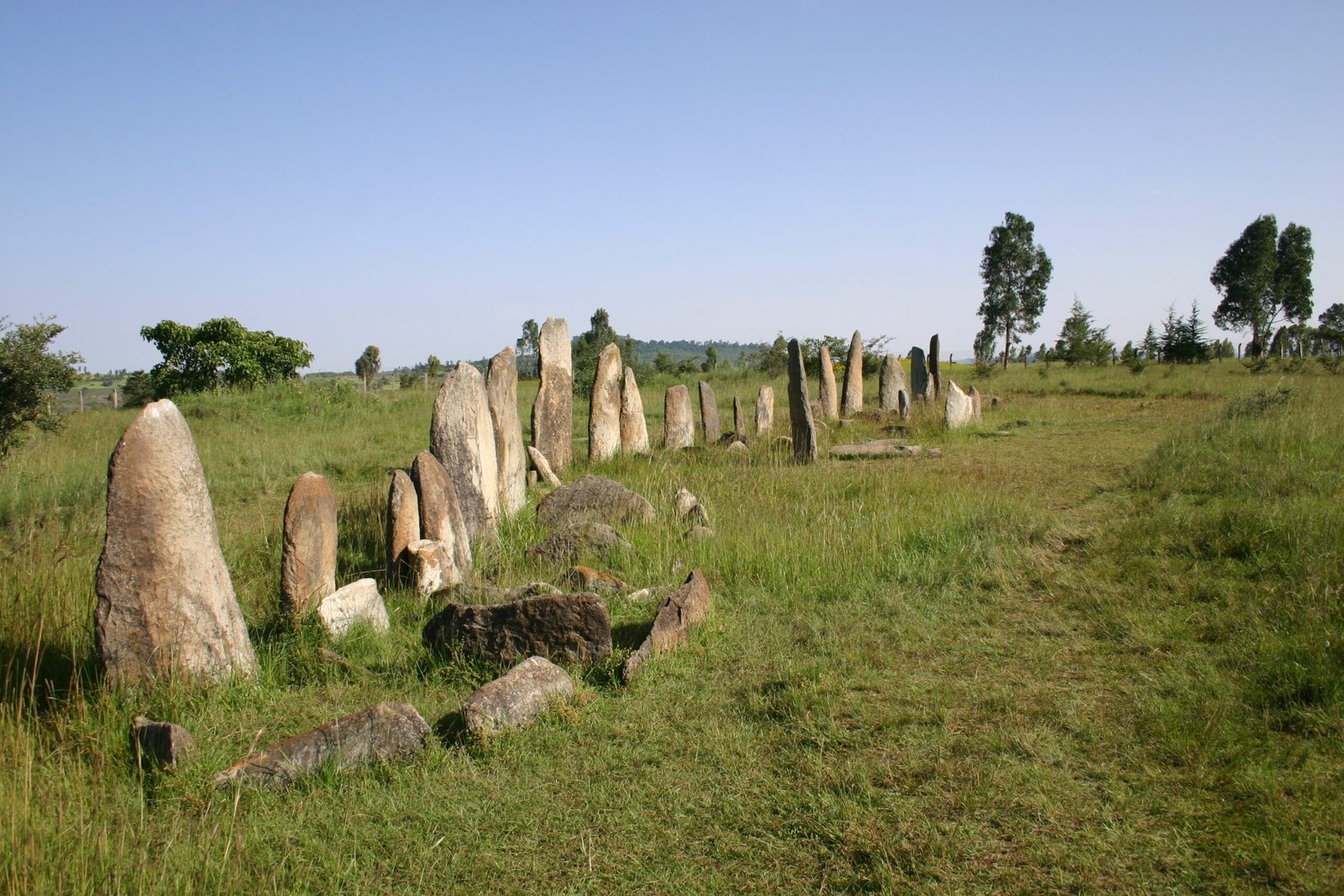
Thirty-six prehistoric standing stones carved with enigmatic sword symbols and erected over a warrior burial ground in the Ethiopian highlands — one of Africa's most atmospheric and least-visited UNESCO World Heritage Sites.
At a glance
In the Gurage Zone of southern Ethiopia, approximately 90 km south of Addis Ababa along the main road to Shashemane, the Tiya stelae field contains 36 prehistoric standing stones, of which 32 bear carved decoration. The distinctive motifs — a T-bar “sword” symbol, female breast shapes, and geometric linear patterns — were cut into the stones by a culture that left no written record. The site was inscribed on the UNESCO World Heritage List in 1980, one of the first sub-Saharan African inscriptions. Post-inscription Franco-Ethiopian excavations revealed a cemetery beneath the field, linking the stelae to a heroic commemoration tradition for warriors killed in battle. The largest stone stands approximately 2.7 metres tall. The field is accessible, compact, and relatively quick to visit — typically 1–2 hours — making it a practical stop on the Addis Ababa–Rift Valley route.
Key facts
- Location: Gurage Zone, Southern Nations, Nationalities, and Peoples' Region, Ethiopia — 8°26′N 38°37′E
- UNESCO inscription: 1980 (one of the earliest sub-Saharan WHS)
- Stelae count: 36 standing stones total; 32 decorated with carved symbols
- Tallest stele: approximately 2.7 metres
- Period: c. 10th–15th century AD (medieval Ethiopian period)
- Principal motif: T-bar “sword” symbol, interpreted as both phallic and weapon iconography
- Beneath the stones: excavated burials showing signs of violent death and ritual reburial
History
The Tiya stelae were erected between approximately the 10th and 15th centuries AD by a culture of the Ethiopian highlands whose identity remains uncertain. This period corresponds to the transition from the ancient Aksumite civilisation to the medieval Christian kingdoms of Ethiopia, though the stelae tradition at Tiya may pre-date or exist alongside both. The people who erected the stones left no inscriptions or accompanying texts — the carvings are entirely symbolic. The T-bar sword motif is found at multiple stele sites across the Ethiopian highlands, particularly among the Sidama and Konso peoples further south, where oral traditions link similar stones to commemorations of warriors killed in battle.
After UNESCO inscription in 1980, a joint Franco-Ethiopian archaeological mission conducted systematic excavations at and around the stelae field. They discovered multiple human burials beneath and near the stones — some showing evidence of traumatic wounds consistent with combat death, others showing signs of ritual reburial in which bones had been moved from their primary position, a practice documented in other Ethiopian commemorative traditions. The excavations confirmed the stelae field as a concentrated burial-memorial complex of a type once widespread across the Ethiopian highlands, of which Tiya is the best-preserved surviving example.
The site represents a type of monument erected at numerous but generally less well-preserved locations across a broad region of highland Ethiopia. Tiya's unusually high density of decorated stones and its intact spatial arrangement — stelae standing at the edge of the burial zone rather than directly above individual graves — make it particularly significant for understanding the tradition as a whole.
What you see
The stele field occupies a relatively small, enclosed area on the edge of a market town. The 36 stones stand in loose groups across a roughly level ground surface; some lean at angles, others stand upright. The carved symbols face outward and are best viewed in morning or late afternoon light, when oblique illumination brings out the shallow relief carving. The T-bar sword motif appears on the majority of decorated stones, sometimes combined with breast symbols or geometric lines. The carvings vary in quality and depth — some are bold and clear, others faint with weathering over five to seven centuries of exposure.
A small site enclosure and modest information boards mark the UNESCO protected area. There is no visitor centre, but local guides are available in the adjacent town of Tiya and from operators in Addis Ababa who include the site in Rift Valley day trips. The surrounding landscape is agricultural highland, with the modern town immediately adjacent to the stele field — a juxtaposition that underscores how long the stones have been integrated into local daily life.
Practical information
- Entry fee: small site fee payable at the enclosure gate (verify locally — fees change)
- Opening hours: daylight hours; no set closing time
- Guides: local guides available on site and through Addis Ababa tour operators
- Photography: permitted; no flash restrictions
- Time needed: 1–2 hours for the stele field; half-day if combined with nearby sites
- Best light: morning or late afternoon for carved relief visibility
- Note: no facilities on site — bring water; nearest services in Tiya town
Getting there
Tiya lies 90 km south of Addis Ababa on the A7 highway toward Shashemane and the Rift Valley lakes. Minibuses run regularly from Addis Ababa's Merkato bus station and from Bishoftu/Debre Zeit to the town of Tiya; journey time from Addis is approximately 2–2.5 hours. The stele field is signposted from the main road through the town centre. Rental car from Addis Ababa is the most efficient option for combining Tiya with the Rift Valley lakes in a single day trip. Most organised tours depart Addis Ababa early morning to reach Tiya by 9–10 am.
Nearby
- Lake Ziway — Rift Valley lake with hippos and pelicans, 50 km south
- Melka Kunture prehistoric site — Acheulean stone tools site on the Awash River, 40 km north
- Adadi Mariam rock-hewn church — 13th-century monolithic church similar to Lalibela, 30 km north
- Butajira — regional market town with additional stele sites in the surrounding Gurage Zone
Sources
- UNESCO World Heritage List — Tiya: whc.unesco.org/en/list/12
- Joussaume, R. (1995). Des dolmens pour les morts. Paris: Hachette.
- Anfray, F. (1982). “Les stèles du Sud: Shoa et Sidamo.” Annales d'Éthiopie 12.
- Wikipedia — “Tiya (archaeological site)”: en.wikipedia.org/wiki/Tiya_(archaeological_site)
- Ethiopian Authority for Research and Conservation of Cultural Heritage (ARCCH) site documentation.
Find it on the map
See this place and what’s around it →📷 Become a Cultural Heritage Online photographer
Share your photos of places: they stay published under your name as the author. The more they're seen, the more you get noticed — and soon a contest will reward the most appreciated photos.
Log in or sign up free to add a photo