
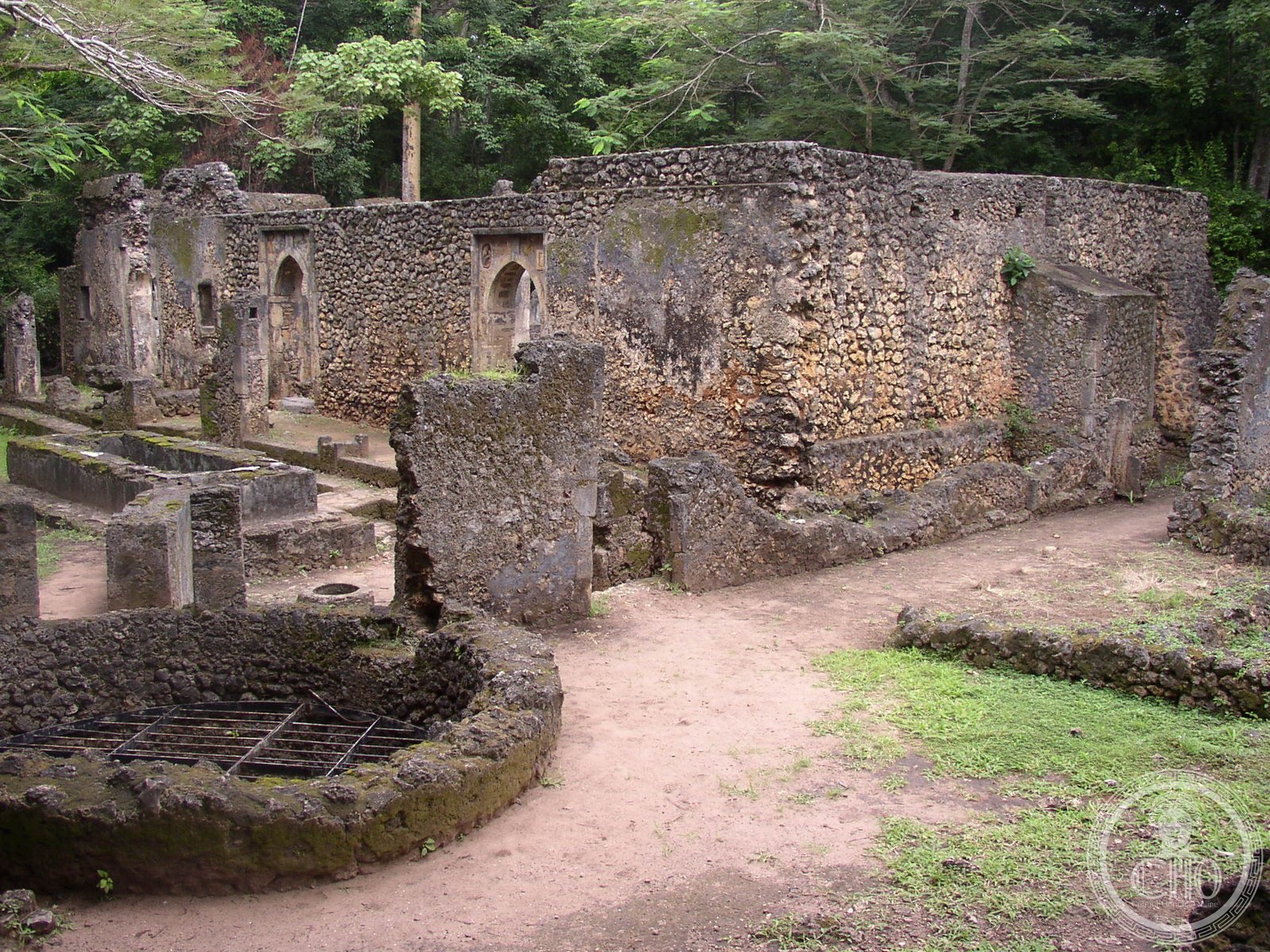
A mysterious abandoned Swahili city swallowed by coastal rainforest — the best-preserved medieval urban site on the East African coast, whose stone mosques, palace, and houses document a sophisticated Indian Ocean civilisation that disappeared without trace in the historical record.
At a glance
In the coastal rainforest of Kilifi County on Kenya’s Indian Ocean coast, approximately 18 km south of Malindi and 100 km north of Mombasa, the ruins of the medieval Swahili city of Gedi stand in a state of partial preservation remarkable for East Africa: stone walls of mosques, a palace, private houses, and warehouses rising in places to two-storey height, surrounded by dense forest that has both preserved the coral-rag construction from total collapse and simultaneously overwhelmed the structures with roots and vegetation. First documented by British colonial officials in the 1920s and excavated from the 1940s onward, Gedi is Kenya’s most atmospherically compelling archaeological site and a key node in understanding the medieval Indian Ocean world.
Key facts
- Location: Near Watamu, Kilifi County, Kenya; 18 km south of Malindi on the Indian Ocean coast
- Period: c. 12th–17th century AD (Swahili Coast civilisation)
- Area: Approximately 45 acres (18 hectares) within two concentric town walls
- Population at height: Estimated 2,500–3,000 people (c. 14th–15th century)
- Structures: Great Mosque, small mosque, palace complex, 14 private houses identified, town walls, wells
- Trade artefacts: Chinese porcelain (Song & Ming), Persian ceramics, Indian textiles, Venetian glass beads
- Status: National Monument (Kenya); on UNESCO World Heritage tentative list
History
At its height in the 14th and 15th centuries, Gedi was a prosperous node in the Indian Ocean trade network that made the East African Swahili coast one of the most commercially dynamic regions of the medieval world. Its economy was based on the exchange of African ivory, gold, and iron with the goods that arrived from Arabia, Persia, India, and China via the monsoon trading routes — the ceramics recovered from Gedi’s excavations include Song and Ming dynasty Chinese porcelain, Persian faience, and glass beads thought to originate in Venice, testifying to a commercial network of extraordinary geographical range. The city was enclosed by two concentric stone walls, the inner wall approximately 2.75 m thick, enclosing the palace and Great Mosque, with the broader settlement extending beyond to the outer wall.
The most perplexing aspect of Gedi is its near-total absence from the historical record. No medieval Arab, Persian, Chinese, or Portuguese source names the city; no oral tradition among the surrounding peoples preserves its memory. Even the name “Gedi” is a Galla/Oromo word meaning “precious” or “valuable”, apparently applied post-abandonment by peoples who had no living connection to its founders. The reason for the city’s abandonment — which appears to have occurred in the late 16th or early 17th century — remains archaeologically unresolved: proposed explanations include Portuguese raids (Portuguese forces were active on the coast from the early 1500s), incursions by the Oromo people moving south from Ethiopia, or a catastrophic drop in the water table making the site untenable. The absence of any historical record makes Gedi simultaneously one of the best-preserved and most mysterious medieval cities in Africa.
What you see
The site is managed as a national monument with a small museum at the entrance. The principal structures are the Great Mosque (the largest and most complete building, its mihrab and columns still standing, its coral-rag walls enveloped in tree roots), the Palace (a complex of interconnected rooms and courtyards), and approximately 14 named private houses whose coral-rag walls preserve details of domestic Swahili architecture: carved plaster niches (zidaka) for displaying imported porcelain, raised sleeping platforms, separate reception rooms. The wells — several still accessible — demonstrate the engineering required to supply a substantial town in a coastal environment without a permanent river.
The forest setting is as significant as the architecture. Giant fig trees have colonised the walls; their roots snake over and through the coral-rag masonry in a visual drama that makes Gedi look like no other archaeological site on the continent. The combination of forest shade, bird life, partially standing walls, and the pervasive mystery of a city without a known name or history makes Gedi one of the most powerfully atmospheric heritage sites in East Africa.
Practical information
- Opening hours: Daily 07:00–18:00
- Entry fee: Non-citizens: approx. USD 20 adults; check current rates with Kenya National Museums
- Museum: On-site museum with finds from excavations including Chinese porcelain, iron tools, and bronze artefacts
- Best time: June–October (dry season); the site is open year-round but can be muddy after rains
- Wear: Sturdy closed shoes; the site involves uneven terrain and tree roots
Getting there
Gedi is located approximately 1 km inland from the coast road (B8) between Malindi and Watamu. From Malindi: matatu or taxi south to the Watamu/Gedi junction, approximately 18 km, then a short walk or boda-boda ride to the entrance. From Mombasa: matatu or bus north along the coast road to Watamu, approximately 100 km. The nearest airport with scheduled services is Malindi Airport (MYD); alternatively Mombasa Moi International Airport (MBA) with onward road transfer.
Nearby
- Watamu Marine National Park — world-class coral reef snorkelling and diving, approx. 2 km from the ruins; turtles nest on Watamu Beach
- Mnarani ruins — a smaller Swahili site at the mouth of Mida Creek, approx. 10 km south; another column tomb cemetery
- Arabuko-Sokoke Forest Reserve — one of the largest surviving indigenous coastal forests in East Africa, immediately adjacent to Gedi; home to Clarke’s weaver and Sokoke scops owl
- Malindi Old Town — the historic Portuguese-era Swahili town with the Chapel of Vasco da Gama (1498), approx. 18 km north
Sources
- Kirkman, James S. — Gedi: The Palace (Mouton, 1963)
- Horton, Mark & Middleton, John — The Swahili: The Social Landscape of a Mercantile Society (Blackwell, 2000)
- National Museums of Kenya — Gedi Ruins: museums.or.ke/gedi-ruins/
- Wikipedia — Ruins of Gedi: en.wikipedia.org/wiki/Ruins_of_Gedi
Find it on the map
See this place and what’s around it →📷 Become a Cultural Heritage Online photographer
Share your photos of places: they stay published under your name as the author. The more they're seen, the more you get noticed — and soon a contest will reward the most appreciated photos.
Log in or sign up free to add a photo