
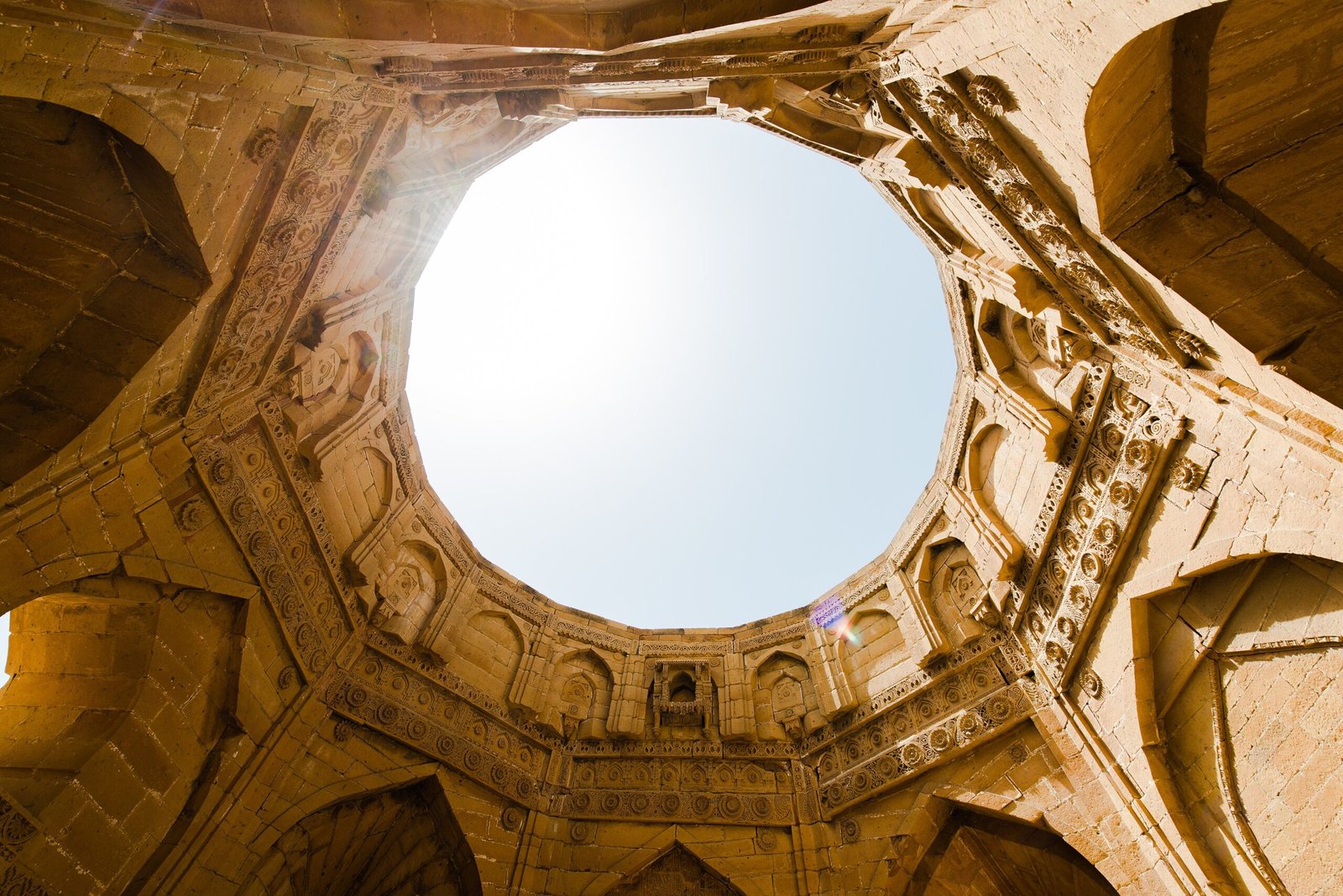
One of the world’s largest ancient necropolises — a 10-square-kilometre ridge near Thatta containing an estimated 500,000 to one million graves and some of the finest funerary architecture in the Islamic world, spanning four centuries of Sindhi dynastic history.
At a glance
On a flat-topped limestone ridge approximately 3 km long and 2 km wide overlooking the plains north of Thatta in Sindh Province, Pakistan — roughly 98 km east of Karachi — the Makli Hill Necropolis covers approximately 10 square kilometres and contains the graves of around one million people: rulers, nobles, saints, scholars, soldiers, and ordinary Sindhis buried across four centuries (c. 1350–1750 AD). This extraordinary concentration of funerary architecture, declared a UNESCO World Heritage Site in 1981 as part of the Historic Monuments of Thatta, is unequalled in scale anywhere in the world.
Key facts
- Location: North of Thatta, Sindh Province, Pakistan; approx. 98 km east of Karachi
- Area: Approximately 10 square kilometres
- Burials: Approximately one million graves spanning c. 1350–1750 AD
- Dynasties: Samma, Arghun, Tarkhan, and Mughal-era
- UNESCO WHS: 1981 — Historic Monuments of Thatta
- Materials: Cut sandstone, carved stone, blue-and-white tilework, terracotta brickwork
- Status: UNESCO WHS; threatened by neglect and urban encroachment
History
The necropolis grew alongside Thatta, capital of lower Sindh, which between the 14th and 17th centuries was one of the wealthiest and most cosmopolitan cities of the Islamic world. The Moroccan explorer Ibn Battuta and the Mughal emperor Akbar both described a city of 400,000–600,000 inhabitants with extensive trade connections throughout the Islamic world, the Indian subcontinent, and Safavid Persia. As successive ruling dynasties — the Samma (c. 1335–1520), the Arghun (c. 1520–1554), and the Tarkhan (c. 1554–1591) — made Thatta their capital, the flat ridge of Makli Hill became their collective burial ground, accumulating royal mausoleums, nobles’ tombs, and saints’ shrines across four centuries.
Mughal rule (from 1591) brought new architectural influences to the necropolis. The most celebrated Mughal-era monument on Makli Hill is the tomb of Isa Khan Tarkhan II (late 16th century), considered the finest example of Mughal-Sindhi funerary architecture in existence: three domed chambers clad in blue-and-white glazed tilework of exceptional quality, combining the structural vocabulary of Mughal tomb design with distinctly Sindhi carved stone decorative panels. The Emperor Shah Jahan, impressed by Thatta during a visit before his accession, later commissioned the city’s great mosque — the Shah Jahan Mosque (completed 1647) — as an imperial gift. Its 93 domes were acoustically engineered so that the call to prayer could be heard throughout the prayer hall, and its interior surfaces are covered in some of the finest Sindhi blue tilework anywhere in the subcontinent. The mosque forms part of the same UNESCO WHS ensemble. The city began to decline in the 18th century as trade routes shifted and the Indus changed course — but the necropolis had already accumulated its extraordinary heritage. Recognised by UNESCO in 1981 and by the Pakistani government as a site of national importance, Makli nevertheless remains under-resourced, with ongoing threats from illegal sand extraction, poor drainage, and inadequate conservation funding.
What you see
The tombs range from simple sandstone slabs to elaborate royal mausoleums several storeys high. The Samma dynasty tombs are particularly celebrated for their carved sandstone decoration — geometric interlace, floral scrollwork, calligraphic friezes — reflecting a synthesis of Hindu, Persian, and Central Asian decorative vocabularies unique to Sindh. The tomb of Jam Nizamuddin (c. 1508), ruler of Sindh at the height of Samma power, is considered one of the finest examples of this tradition. The Tarkhan and Mughal-era tombs introduce domed structures, glazed blue-and-white tilework, and large enclosed courtyards reflecting the influence of Safavid Persia and Mughal court architecture. The tomb of Isa Khan Tarkhan II — three linked domed chambers with facades of blue-and-white tilework amid carved sandstone — is the single most formally accomplished monument on the site and a reference point for the Sindhi synthesis of Mughal and indigenous decorative traditions. The nearby Shah Jahan Mosque in Thatta town, its 93 shallow saucer domes distributed across the prayer-hall roof, completes the WHS ensemble and rewards a combined visit.
Walking across the ridge today, visitors move through a landscape of stone in various states of preservation: some mausoleums are structurally intact, their carved surfaces still sharp; others have collapsed to low walls; many simple tombs are marked only by eroded sandstone fragments. The scale — thousands of monuments stretching to the horizon across an open limestone plateau — creates a cumulative effect unlike any other heritage site in South Asia.
Practical information
- Access: Open daily; no formal entry fee as of recent reports, though guards may request a contribution
- Best time to visit: October to March (winter); the Sindh summer (April–September) is extremely hot
- Facilities: Very limited on site — bring water and sun protection
- Photography: Permitted; the golden-hour light on the carved sandstone is exceptional
- Guides: Local guides available at the entrance; recommended for navigating the scale of the site
Getting there
Thatta is approximately 98 km east of Karachi on the N-55 national highway, roughly a 90-minute drive. From Thatta, Makli Hill is 2–3 km north of the town centre, accessible by rickshaw or taxi. Buses run regularly between Karachi and Thatta. The nearest international airport is Jinnah International Airport (KHI), Karachi.
Nearby
- Shahjahan Mosque (Jama Masjid), Thatta — the extraordinary 17th-century Mughal mosque with 93 domes and Sindhi tilework, built by Shah Jahan; also a UNESCO WHS within the Thatta ensemble
- Keenjhar Lake — one of the largest freshwater lakes in Pakistan, approx. 30 km northwest; important wetland and fishing area
- Chaukundi Tombs — a separate necropolis of elaborately carved sandstone tombs approximately 29 km west of Karachi; similar Sindhi funerary tradition
Sources
- UNESCO World Heritage List — Historic Monuments of Thatta (1981): whc.unesco.org/en/list/143
- Wikipedia — Makli: en.wikipedia.org/wiki/Makli
- Panhwar, M.H. — Chronological Dictionary of Sindh (Institute of Sindhology, 1983)
- Khan, Ahmad Nabi — Islamic Architecture in South Asia (Oxford University Press, 1990)
Find it on the map
See this place and what’s around it →📷 Become a Cultural Heritage Online photographer
Share your photos of places: they stay published under your name as the author. The more they're seen, the more you get noticed — and soon a contest will reward the most appreciated photos.
Log in or sign up free to add a photo