
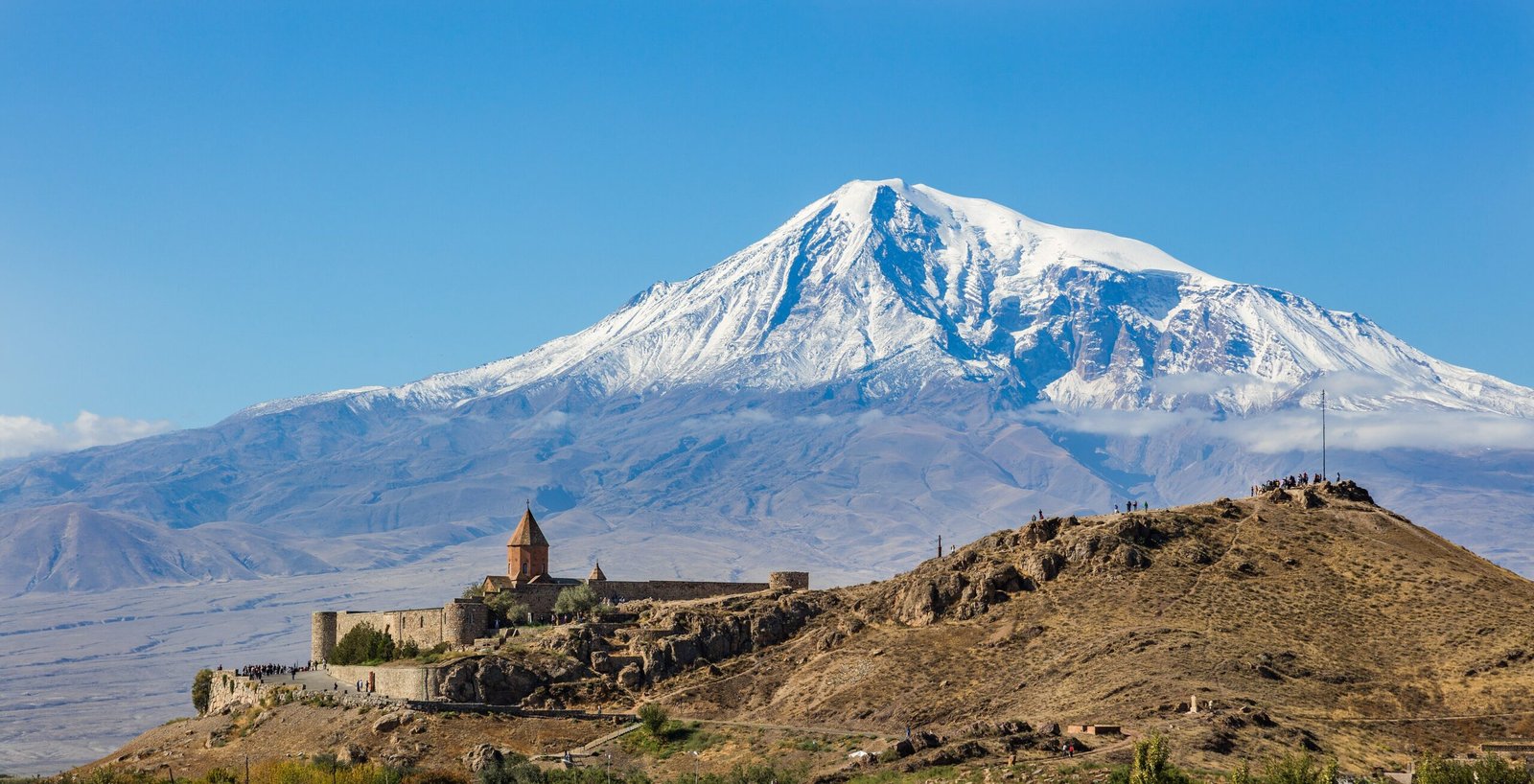
On a flat plain in southern Armenia, separated from Turkey by only the narrow Araxes River, the monastery of Khor Virap rises from an ancient hillock directly before the snow-capped mass of Mount Ararat — and marks the place where Gregory the Illuminator was imprisoned for thirteen years before emerging to make Armenia the first Christian kingdom in the world.
At a glance
Khor Virap stands approximately 45 km south of Yerevan in the Ararat Valley, on a hillock that was once the site of the ancient Armenian capital Artashat, founded by King Artashes I in 189 BC. Beneath this hillock, in a pit approximately 6 metres deep and 4.4 metres in diameter, Gregory the Illuminator (Grigor Lusavorich) was imprisoned for thirteen years by King Tiridates III — from around 287 AD until his release in approximately 301 AD. His release, his baptism of the king, and Armenia’s subsequent declaration of Christianity as its state religion in 301 AD make Khor Virap one of the most significant sites in the history of Christianity. The monastery complex visible today dates primarily to the 17th and 18th centuries, but the holy pit — accessible by a steep metal ladder from inside the chapel — has been venerated as a pilgrimage site without interruption for over 1,700 years. The dominant visual fact of the site is the backdrop: the twin snow-capped peaks of Greater Ararat (5,137 m) and Lesser Ararat (3,896 m), now within Turkish territory, visible at approximately 35 km distance.
Key facts
- Location: Ararat Province, approximately 45 km south of Yerevan, near the Turkish border.
- Gregory’s imprisonment: c. 287–301 AD; pit depth approximately 6 m, diameter approximately 4.4 m.
- Armenia’s conversion: 301 AD — the first state in the world to adopt Christianity as its official religion.
- First church on site: 642 AD, built over the pit by Catholicos Nerses III.
- Current monastery complex: largely 17th–18th century, rebuilt by Catholicos Yeghavert.
- Chapel of St. Gregory: rebuilt 1661; the holy pit is accessible from inside by metal ladder.
- Chapel of St. Zosimus: 1666, built over the original 7th-century church.
- Name meaning: “deep pit” in Armenian — a direct reference to Gregory’s prison.
- Distance to Ararat: approximately 35 km (peak in Turkish territory since 1921).
History
The historical sequence that made Khor Virap begins with Gregory, a Christian of Parthian royal descent who refused to participate in pagan rites at the court of the Armenian king Tiridates III. In approximately 287 AD Tiridates ordered him thrown into the pit at Artashat — then the royal capital — where he survived for approximately thirteen years on food delivered covertly by a pious Christian widow. The king subsequently ordered the execution of a group of Christian nuns (including the abbess Gayane and the noblewoman Hripsime) who had fled persecution in Rome; according to tradition, Tiridates was afflicted with madness as divine punishment for this act. Gregory was brought out of the pit, cured the king, baptised him, and then baptised the entire court. Armenia declared Christianity its state religion in 301 AD — several years before the Edict of Milan made Christianity legal in the Roman Empire, and more than a century before it became the Roman state religion under Theodosius I.
The first church on the hillock was built in 642 AD by Catholicos Nerses III directly over the pit. It was destroyed and rebuilt multiple times during the subsequent centuries of Arab, Seljuk, and Mongol invasions of the Ararat plain. The monastery complex visible today was largely built or rebuilt in the 17th and 18th centuries, when Catholicos Yeghavert and his successors constructed the chapel of St. Gregory (1661), the chapel of St. Zosimus (1666), and the defensive perimeter walls. The site was closed during the Soviet period but reopened after Armenian independence in 1991 and is now among the most actively visited pilgrimage destinations in Armenia. The pit itself, maintained as a holy site, is accessible by ladder from within the chapel of St. Gregory and is visited by pilgrims who descend to touch the stone walls of the chamber where Gregory was held.
The backdrop of Mount Ararat — the biblical mountain of Noah’s ark and the national symbol of Armenia, visible from Khor Virap in its full mass yet located entirely within Turkish territory since the 1921 Treaty of Kars — gives the site a quality of historical and political pathos that is remarked upon by every visitor. Armenia does not formally recognise the 1921 border, and Ararat appears on the Armenian coat of arms.
What you see
The monastery complex sits on a low defensive hillock surrounded by the flat agricultural plain of the Ararat Valley. The enclosing walls, rebuilt in the 17th century, give it the silhouette of a small fortress. Within the walls, the two main chapels — St. Gregory (the larger, with the entrance to the holy pit) and St. Zosimus — are separated by a small courtyard. Both chapels are built in the Armenian khachkar tradition, with heavy basalt and tuff masonry, conical stone roofs, and carved decorative elements around the portal arches. The interiors are dark, lit primarily by candles and small oil lamps; the walls bear painted images of saints and episodes from Gregory’s imprisonment. The entrance to the holy pit, in the floor of the chapel of St. Gregory, is a narrow shaft fitted with a near-vertical iron ladder approximately 6 metres long. Descent requires physical agility; pilgrims venerate the pit walls and the approximate position of Gregory’s long captivity in near-total darkness.
The panoramic view from the monastery walls is the site’s most immediately striking feature: to the west and southwest, filling the entire sky, the twin summit pyramid of Greater Ararat rises to 5,137 metres and its smaller companion Lesser Ararat to 3,896 metres, both snow-capped for most of the year. On clear days — most common in autumn and winter — the full volcanic mass of the mountain is visible from base to summit across only 35 km of flat valley floor, unobstructed by any intermediate topography. This view is the photograph most associated with Armenia internationally.
Practical information
- Open: Daily, year-round; the monastery is an active religious site.
- Entry: Free; donations welcomed at the chapel.
- Dress code: Modest dress required; women should cover their hair inside the chapels; shawls available at the entrance.
- Holy pit descent: Via steep metal ladder inside the chapel of St. Gregory; not recommended for those with limited mobility.
- Best light for Ararat views: Early morning (sunrise) or late afternoon; clearest in October–November and February–March.
- Photography: Permitted throughout the complex.
Getting there
Khor Virap is approximately 45 km south of Yerevan along the main highway to Artashat. The journey by car takes approximately 45–50 minutes. There is no direct public bus to the monastery from Yerevan; the nearest marshrutka (shared minibus) route serves Artashat, from where taxis cover the remaining 10 km. The most practical approach for independent visitors is a hired car or one of the many guided day tours departing from Yerevan that combine Khor Virap with the nearby wine-producing villages of the Ararat valley (Vedi, Areni) or with the monastery of Noravank.
Nearby
- Artashat — 10 km; the modern town built on the site of the ancient Armenian capital founded 189 BC.
- Khosrov Forest State Reserve — 30 km east; one of the oldest protected natural areas in the world, established by King Khosrov III in the 4th century.
- Noravank Monastery — 80 km southeast in the Amaghu river gorge; 13th–14th century, among the finest Armenian medieval architecture.
- Areni village — 90 km southeast; centre of Armenian wine production, site of the world’s oldest winery (6,000 years BP, excavated 2007).
Sources
- Agathangelos, History of the Armenians (5th century, primary source for Gregory’s imprisonment and conversion narrative).
- Wikipedia, “Khor Virap,” accessed 2026-06-11.
- Armenian Ministry of Culture and Youth Affairs, official site documentation.
- UNESCO World Heritage Tentative List: “Khor Virap Monastery” (submitted).
- Nina Garsoian, “The Arsakuni Dynasty (A.D. 12–[180]–428),” The Armenian People from Ancient to Modern Times, ed. Richard Hovannisian (1997).
Find it on the map
See this place and what’s around it →📷 Become a Cultural Heritage Online photographer
Share your photos of places: they stay published under your name as the author. The more they're seen, the more you get noticed — and soon a contest will reward the most appreciated photos.
Log in or sign up free to add a photoIs this page about you?
This page is read by travellers and heritage enthusiasts who find it on Google. Tell us how you are connected to this place and we will take it from there.