
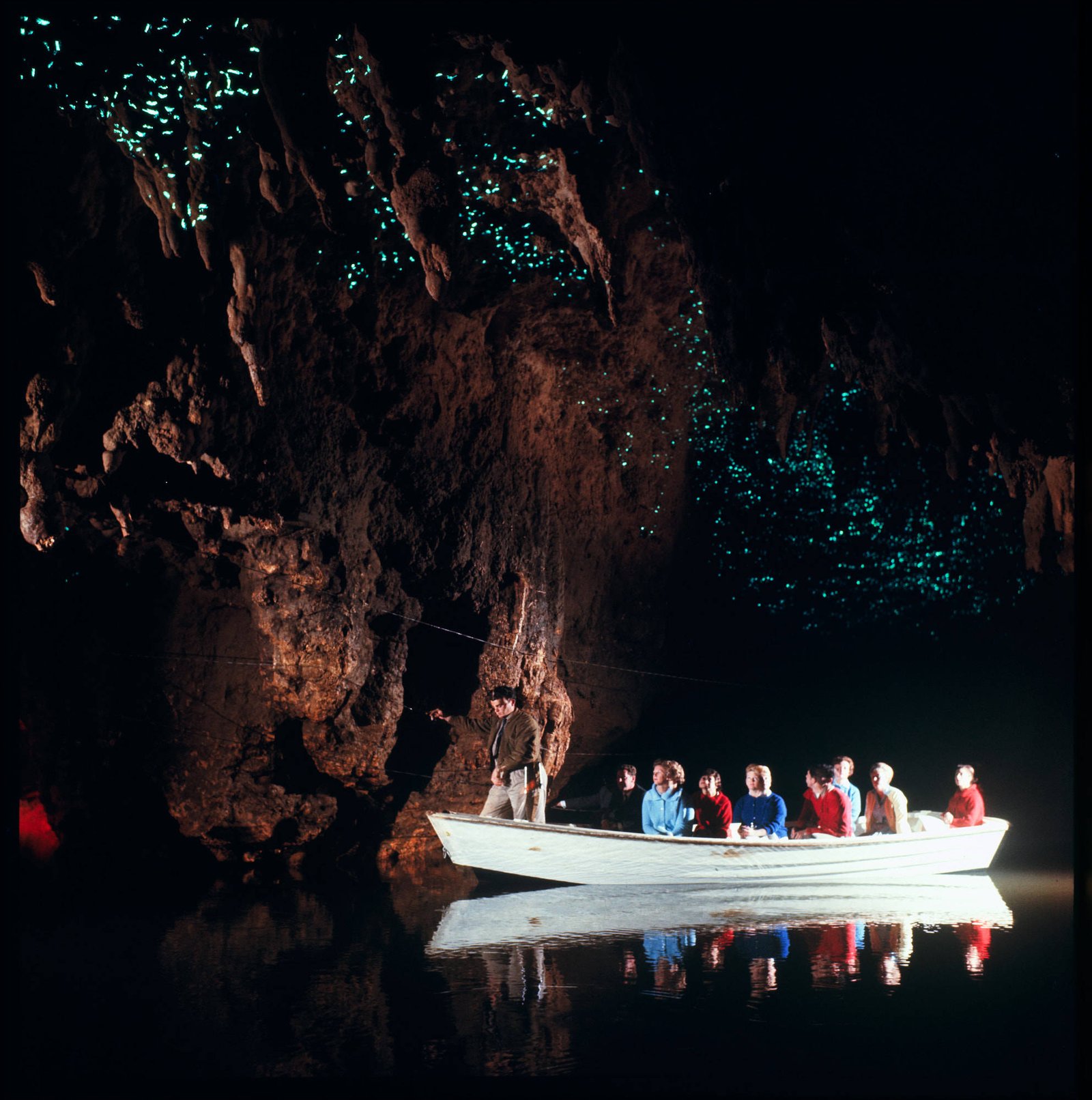
A limestone cave system in New Zealand’s Waikato region whose innermost chamber is lit entirely by the bioluminescent larvae of Arachnocampa luminosa — a species of fungus gnat found nowhere else on Earth — transforming the cave ceiling into a living night sky of azure-blue light.
At a glance
The Waitomo Glowworm Caves lie in the limestone karst country of the Waikato region on New Zealand’s North Island, approximately 200 km south of Auckland. Formed from Oligocene marine limestone deposited approximately 30 million years ago, the caves were shaped by groundwater dissolution over roughly the past 100,000 years. What makes Waitomo unique among the world’s cave systems is not its geology but its permanent residents: the larval stage of Arachnocampa luminosa, a bioluminescent fungus gnat endemic to New Zealand and Australia, which suspends itself from cave ceilings on mucus threads and uses a steady azure-blue bioluminescent organ at 490–510 nm to attract flying insects. In the Glowworm Grotto — the deepest and most celebrated chamber — tens of thousands of individual larvae cover the ceiling approximately 15 metres above the floor of an underground river, producing a spectacle that has drawn visitors since 1904. The system extends for approximately 45 km of mapped passages; three principal tourist caves (Glowworm Caves, Ruakuri, and Aranui) have welcomed over 10 million visitors in total.
Key facts
- Location: Waitomo, Waikato region, North Island, New Zealand — approx. 200 km south of Auckland
- Limestone age: c. 30 million years (Oligocene Te Kuiti Group marine sediments); cave formation c. 100,000 BP
- Glowworm species: Arachnocampa luminosa — endemic to New Zealand and Australia; the larval stage is the bioluminescent phase
- Grotto ceiling height: approximately 15 metres above the underground river floor
- System extent: approximately 45 km of mapped passages; three principal tourist caves
- Visitor history: opened to tourism 1904; over 10 million visitors to date
- First Western documentation: 1887, Maori chief Tane Tinorau and surveyor Fred Mace
- Management: returned to descendants of Tane Tinorau in 1989 (Treaty of Waitangi settlement)
History
The Maori people of the Waikato region were long familiar with the Waitomo system before its entry into Western records. The name Waitomo derives from wai (water) and tomo (hole or shaft) — a direct description of the sinkhole entrances characteristic of the karst surface above. In 1887, Maori chief Tane Tinorau guided government surveyor Fred Mace through the passages by candle and raft along the underground river, entering the Glowworm Grotto for the first time by boat. Tane Tinorau subsequently opened the cave to visitors from around 1889. Control passed to the New Zealand government in 1906 under the Tourist and Health Resorts Act, but was returned to the descendants of Tane Tinorau in 1989 following a Treaty of Waitangi settlement — making Waitomo one of the first significant natural sites in New Zealand to return to Maori ownership and management.
The biology of Arachnocampa luminosa was first formally described by F.W. Hutton in 1902. Its bioluminescent mechanism — a luciferin-luciferase reaction in modified Malpighian tubules — produces a steady light rather than the flashing pattern of fireflies, because the larvae use it as a lure rather than a mating signal. The Te Kuiti Group limestone formations contain abundant Oligocene marine fossils including bivalves, bryozoans, and echinoids deposited on the floor of a warm shallow sea approximately 30 million years ago. The caves’ stable temperature, high humidity, and negligible air movement create the specific microclimate that supports the extraordinary density of glowworm colonies in the Grotto.
What you see
The standard tour proceeds through three chambers of increasing drama before culminating in the Glowworm Grotto. The Cathedral — the largest accessible chamber, approximately 18 metres high — is used for concerts because of its exceptional natural acoustics; its walls display tomo (vertical shafts), stalactites, and flowstone formations. The Banquet Chamber beyond contains some of the system’s most developed speleothem formations. The final section involves boarding a flat-bottomed punt on the underground stream, gliding in complete silence beneath the Grotto ceiling. In the Grotto, tens of thousands of individual bioluminescent points on an irregular limestone ceiling produce an effect indistinguishable from a night sky at altitude, with the underground river acting as a mirror beneath. Visitors are asked to remain silent: vibrations can cause the larvae to retract their threads and extinguish their light.
The other two principal tourist caves reward separate visits. Ruakuri — the longer, more geologically complex system — features elaborate stalactite and helictite formations and is fully wheelchair-accessible via a purpose-built spiral entrance ramp. Aranui is a dry fossil cave, completely different in character: its formations are predominantly pink and white flowstone, built by mineral-rich drip water over millennia in the absence of any stream. Each cave operates on a separate ticket and tour schedule.
Practical information
- Open: Daily, year-round; Glowworm Caves tours depart every 30 minutes
- Glowworm Caves tour: 45 minutes, ends with silent boat ride through the Grotto
- Ruakuri Cave: 1 hour 30 minutes — fully wheelchair-accessible via spiral entrance ramp
- Aranui Cave: 45 minutes walking tour — dry fossil cave, exceptional formations
- Photography: permitted without flash; tripods not permitted on the boat
- Advance booking strongly recommended in summer (December–February) and NZ school holidays
- Website: waitomo.com
Getting there
Waitomo is approximately 200 km south of Auckland via State Highway 1 to Otorohanga, then west on State Highway 37 — about 2.5 hours by car. Otorohanga is served by the Northern Explorer train service (Auckland–Wellington) and by InterCity coaches; a shuttle connects Otorohanga to Waitomo (16 km) and meets trains and coaches. All access to the caves is through guided tours booked at the Waitomo Caves Discovery Centre or online.
Nearby
- Ruakuri Cave — 1 km; longest accessible passage in the Waitomo system, fully wheelchair-accessible
- Aranui Cave — 3 km; dry fossil cave with exceptional pink and white formations
- Otorohanga Kiwi House — 16 km; nocturnal house where kiwi birds can be observed in daylight hours
- Raglan — 70 km northwest; black-sand surf beach and internationally known point break
Sources
- Waitomo Caves Discovery Centre, official interpretive materials, 2024
- F.W. Hutton, “The Luminous Larvae of Waitomo Cave,” Transactions and Proceedings of the New Zealand Institute 35 (1902)
- Wikipedia, “Waitomo Glowworm Caves,” accessed 2026-06-11
- New Zealand Department of Conservation, Te Kuiti Limestone geological survey notes
- Treaty of Waitangi Tribunal documentation on Waitomo land return, 1989
Find it on the map
See this place and what’s around it →📷 Become a Cultural Heritage Online photographer
Share your photos of places: they stay published under your name as the author. The more they're seen, the more you get noticed — and soon a contest will reward the most appreciated photos.
Log in or sign up free to add a photo