
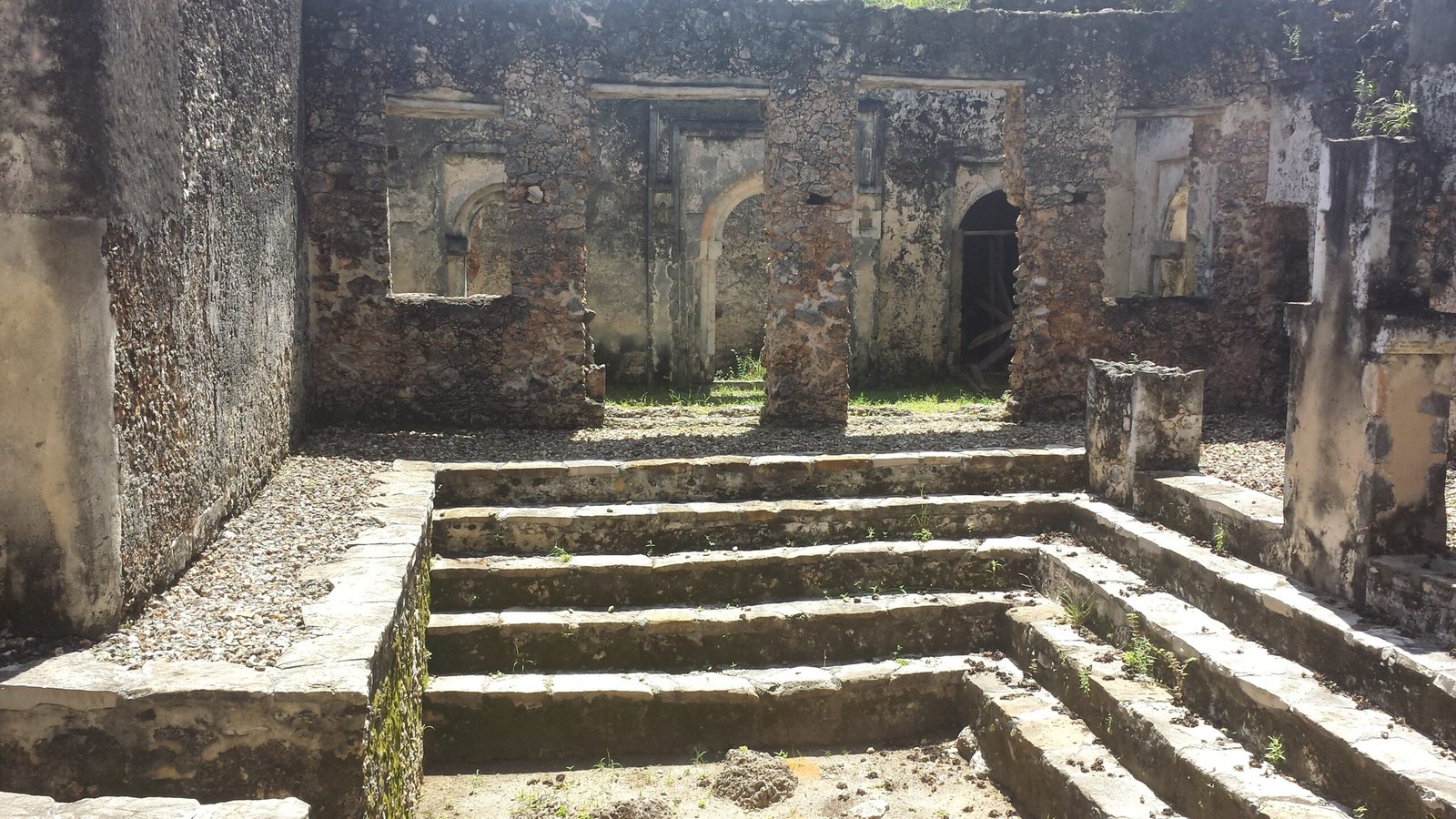
The most complete surviving medieval Swahili city: forty stone houses, five mosques, a palace and coral-built compounds on a deserted island in the Kilwa Archipelago, abandoned after the Portuguese broke the Indian Ocean trade in the 16th century. UNESCO World Heritage Site since 1981.
At a glance
On a small island off the southern coast of Tanzania, Songo Mnara preserves roughly 1 km² of coral-ragstone architecture abandoned in the mid-16th century and untouched since: houses, mosques, a palace, and harbour compounds built by the Swahili trading civilization at the height of its power. The island is accessible only by boat from Kilwa Masoko and receives very few visitors, making it one of the least-known UNESCO World Heritage Sites in Africa.
Key facts
- Location: Kilwa Archipelago, Lindi Region, southern Tanzania
- UNESCO WHS: 1981 (Ruins of Kilwa Kisiwani and Ruins of Songo Mnara, ref. 144)
- Period: c. 1250–1550 AD (Kilwa Sultanate)
- Size: approximately 1 km²; ~40 stone houses, 5 mosques, 1 palace complex
- Construction: coral ragstone (fossilised coral slabs), lime plaster, carved wooden doorways
- Trade: gold from Zimbabwe Plateau, ivory, slaves — exported to Persia, India, China
- Abandonment: post-1505 Portuguese bombardment of Kilwa; trade route disruption
History
Songo Mnara was one of the satellite towns of the Kilwa Sultanate, the dominant commercial state on the East African coast between approximately 1250 and 1500 AD. The sultanate controlled the export of gold from the Zimbabwe Plateau — the same gold that built Mapungubwe and Great Zimbabwe — through its main port at Kilwa Kisiwani. The wealth of Kilwa impressed Ibn Battuta, who visited in 1331 and described the city as “one of the most beautiful and best-constructed towns in the world.” At Songo Mnara, merchants, officials and craftsmen lived in coral-built houses of considerable sophistication, with plastered interiors, barrel-vaulted rooms, and decorative niches.
Vasco da Gama called at Kilwa in 1498 on his first voyage to India. In 1505 a Portuguese fleet under Francisco d’Almeida bombarded and occupied Kilwa Kisiwani, breaking the Arab-Swahili monopoly on the Indian Ocean trade. The Kilwa Sultanate never recovered; Songo Mnara was abandoned in the mid-16th century, its population dispersed, its coral buildings left to vegetation and the occasional storm. Isolated from the mainland and visited only rarely since Portuguese times, the ruins have remained in a state of remarkable preservation — though gradual collapse due to root damage and storm surge is accelerating.
Serious archaeological investigation began only in the 1950s with British and later international teams. The UNESCO inscription in 1981 brought some protection and funding for documentation, but excavation remains partial and many questions about the town’s internal organization, population, and material culture are unresolved. Recent fieldwork by the Songo Mnara Urban Landscape Project (2009–2015) has produced detailed spatial analysis of the settlement structure and evidence of intensive craft production.
What you see today
The ruins of Songo Mnara span roughly 1 km² across the northern tip of the island. The stone architecture is built almost entirely of coral ragstone — slabs of fossilised coral cut from reef outcrops — laid in courses with lime mortar made from burned coral. Wall surfaces were plastered and in some cases painted; door frames are carved in the distinctive Swahili style with geometric and floral motifs. Five mosques survive in varying states of preservation, the largest with a colonnaded prayer hall; the palace compound at the northern edge of the site includes multiple enclosures and storage chambers. The approximately 40 residential buildings range from modest single-room structures to multi-room courtyard houses with private wells.
The site is not formally managed or staffed — there is no entrance fee, no guides, and no visitor infrastructure. The same isolation that preserved the ruins makes them vulnerable: the vegetation is encroaching, several walls have collapsed in recent storm seasons, and there is no on-site conservation presence. Visitors who make the boat crossing from Kilwa Masoko effectively have the ruins to themselves — a genuinely remote experience, but one that requires preparation.
Practical information
- Access: boat from Kilwa Masoko (30–45 min crossing, charter or local fishermen)
- Ticket: no formal entrance fee; TANAPA conservation fee may apply
- Best season: June–October (dry season; avoid March–May monsoon)
- Time: allow 2–3 hours on the island; full day with travel from Kilwa Masoko
- Conditions: no water, food or shade on the island; bring supplies
- Combined visit: Kilwa Kisiwani (UNESCO, same island group) is the most visited and easiest to access
Getting there
Kilwa Masoko is reached by bus from Dar es Salaam (7–9 hours on the TAZARA road via Lindi) or by light aircraft from Julius Nyerere International Airport. From Kilwa Masoko waterfront, negotiate a boat charter to Songo Mnara island; the crossing takes 30–45 minutes depending on tides. There is no scheduled ferry service. Basic guesthouses are available in Kilwa Masoko; the nearest international-standard accommodation is in Dar es Salaam.
Nearby
- Kilwa Kisiwani — the main Kilwa Sultanate port, UNESCO WHS, 30 min by boat; more excavated and visited, with the Great Mosque of Kilwa (14th c.) and the Husuni Kubwa palace
- Kilwa Kivinje — 19th-century Omani-era trading town on the mainland, with significant colonial-era architecture
- Mafia Island — marine park, 150 km north by boat; known for whale shark diving
Sources
- UNESCO World Heritage List: Ruins of Kilwa Kisiwani and Ruins of Songo Mnara (ref. 144, inscribed 1981)
- Wynne-Jones, S. & Fleisher, J. (eds.), Songo Mnara Urban Landscape Project, 2009–2015
- Chittick, H.N., Kilwa: An Islamic Trading City on the East African Coast, British Institute in Eastern Africa, 1974
- Ibn Battuta, Rihla (Travels), 1331 AD, description of Kilwa
- Wikipedia: Songo Mnara
Find it on the map
See this place and what’s around it →📷 Become a Cultural Heritage Online photographer
Share your photos of places: they stay published under your name as the author. The more they're seen, the more you get noticed — and soon a contest will reward the most appreciated photos.
Log in or sign up free to add a photo