

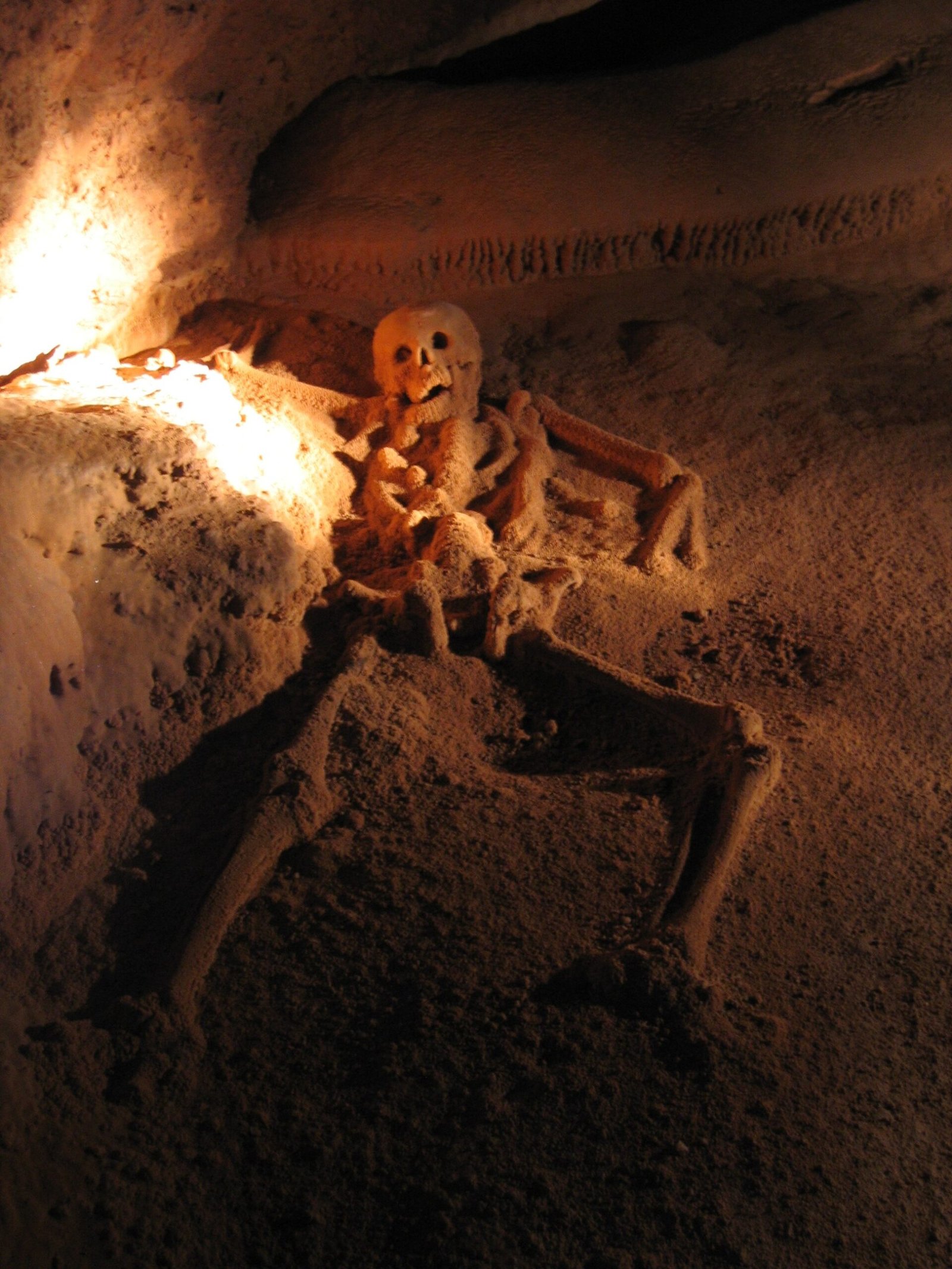
A sacred Maya cave in the Belizean jungle where a river disappears into the mountain and, one hour inside, the calcified skeleton of a teenage girl sacrificed 1,100 years ago glitters in the darkness — entirely crystallised by cave minerals into a form the world calls the Crystal Maiden.
At a glance
Actun Tunichil Muknal — “Cave of the Crystal Sepulchre” in Yucatec Maya — is a ceremonial cave deep in the Tapir Mountain Nature Reserve of western Belize, accessible only by wading and swimming the entrance river, then hiking 40 minutes through a living cave system before reaching the cathedral chambers where Maya priests performed rites during the Terminal Classic collapse (c. 800–900 AD). The cave contains the undisturbed ritual deposits of approximately 200 years of Maya ceremonial activity: at least 14 human skeletons, hundreds of deliberately broken pottery vessels, jade objects, obsidian blades, and stingray spines used for bloodletting. It was unknown outside the local community until archaeologist Thomas Miller documented it in 1989.
Key facts
- Coordinates: 17.1811° N, 88.9522° W — Tapir Mountain Nature Reserve, Cayo District, Belize
- Period of use: c. 700–900 AD (Maya Terminal Classic)
- The Crystal Maiden: Calcified skeleton of a teenage girl, sacrificed c. 800–900 AD, now fully mineralised and crystalline
- Human remains: At least 14 skeletons including children; evidence of child sacrifice and ritual killing
- Ceramics: Hundreds of killed pottery vessels (deliberately smashed by a single blow and left in situ)
- Photography: Banned since 2012 after a tourist broke a skull by dropping a camera
- Access: Guided tour only; requires swimming the entrance river and hiking in darkness for approximately 40 minutes
History and significance
The Maya of the Classic period understood caves as portals to Xibalba — the underworld, the realm of gods and ancestors, the source of rain and agricultural fertility. Actun Tunichil Muknal was used as a ceremonial space for at least two centuries, but the evidence concentrated in its innermost chambers belongs overwhelmingly to the Terminal Classic period (c. 800–900 AD), the era of the Maya civilisational collapse. Across the southern lowlands, the combination of prolonged drought, endemic warfare, deforestation, and political fragmentation caused city after city to be abandoned. The priests of this cave, apparently unable to halt the catastrophe through ordinary ritual means, escalated: the deposits show increasing desperation — more offerings, more sacrifice, younger victims. The Crystal Maiden herself, a girl of approximately 18 years, has vertebrae showing perimortem damage consistent with a killing blow. She was not the only one: the smaller skeletons in the cave suggest children were also sacrificed here.
The cave was documented in 1989 by Thomas Miller and excavated through the 1990s by teams from the University of New Mexico and the Institute of Archaeology of Belize. It was opened to guided tourism in the early 2000s. In 2012, a tourist dropped a camera on a skull and broke it, leading to a permanent photography ban — today visitors may not bring cameras into the cave at all, and the experience must be carried away entirely in memory.
What you encounter
The cave entrance is a dramatic reveal: a river emerges from the base of a limestone cliff, and visitors wade chest-deep into its current to enter. Beyond the entrance, the cave rises into enormous chambers whose walls are studded with stalactites, stalagmites, and extraordinary mineral formations — pale flowstone curtains, crystalline cave coral, and white calcite columns that give the cave its luminous quality in torchlight. The ceremonial chambers are elevated above the cave floor on natural limestone shelves, and the Maya pottery and skeletal remains are precisely where they were left: unexcavated, undisturbed, encountered in situ. The effect is unlike any museum: you are not looking at objects removed from context and placed in cases, but at a moment frozen in time, exactly as the priests left it when the rituals ended and no one ever returned.
The Crystal Maiden is located at the deepest accessible point of the cave system, approximately 1km from the entrance, in a high chamber with exceptional mineral formations. Her skeleton is oriented east-west, lying on the cave floor, and the bones have been completely replaced over centuries by calcium carbonate deposited by the cave environment — she is no longer bone but stone, glittering with the same crystalline quality as the stalactites around her.
The Maya collapse and the cave
The deposits at Actun Tunichil Muknal are a physical record of civilisational crisis. The Terminal Classic collapse of the Maya southern lowlands — between roughly 800 and 900 AD — saw the abandonment of the great cities: Tikal, Copan, Quirigua, Dos Pilas, and eventually Calakmul. The causes involve severe multidecadal droughts documented in the paleoclimatic record for 820 AD and 860 AD, overpopulation relative to agricultural productivity, deforestation, intensified endemic warfare, and the breakdown of long-distance trade networks. The Maya of the southern lowlands did not disappear — their descendants are present today in Guatemala, Belize, Honduras, and Mexico — but the urban civilisation, the monument-building, the complex bureaucratic state: those ended. The cave rituals at ATM are one of the last desperate responses to that ending, preserved intact for 1,100 years in the darkness of a Belizean mountain.
Practical information
- Location: Tapir Mountain Nature Reserve, Cayo District, western Belize; approximately 45km from San Ignacio
- Access: Licensed guided tours only, required by the Institute of Archaeology of Belize
- Physical demands: River wade (chest-deep), short swim, approximately 2km hiking through cave; not suitable for those with limited mobility or claustrophobia
- Photography: Banned inside the cave since 2012
- Duration: Full-day experience; typically 5–7 hours including jungle hike and cave exploration
- Best season: Dry season (February–May); the cave floods during heavy rain
- Group size: Maximum 8 visitors per guide
Getting there
From San Ignacio town (Cayo District), tours depart early morning and include a 45-minute jungle hike through Tapir Mountain Nature Reserve to the cave entrance. The reserve road requires a 4WD vehicle. Tours must be booked with licensed guide operators in San Ignacio; independent access is not permitted. The nearest international airport is Philip S. W. Goldson International Airport in Belize City (approximately 3 hours from San Ignacio). San Ignacio is also reachable by bus from Belize City via the Western Highway.
Nearby
- Caracol — the largest Maya site in Belize, approximately 75km south, with the towering Caana pyramid
- Xunantunich — Maya site above the Mopan River at San José Succotz, with panoramic views from El Castillo pyramid
- Cahal Pech — Maya hilltop site immediately above San Ignacio town, with a small museum
- Barton Creek Cave — another Maya sacred cave accessible by canoe, with skeletal remains visible from the water
Sources
- Awe, Jaime J. Actun Tunichil Muknal: Cave of the Crystal Sepulchre. Institute of Archaeology, Belize, 1998.
- Brady, James E. and Prufer, Keith M. (eds.) In the Maw of the Earth Monster: Mesoamerican Ritual Cave Use. University of Texas Press, 2005.
- Webster, David. The Fall of the Ancient Maya. Thames and Hudson, 2002.
- Wikipedia contributors. “Actun Tunichil Muknal.” Wikipedia, The Free Encyclopedia. Accessed 2026.
- Institute of Archaeology of Belize — official documentation and permit system.
Find it on the map
See this place and what’s around it →📷 Become a Cultural Heritage Online photographer
Share your photos of places: they stay published under your name as the author. The more they're seen, the more you get noticed — and soon a contest will reward the most appreciated photos.
Log in or sign up free to add a photo